
TRUMP’S CRYPTO CONNECTIONS


Trump Crypto Tracker
2026
June
June 30
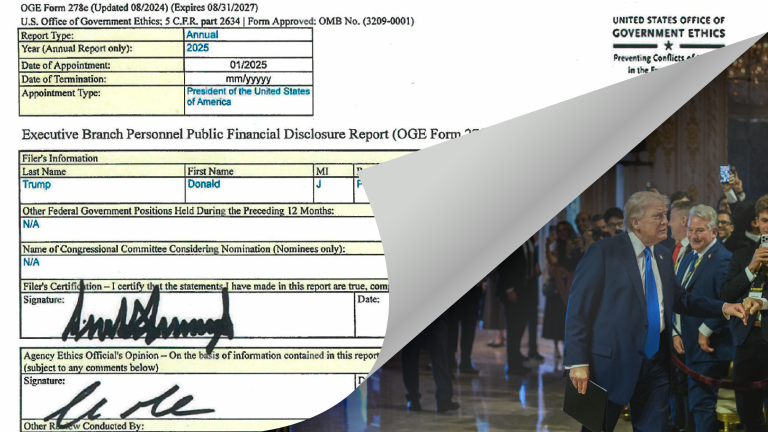
Trump’s financial disclosure reveals $1.4 billion in revenue from crypto ventures including World Liberty Financial and $TRUMP meme coins.
Forbes reports that his earnings totaled $2.4 billion in 2025 — 6,000 times more than the presidential salary and significantly higher than the estimated $760 million he received in 2024. His crypto businesses took in more earnings than any publicly traded U.S. digital asset enterprise last year.
His report suggests that he did not keep the revenue in digital assets, but rather invested them into traditional securities, making over 21,000 trades with stocks, bonds, and mutual funds.
Everyday investors in his crypto ventures have lost billions of dollars, with nearly 1 million owners of $Trump losing an aggregate $3.8 billion.
The President reported zero purchases or sales of cryptocurrency in the transaction section of his report. This follows new, softer interpretations from the Securities and Exchange Commission’s (SEC) Division of Corporation Finance, including the position that meme coins, like $TRUMP, are not securities, and therefore would not need to be reported as such. However, experts have highlighted that even under the SEC’s looser approach, crypto tokens like those of $WLFI should be classified as securities.
Seven Critical Revelations From President Trump’s Financial Disclosure Report
July 20, 2026
Read moreJune 23
Senate Banking Committee Democrats publish “American National Security for Sale”, a report detailing Trump’s crypto corruption related to World Liberty Financial (WLF) and the United Arab Emirates (UAE).
The report explains how the Trump Administration favored the UAE in foreign policy decisions following their 49% stake investment in WLF, which delivered $187 million to the Trumps and was backed by the UAE’s national security advisor. In relation to the new report, Senator Warren explained “Congress needs to grow a spine. We cannot allow American national security simply to be sold to the highest bidder.”
June 14
World Liberty Financial pays UFC fighters at White House event bonuses totaling $250,000 in USD1 stablecoin.
The Trump-backed currency was listed as an “official sponsor” for the UFC Freedom 250 event, which occurred on government property and used seven federal agencies and cost $60 million, plus an estimated $10-12 million from taxpayers in security costs.
June 11
Politico reports that CFTC Chair Michael Selig is the only member of a “what is supposed to be a five-person bipartisan commission,” giving Selig “unilateral say” over cryptocurrency and prediction market regulatory questions. Selig, along with President Trump, has been a central proponent of the Clarity Act.
May
May 28
CFTC asks judge to undo a $5 million penalty against Winklevoss twins, who each donated $1 million to Trump’s 2024 campaign.
The CFTC said the twins, owners of Gemini Trust Company, should have never been accused of making false statements connected to Bitcoin futures. Gemini and the CFTC cited the new crypto enforcement policy under Trump as justification for the vacated settlement.
May 26
Trump vows to protect the crypto industry in a post also advocating for the CFTC’s “exclusive authority” of prediction markets.
May 24
The New York Times publishes an investigation revealing that the CFTC has softened regulatory enforcement while helping advance both crypto and prediction markets. The report emphasizes how the CFTC intervened to help companies related to the Trump Family business empire.
May 14
Senate Banking Committee approves Clarity Act in a win for the Crypto industry. The bill will proceed to the Senate floor next.
Leading Democrats expressed concern for the current state of the bill: “This bill puts investors, our national security and our entire financial system at risk — and it will turbocharge Donald Trump’s crypto corruption,” said Senator Warren.
Trump files a periodic financial disclosure report revealing Q1 investment in crypto companies Coinbase, MARA Holdings, and Strategy Inc. made during the administration’s push for pro-crypto legislation.
Amid these investments, Trump made a Truth Social post calling for speedy passage of the Clarity Act.
May 12
Bloomberg reports that undisclosed sales of World Liberty Financial (WLF) boosted the Trump family fortune by $660 million.
May 4
World Liberty Financial (WLF) countersues Justin Sun for defamation, alleging that Sun improperly transferred WLF tokens, conducted straw purchases, and placed bets on the token’s market value.
WLF accuses Sun of conducting these actions in a deliberate campaign to lower the token’s market price before public trading opened in September.
April
April 30
Forbes reports that Eric Trump, the president’s son, “no longer appears on the leadership webpage for Alt5 Sigma Corp., a fintech company closely linked to his family’s World Liberty Financial crypto venture,” though it is not clear why.
April 29
The website for President Trump’s meme coin ($TRUMP) is advertising a “members only, limited access” club, which will provide “invitation-only luxury suites at the biggest sporting events in the world, private dinners, and the most elite and extraordinary experiences,” Molly White reports in her citation needed newsletter.
April 28
The Wall Street Journal reports that World Liberty Financial “partnered with a virtual-currency venture called AB,” which housed a project “led by two men sanctioned” in the United States.
The Trump administration had said the sanctions targeted “a transnational criminal syndicate that had stolen billions of dollars from Americans and others through online scams.” An attorney for World Liberty Financial told the Wall Street Journal “[World Liberty Financial] has never had any association or relationship with the sanctioned individuals and that it had no knowledge of the planned ‘blockchain’ resort when it announced its arrangement with AB.”
April 25
President Trump hosts the top purchasers of his $TRUMP cryptocurrency at his Mar-a-Lago club in Palm Beach, Florida.
The attendees won the second annual meme coin contest for $TRUMP, even though the value of the token had decreased by more than 95% since last year.
April 22
Justin Sun, one of World Liberty Financial’s largest investors, sues the company, claiming it pressured him into buying more tokens and threatened to report him to law enforcement officials.
April 15
World Liberty Financial announces a proposal that would prevent investors from cashing out their tokens until after President Trump’s term.
March
March 17
The SEC issues new guidance that classifies crypto tokens into five categories: “digital commodities, digital collectibles, digital tools, stablecoins, and digital securities.”
It also addresses how a “non-security crypto asset” may become subject to an “investment contract.” SEC Chairman Paul S. Atkins says the new guidance clarifies “that most crypto assets are not themselves securities” and “only one crypto asset class remains subject to the securities laws: digital securities, namely traditional securities that are tokenized.”
March 13
World Liberty Financial offers “guaranteed direct access” to certain team members for investors who hold $5 million in tokens for six months in exchange for voting rights, though it says President Trump and his sons are not participating.
March 11
The SEC and the Commodities Futures Trading Commission (CFTC) announce that they have entered into a joint memorandum of understanding, which includes the agencies “[p]roviding a fit-for-purpose regulatory framework for crypto assets and other emerging technologies.”
March 5
The SEC settles its fraud case against Justin Sun, a crypto investor who partnered with World Liberty Financial early on, with Sun’s company agreeing to pay a $10 million penalty.
February
February 27
Trump Media and Technology Group (Ticker Symbol: DJT) announces it “had a $712.3 million consolidated net loss” in 2025 while posting just “$3.7 million in revenue for the year. The company says “most” of its losses were “comprised” of “unrealized losses stemming from a drop in the price of digital assets and digital asset related securities.”
February 23
Crypto.com says it has received conditional approval from the Office of the Comptroller of the Currency for a national trust bank charter.
February 18
February 16
Crypto firm Nexo announces that it has returned to the U.S. market, after previously paying a $45 million fine in response to a challenge by regulators who claimed that one of its crypto lending products should have been registered as a security.
February 12
World Liberty Financial announces that it plans to launch a new foreign exchange for consumers to trade national currencies with one another.
February 7
The New York Times reports that World Liberty Financial’s (WLF) digital coin has become “one of the world’s top cryptocurrencies,” with “[m]uch of that success” coming from its “alliance with the crypto exchange Binance — founded by Changpeng Zhao, the billionaire mogul who was pardoned by President Trump last year.”
January
January 31
The Wall Street Journal reports that “lieutenants” for Sheikh Tahnoon bin Zayed Al Nahyan, “an Abu Dhabi royal who has been pushing the U.S. for access to tightly guarded artificial intelligence chips,” agreed to purchase 49% of World Liberty Financial for $500 billion.
The deal, which took place just four days prior to Trump’s inauguration, “steer[ed] $187 million to Trump family entities.”
The New Yorker estimates that during the first year of Trump’s second presidency he and his family had net gains of more than $4 billion, with the Trump family earning “a net total of about six hundred and fifty million dollars from crypto since August” 2025 alone.
January 28
World Liberty Financial (WLF) announces that its main digital coin had reached $5 billion in circulation, a major milestone.
January 20
The New York Times’s editorial board reports that Trump “has used the office of the presidency to make at least $1.4 billion” during the first year of his second term, with the Trump family making “at least $867 million through various cryptocurrencies.”
The Times describes these figures as minimums, finding it is “probable” that the president “has collected several hundred million dollars in additional profits from his cryptocurrency ventures over the past year.”
Trump Media and Technology Group (Ticker Symbol: DJT) announces that under its digital token initiative all “registered holders of at least one whole share of DJT stock as of” Feb. 2, 2026 “will be eligible to receive tokens and associated incentives.”
Bloomberg reports that the Trump family has “generated about $1.4 billion from crypto projects that are new to” President Trump’s second term, with those projects getting a “boost from Trump’s own policies, as he signed crypto legislation and appointed regulators who tossed out lawsuits against the industry.”
January 14
The Government of Pakistan announces that it has agreed to partner with an affiliate of World Liberty Financial (WLF) “to explore using World Liberty’s USD1 stablecoin for cross-border payments,” according to Reuters.
2025
December
December 31
December 30
Trump Media and Technology Group and Yorkville America Equities announce “that the first five Truth Social ETFs” (exchanged traded funds) “are launching today on the New York Stock Exchange.”
December 24
World Liberty Financial’s USD1 stable coin jumps $150 million in value after its partner Binance announced a “USDI Boost[er] Program.”
December 23
Binance launches its “USD1 Booster Program,” creating financial incentives for customers holding the World Liberty Financial stablecoin.
December 14
The New York Times reports (see also here) that the S.E.C. has “eased up on more than 60 percent of the crypto cases that were ongoing when” Trump “returned to the White House, moving to pause litigation, lessen penalties or outright dismiss the cases.” The times found that the dismissals were “particularly unusual,” coming “at a far higher rate for crypto firms than other cases.”
December 12
December 10
Binance announces zero-fee trading for customers using World Liberty Financial’s USD1 stablecoin, as well as several new products that are paired with USD1, in certain trades.
Binance also says that all “collateral assets of Binance-Peg BUSD (B-Token) will be converted to USD1 at a 1:1 ratio.” The moves reportedly led to a 400% spike in USD1 trading volume as well as “large institutional deposits flowing into Binance’s USD1 wallets.”
November
November 26
Leading stock exchanges warn in a letter to the SEC that exempting crypto companies from existing regulations so they can sell “tokenised” stocks could introduce new risks to investors.
The letter comes in response to recent statements by SEC Chairman Paul Atkins regarding the agency’s hopes to create an “innovation exemption” for crypto companies that create new business models.
November 25
The New York Times reports that the “families of 300 U.S. citizens hurt or killed in the Oct. 7 attack on Israel sued Binance, claiming the cryptocurrency exchange aided Hamas and other terrorist groups by transferring more than $1 billion among accounts they controlled.”
In 2023, Binance founder Changpeng Zhao pleaded guilty to failing to maintain an effective anti-money launder program after the DOJ accused the company of allowing money to flow to terrorist groups. Trump pardoned Zhao in October.
November 21
Forbes reports that Alt5 Sigma, a crypto company linked to World Liberty Financial, may have violated SEC rules by failing to make a timely report of the suspension of Alt5 Sigma CEO Peter Tassiopoulos.
November 18
Two U.S. Senators raised concerns with the DOJ about World Liberty Financial’s ties to “various suspicious entities” in North Korea and Russia.
November 17
The New York Times reports that “at least $28 billion tied to illicit activity has flowed into crypto exchanges over the last two years.”
November 12
SEC Chairman Paul Atkins describes his agency’s “Project Crypto” as an effort to create a new “regulatory framework” for digital assets, explaining he “believes that most crypto tokens trading today are not themselves securities.”
November 4
Politico reports that “[o]verseas crypto currency giants like Binance and Tether,” which had been investigated by the DOJ, “are enjoying a newfound embrace from President Donald Trump that could help them penetrate the mainstream American financial system.”
October
October 28
October 23
President Trump pardons Binance founder, Changpeng Zhao.
October 22
Britain’s Financial Conduct Authority sues HTX, a crypto exchange advised by Justin Sun, alleging that it is “unlawfully promoting crypto asset services to UK consumers.”
October 15
The Guardian reports that Bitmain, a Chinese company, “is giving preferential access to its technology and providing unusually beneficial payment terms on hundreds of millions of dollars worth of specialized equipment” to American Bitcoin, which is partly owned by Eric Trump.
October 14
President Trump’s DOJ makes a deal with “Bitcoin Jesus,” Roger Ver, to avoid prosecution for allegedly evading tens of millions of dollars in tax payments.
Ver agrees to pay up to $49.9 million in penalties as part of the deferred prosecution agreement.
October 13
The value of leading cryptocurrencies suddenly crashes after President Trump threatened to levy new tariffs on Chinese imports, demonstrating the volatility of the crypto market and how closely tied it is to U.S. policy.
September
September 30
The White House withdrew Brian Quintenz’s nomination to chair the CFTC after “crypto billionaires Tyler and Cameron Winklevoss pressed President Donald Trump to reconsider his selection.”
September 23
The CFTC announced “an initiative for the use of tokenized collateral including stablecoins in derivatives markets.”
The initiative could pave the way for crypto tokens to be used as collateral for margin calls in derivative trading.
September 17
The SEC approved rules changes that allow for digital commodities to be listed on regulated exchanges under generic rules, making it easier for such crypto products to be offered.
September 15
The New York Times reports on the conflicts of interest that plagued the United Arab Emirates’ sovereign wealth fund’s $2 billion investment in World Liberty Financial and the U.S.-UAE A.I. microchip deal.
The Times’s report focused on the roles played by members of the Witkoff family and David Sacks.
September 12
Crypto company Tether, which issues the largest stablecoin, appointed former White House aide Bo Hines as the new CEO of its stablecoin.
Hines recently left the Trump administration as the head of the Presidential Council of Advisors for Digital Assets.
September 7
Bloomberg reports that the public offerings of World Liberty Financial and American Bitcoin netted the Trump family $1.3 billion.
September 5
Justin Sun declares his plan to buy $20 million more in Trump family-affiliated crypto products.
Sun, a Trump family business partner previously investigated by the SEC, announces in a since deleted tweet his intent to invest an additional $10 million in both WLFI and ALT5 Sigma.
September 3
American Bitcoin, a Trump family joint-venture company, goes public on the Nasdaq.
September 2
The Securities and Exchange Commission (SEC) and the Commodity Futures Trading Commission (CFTC) issued a joint statement clarifying that trading spot crypto products was permissible on regulated exchanges.
The move means that cryptocurrencies can be bought and sold at their current market price like other assets, opening the door for institutional investors to buy and sell cryptocurrencies.
September 1
World Liberty Financial tokens ($WLF) start publicly trading, creating a potential $5 billion windfall for the Trump family.
August
August 26
Truth Social and Crypto.com announce a creation of a new crypto entity and a utility token on Truth Social.
This deal involved the creation of Trump Media Group CRO Strategy which will be majority owned by Trump Media, Crypto.com and Yorkville Acquisition Corp — a special purpose acquisition company with numerous ties to Trump ventures.
August 19
Former White House Crypto Council Executive Director Bo Hines is hired at cryptocurrency company Tether weeks after he leaves government service.
Hines takes on a role as a strategic advisor to Tether helping them navigate the regulatory environment he was involved in creating up until he left the White House Crypto Council.
August 12
The Wall Street Journal estimates President Trump’s crypto empire to have created more than $4.5 billion in wealth since the election.
The Journal attributes this crypto wealth, which is greater than any other portion of his portfolio, in large part due to a partnership between World Liberty Financial and PancakeSwap, a company created by Binance employees to promote the circulation and value of certain cryptocurrencies including World Liberty Financial’s USD1.
August 11
The New Yorker estimates President Trump’s crypto wealth to have generated at least $2.3 billion.
Alt5 Sigma Corporation and World Liberty Financial announce a $1.5 billion deal transferring common stock for governance tokens.
Alt5 traded 100,000,000 shares of common stock in exchange for 7.5% of the total supply of WLF governance tokens. As a result of this deal, World Liberty Financial executives, Eric Trump, Zak Folkman, and Matt Morgan took positions on Alt5’s board of directors and executive team.
Accountable.US estimates President Trump’s crypto ventures to be “up to 73%” of his total net worth.
Based in part on the value added through both the impending tradeability of World Liberty Financial governance tokens and $TRUMP meme coins vesting schedule, Accountable.US projected Trump’s total net worth to be approximately $15.9 billion with his crypto assets accounting for $11.6 billion.
August 8
Bloomberg reports that World Liberty Financial has been soliciting investors to fund a public company which would hold WLF governance tokens.
While details remained vague at the time, reporting indicated that World Liberty Financial was interested in offers around $1.5 billion.
August 7
President Trump signs Executive Order 14330 directing the Secretary of Labor to re-evaluate the Labor Department’s position on cryptocurrency, and other assets, as a part of 401(k) plans, reversing previous guidance and causing Bitcoin prices to rise.
In light of the Executive Order, the price of bitcoin surged as the Order further opened the door for the cryptocurrency to intermix with the $12.2 trillion held in 401k accounts.
This decision is in line with a May 2025 decision from the Department of Labor to drop the Biden Administration regulation directing employers to exercise “extreme caution” when considering cryptocurrency assets in retirement plans. (See Executive Order 14330)
The SEC & Ripple Labs drop cross-appeals, ending years-long litigation and the potential for a $2 billion fine relating to Ripple’s alleged sale of unregistered securities. Ripple Labs will pay a $125 million fine but could have owed up to $2 billion in fines had the SEC won its appeal.
July
July 31
In a speech to the America First Policy Institute in Washington, D.C, Chairman Paul Atkins announced that the SEC’s Project Crypto would be “the SEC’s north star in aiding President Trump in his historic efforts to make America the ‘crypto capital of the world.’”
July 30
Trump’s Working Group on Digital Assets releases its report, Strengthening American Leadership in Digital Financial Technology.
The Digital Assets Working Group was created through Executive Order 14178 Strengthening American Leadership in Digital Financial Technology. This report contains recommendations to “support growth and innovation in the digital assets industry”.
July 29
The Securities and Exchange Commission changes its policy to permit cryptocurrency exchanges for exchange-traded products.
SEC policy previously required cryptocurrency to be converted into U.S. dollars.
July 20
Trump Media & Technology Group announces a stockpile of over $2 billion in digital assets.
July 18
President Trump signs the GENIUS Act into law after lobbying lawmakers to vote yes during “Crypto Week.”
The law creates a legal pathway for payment stablecoins like World Liberty Financial’s USD1 to receive regulatory safe harbor to trade in the US. The bill was passed during the House of Representative’s “crypto week” and after the President lobbied individual lawmakers to vote yes.
July 16
$WLFI governance token holders at World Liberty Financial vote to make governance tokens tradable.
The exact arrangement by which the Trump family benefits from each transaction or sale of the tokens is unclear but as the value of the tokens increase, the Trump family net worth increases.
June
June 30
SEC filings, related to a merger deal, disclose American Bitcoin raised $220 million for the purchase of digital asset mining equipment and Bitcoin.
American Bitcoin is a company whose backers include Eric and Donald Trump Jr. In a filing by Gryphon Digital Mining the capital raised by American Bitcoin was communicated as follows:
“ABTC received aggregate gross proceeds of $220,059,080 and aggregate net proceeds of approximately $215 million after deducting certain fees and expenses incurred in connection with the financing. ABTC intends to use the net proceeds from the financing to fund its strategic and Bitcoin accumulation goals, which may include, but is not limited to, the purchase of Bitcoin and/or miners.” American Bitcoin appears in Gryphon Digital Mining’s filings because of plans to merge with Gryphon to go public.
June 27
President Trump declines to say if he will disassociate from his crypto ventures as Congress votes on related bills.
He says, “We’ve created a very powerful industry and that’s more important than anything we invest in.”
June 27
WLF enters a partnership with Re7, a London-based hedge fund with ties to Hong Kong, to work on a USD1 stablecoin initiative.
According to CoinDesk, Re7 announced days earlier that it had secured $10 million in funds from “VMS Group, a Hong Kong family office with just under $4 billion in assets under management,” and which “is venturing into crypto for the first time.”
June 26
A fund based in the United Arab Emirates, Aqua 1 Foundation, announces that it has purchased $100 million in WLF’s governance tokens, making Aqua 1 the biggest backer of WLF.
According to Reuters, the purchase makes the fund WLF’s “largest publicly known investor.”
June 25
WLF announces on X.com that it is working to make $WLFI transferable.
June 13
Trump Media and Technology Group Corp. informs the SEC that its Bitcoin treasury deal has become effective, stating that it has raised $2.3 billion in capital for the initiative.
June 11
Justin Sun announces on X.com that the “first USD1 has officially been minted on TRON – a small step for USD1, a giant leap for stablecoins!”
June 8
According to Forbes, DT Marks DEFI LLC (the Trump Family) “owns about 40%” of WLF as of this date or shortly thereafter.
June 6
Eric Trump posts on X.com that WLF “plans to acquire a substantial position in $TRUMP for their Long-Term Treasury.”
Citing an estimate by Chainalysis, The New York Times reports that Trump’s meme coin business has generated “at least $320 million” in revenues.
June 5
Trump Media and Technology Group Corp. announces that it has filed an initial registration statement with the SEC for the Truth Social Bitcoin ETF, B.T. (“the ETF”).
The ETF “will hold bitcoin directly and offer its shares (the ‘Shares’) to investors, aiming to reflect Bitcoin’s price performance.”
May
May 21
Binance announces that it will list WLF’s stablecoin, USD1, on its exchange. Binance also announces the next day that it will be added to several of its platforms.
Trump holds a dinner gala for his top 220 meme coin customers at his golf club in the suburbs of Washington, D.C.
Among those in attendance is Justin Sun. Two separate New York Times pieces raise ethical concerns with the meme coin contest. Sun “spent more than $40 million on $TRUMP coins, earning himself the top spot on the leaderboard.” Separately, He Tianying, “a member of a Chinese government group,” was one of the top meme coin purchasers and in attendance.
May 20
In a post on X, Justin Sun describes himself as the “top holder of $TRUMP” and announces that he will be attending Trump’s gala dinner for the top meme coin customers.
May 16
WLF and Chainlink announce a new partnership, stating that “the USD1 stablecoin has skyrocketed in record time to eclipse $2 billion in market capitalization.”
May 13
GD Culture Group, a “struggling technology company that has ties to China and relies on TikTok,” says that it has “secured funding to buy as much as $300 million of $TRUMP,” according to The New York Times and an SEC filing.
May 12
Freight Technologies, Inc. (“Fr8Tech”) announces that it is purchasing an additional $1 million in $TRUMP, bringing its total investment in the meme coin to $2 million.
“Fr8Tech’s continued investment into TRUMP puts us at the intersection of finance and advocacy. It reflects our confidence in the long-term value and utility of blockchain-based digital assets and provides a unique opportunity to champion fair and free trade across the US-Mexico border in the interests of our customers,” Javier Selgas, the CEO of Fr8Tech, said.
May 7
According to an analysis by Bloomberg News, 19 of the top 25 holders of Trump’s meme coin ($TRUMP) “who have registered on the website’s leaderboard used foreign exchanges that say they exclude customers living in the US.”
At least “56% of the leaderboard’s top 220 holders used similar offshore exchanges.”
May 1
Zach Witkoff says that MGX, an Abu Dhabi-based company, would use WLF’s USD1 stablecoin to close a $2 billion investment in Binance.
April
Trump DOJ limits prosecution related to digital assets.
April 30
Freight Technologies, Inc. (“Fr8Tech”), a Mexico-based company, announces that it has raised $20 million in capital, which “is exclusively earmarked for purchasing Official Trump Tokens ($TRUMP), making Fr8Tech one of the first public companies to make $TRUMP a cornerstone of its digital asset strategy.”
Javier Selgas, the CEO of Fr8Tech, explained the company’s strategy: “We believe that the addition of the Official Trump tokens are an excellent way to diversify our crypto treasury, and also an effective way to advocate for fair, balanced, and free trade between Mexico and the US.”
April 16
The UAE-based DWF Labs announces that it has purchased $25 million in $WLFI governance tokens “in a strategic private transaction,” as well as plans to open an office in New York City.
200 million meme coins were initially released for sale, with plans to sell approximately 1 billion meme coins released over three years.
April 11
The Wall Street Journal reports that Binance executives met with Treasury Department officials in March to discuss “loosening U.S. government oversight on the company,” including the removing “a U.S. monitor that oversees the exchange’s compliance with anti-money-laundering laws.”
DWF Labs describes WLF as “the decentralized finance protocol and governance platform inspired by President Donald J. Trump.”
April 8
In a memorandum to all Department of Justice employees, Deputy Attorney General Todd Blanche directs prosecutors not to pursue criminal charges involving digital assets unless the case relates to “individuals who victimize digital asset investors, or those who use digital assets in furtherance of criminal offenses such as terrorism, narcotics and human trafficking, organized crime, hacking, and cartel and gang financing.”
As a result of the policy shift, the DOJ “will no longer target virtual currency exchanges, mixing and tumbling services, and offline wallets for the acts of their end users or unwitting violations of regulations.”
March
Government to stockpile digital assets.
March 29
President Trump reportedly pardons three co-founders of the BitMEX cryptocurrency exchange,
as well as a former employee, after the company had previously pleaded guilty to “violating the Bank Secrecy Act by willfully failing to establish, implement, and maintain an adequate anti-money laundering (‘AML’) program.” In Jan. 2025, BitMEX was sentenced to pay a $100 million fine for its violations.
March 25
Fortune estimates that President Trump’s crypto assets were worth $2.9 billion and his non-crypto assets were worth $4.8 billion as of the middle of the month.
Based on these estimates, the combined value of Trump’s crypto and non-crypto assets would be approximately $7.7 billion. If accurate, Trump’s crypto assets would therefore comprise approximately 37% of his total assets.
WLF announces the launch of USD1, a “stablecoin redeemable 1:1 for the US dollar (USD)” and which “will be 100% backed by short-term US government treasuries, US dollar deposits, and other cash equivalents.”
WLF expressly seeks investments by foreign governments and their sovereign wealth funds. Zach Witkoff, WLF’s co-founder, states: “We’re offering a digital dollar stablecoin that sovereign investors and major institutions can confidently integrate into their strategies for seamless, secure cross-border transactions.” WLF also announces that it has partnered with BitGo, Inc. on the USD1 stablecoin. “USD1 reserves will be custodied by BitGo, the world’s largest independent qualified custodian and leader in digital asset security, custody, and liquidity,” WLF states. In addition, “BitGo Prime, BitGo’s prime brokerage service, will also support USD1 — providing institutional clients with access to deep liquidity and trading, all from insured and regulated qualified custody.”
March 17
March 13
The Wall Street Journal reports that the Trump family’s representatives “have held talks to take a financial stake in the U.S. arm of crypto exchange Binance.”
Changpeng Zhao founded Binance, the world’s largest cryptocurrency exchange, in 2017. In November 2023, Binance and Zhao pleaded guilty to anti-money laundering, unlicensed money transmitting, and sanctions violations. Binance allegedly allowed money to flow to terrorists, cybercriminals and child abusers. As a result of the guilty pleas, Zhao stepped down as Binance’s CEO and served several months in prison. Binance also agreed to pay more than $4 billion in fines. According to the WSJ, Zhao has been seeking a presidential pardon from Trump.
March 7
The Financial Times reports that Trump’s “Crypto Project made at least” $350 million “from the launch of his memecoin.”
March 6
Trump orders the U.S. government to establish a strategic bitcoin reserve and to stockpile digital assets.
March 5
The White House Counsel’s office grants David Sacks, Trump’s White House Crypto Czar, a waiver for assets including his investment in BitGo, Inc.
At the time of the waiver, BitGo, Inc. accounts for 2.468% of Sacks’ total assets in digital asset-related companies. Later in the month, WLF will announce that it has partnered with BitGo on its USD1 stablecoin.
February
SEC asks district judge to pause civil fraud case against Justin Sun.
February 26
In a letter to a district judge, the SEC and Justin Sun’s defense counsel jointly request a stay in the government’s civil fraud case against Sun, who was charged nearly two years earlier.
The parties request that the court “stay this matter while they consider a potential resolution and agree that no party or non-party would be prejudiced by a stay,” claiming it is in the “public’s interest.”
On Mar. 22, 2023, the SEC announced charges against Sun and three of his companies. The SEC alleged that they had engaged in the “unregistered offer and sale of crypto asset securities Tronix (TRX) and BitTorrent (BTT).” The SEC “also charged Sun and his companies with fraudulently manipulating the secondary market for TRX through extensive wash trading, which involves the simultaneous or near-simultaneous purchase and sale of a security to make it appear actively traded without an actual change in beneficial ownership, and for orchestrating a scheme to pay celebrities to tout TRX and BTT without disclosing their compensation.”
February 19
During a conference held in Hong Kong, WLF co-founder Zachary Folkman credits Justin Sun with “much of its early success.”
According to CoinDesk, Folkman gestured to Sun and said: “This guy saw that regardless of the outcome, this project is a monumental move forward for the entire crypto community.” In addition to Sun’s investment in $WLFI, WLF also purchased “$10 million worth of TRX tokens — the native token of Sun’s TRON blockchain — and WBTC, a Sun-linked bitcoin derivative.”
January
Days before inauguration, President-elect Trump launches a personal meme coin, $TRUMP. In less than 24 hours, it is estimated Trump and his team “made at least [$58 million] in trading fees alone” from the initial sales of the $TRUMP meme coin.
January 30
As of this date, according to an analysis by Reuters, $TRUMP had generated trading fees between $86 million to $100 million.
According to Reuters, the $TRUMP meme coin is sold under an arrangement with the cryptocurrency exchange Meteora.
Under this arrangement, “traders pay a fee to the coin creators for providing liquidity, a function that enables buyers and sellers to trade an asset smoothly. The creators do so by putting some of their assets in so-called ‘liquidity pools’, which then stand ready to enable trading on the exchange.” However, Reuters indicated that it “could not determine what portion of the fees so far, if any, had accrued to Trump personally, nor the ownership of the other entities behind the coin.”
January 24
By this date, the Trump’s family business, DT Marks DEFI LLC, reportedly owns “approximately 60%” of WLF — a decrease from their reported 75% ownership stake at the end of December.
January 23
President Trump issues Executive Order 14178 “to establish a regulatory framework that will promote the growth of digital assets and financial technology.”
The policy specifically endorses dollar-backed stablecoins developed by the private sector and rejects the development of central bank digital currencies — the policy position previously under serious study by the Biden administration to mitigate against “significant illicit finance risks, including money laundering, cybercrime and ransomware, narcotics and human trafficking, and terrorism and proliferation financing”. (See Executive Order 14067, issued on Mar. 9, 2022.)
January 20
Donald Trump is inaugurated as the 47th President of the United States.
January 19
Melania Trump launches her own meme coin, $Melania, via social media.
WLF announces that it has sold its 20% of its token supply and will be offering “an additional block of 5% of token supply.”
Justin Sun announces his company invested “an additional $45 million” in WLF, “bringing the total investment to $75 million.”
January 17
Trump announces $TRUMP meme coin on social media and promotes the website for purchasing the coin.
200 million meme coins were initially released for sale, with plans to sell approximately 1 billion meme coins released over three years.
The official website for $TRUMP states: “Trump Memes are intended to function as an expression of support for, and engagement with, the ideals and beliefs embodied by the symbol ‘$TRUMP’ and the associated artwork, and are not intended to be, or to be the subject of, an investment opportunity, investment contract, or security of any type. GetTrumpMemes.com is not political and has nothing to do with any political campaign or any political office or governmental agency.”
The website further states that the Trump family companies – CIC Digital LLC, an affiliate of The Trump Organization, and Fight Fight Fight LLC – “collectively own 80% of the Trump Cards, subject to a 3-year unlocking schedule” and “will receive trading revenue derived from trading activities of Trump Meme Cards.”
2024
December
By the end of the year, Trump has earned more than $57 million from WLF “token sales.” As of December 31, DT Marks DeFi LLC reportedly owns a 75% interest in WLF.
December 21
Trump has earned $57.4 million in income from WLF “Token Sales” as of this date, according to his Executive Branch Personnel Public Financial Disclosure Report (OGE Form 278e)*.
This income is earned in just a few months, as WLF did not begin selling tokens until mid-October 2024.
The 278 filing describes the underlying asset that generated this income, stating: “Primarily owns the WLFI protocol and governance platform and related token treasury, digital wallets and intellectual property.” The filing values this asset as “Over $50,000,000” and adds that Trump has “rights to certain service agreements with the founders of World Liberty Financial as of December 31, 2024.” In addition, the filing indicates that Trump holds 15.75 billion $WLFI governance tokens. According to the “Gold Paper,” DT Marks DEFI LLC, which is owned by the Trump family, was granted 22.5 billion tokens at WLF’s inception. The 278 filing does not indicate that Trump’s 15.75 billion $WLFI tokens are owned by DT Marks DEFI LLC, but instead held in a “Cryptocurrency Wallet Virtual Ethereum Key.” Trump’s filing claims these governance tokens are worth only “$1,001 to $15,000.”
November
November 25
Crypto investor Justin Sun announces on X.com: “We are thrilled to invest $30 million in World Liberty Financial @worldlibertyfi as its largest investor.”
According to CNBC, just “$21.2 million worth of the [$WLFI] token had been sold” prior to Sun’s investment. In addition, the Trump’s LLC has “the right to 75% of revenues above a $30 million threshold” and sales “now appear to have crossed” that threshold to trigger revenue distribution to Trump’s LLC.
November 1
Tron Founder Justin Sun announces $30 million investment in WLF.
The next day, WLF welcomes Sun as an “advisor” to the company.
October
“BIG NEWS!” Trump promotes WLF’s first token and proclaims “Crypto is the future,” while linking to WLF’s website for purchases.
October 30
WLF states in a filing with the Securities and Exchange Commission (SEC) that it “currently only plans to sell tokens up to $30M in the offering before terminating sale.”
The $30 million in expected token sales is far short of the nearly $300 million WLF initially said it hoped to raise. Indeed, the same SEC filing notes that only $2.7 million in tokens had been sold to-date, out of total offering amount of $288.5 million.
October 15
Trump announces in a video on X that sales of the $WLFI token are now “live,” providing a link to WLF’s website for purchases.
October 10
The Block reports that, in a “roadmap shared with prospective investors,” WLF states that its initial sale of $WLFI would include 20% of the token supply, with the goal of raising $300 million on a valuation of $1.5 billion.
September
World Liberty Financial (WLF) is launched. Trump seemed “to be leveraging attention from his White House run to promote” the “new business venture — one that by its nature could spark calls of constitutional conflicts,” Axios reported.
September 16
Then former president Trump invites his more than 90 million X followers to a livestream, where the launch of cryptocurrency company World Liberty Financial is announced.
During the livestream, Trump said WLF would provide a decentralized financing (DeFi) platform to offer an alternative to traditional banking. “We’re embracing the future with crypto, and leaving the slow and outdated big banks behind,” he said days prior.
During the livestream, Trump said WLF would provide a decentralized financing (DeFi) platform to offer an alternative to traditional banking. “We’re embracing the future with crypto, and leaving the slow and outdated big banks behind,” he said days prior.
As part of its initial offering, WLF offered a governance token ($WLFI), the terms of which were outlined in a “Gold Paper”:
Sales of $WLFI are supposedly restricted to persons outside of the United States.
$WLFI tokens are to be used for the purpose of determining the “governance” of WLF’s DeFi platform and are “locked indefinitely in a wallet or smart contract[.] until such time, if ever, $WLFI are unlocked through protocol governance procedures…”
The total supply of $WLFI tokens was set at 100 billion. DT Marks DEFI LLC, a company owned by the Trumps, was allocated 22.5 billion of the tokens, as well as “a right to receive 75% of the net protocol revenues as defined in the services agreement after deduction of agreed operating expenses and the initial treasury reserve.” Axiom Management Group, LLC (AMG), “wholly owned by Chase Herro and Zachary Folkman,” was awarded “7.5 billion $WLFI tokens and 25% of net protocol revenue,” though AMD “agreed to allocate 50% of such amounts to WC Digital Fi LLC, an affiliate of Steve Witkoff and certain of his family members pursuant to the terms of a service agreement.”
Dough Finance co-founder Zachary Folkman also reveals that 63% of the $WLFI tokens will be sold to the public, 17% allocated for user rewards, and the remaining 20% for team compensation.