
Term in Review: America at 250 and the Roberts Court’s Countermajoritarian Project
Introduction
The nation’s 250th birthday prompted pride and reflection, while renewing questions about whether the United States is living up to its founding promises. Public debate has largely focused on abuses of presidential power, deepening political polarization, and the resilience of democratic governance in an age of unprecedented challenges. Yet one institution deserves more critical scrutiny: the U.S. Supreme Court.
The Declaration of Independence cites major rule of law concerns to make the case for separation from Britain, highlighting a king who “suspended [Laws] in their operation till his Assent should be obtained.” In plain English: the king could unilaterally block laws. Two and a half centuries later, many justifiably worry about a weak Congress and an executive branch flexing newfound muscle. But we cannot ignore that, term by term, it is the Supreme Court that is reshaping our democracy.
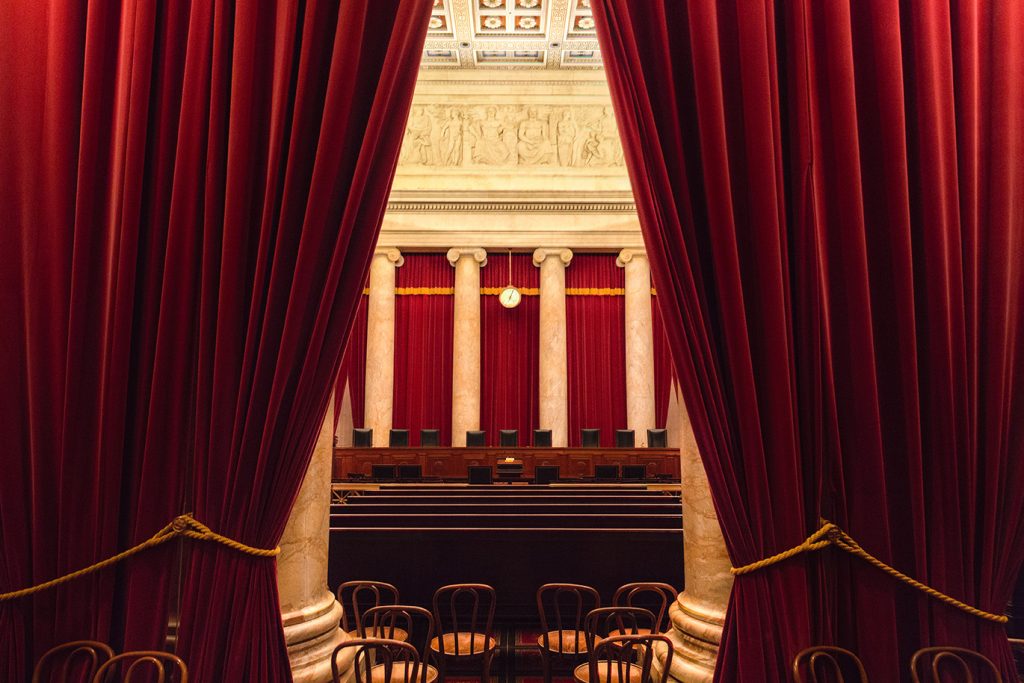
For more than two decades, Chief Justice John Roberts has presided over a Court that has dismantled democratic safeguards, favored the wealthiest Americans, and stifled multiculturalism. The Supreme Court is, first and foremost, an institution — one with an unparalleled air of legitimacy. When the justices don their black robes, sit beneath the motto “Equal Justice Under Law,” and issue opinions dense with citations and centuries-old precedent, they command a veneer of impartiality that no other branch can match.
This appearance obscures the real-world implications of the Court’s opinions. The Chief Justice — now the most frequent swing vote since Justice Anthony Kennedy retired — brokers alliances that produce occasional decisions favored by liberals, which is just enough to sustain an impression of ideological balance. The Court often avoids striking down laws outright, instead crafting intricate new tests that accomplish the same result over time, without inviting the acute political backlash a definitive rejection might cause. But the Court also applies its tests inconsistently, depending on the parties before it, rather than as neutral principles for all.
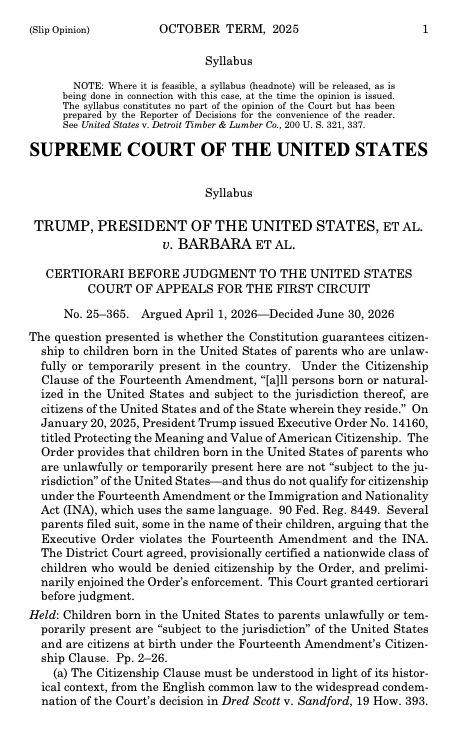
While news headlines often fragment around major opinions, the Court quietly shepherds through lesser-known, but dangerous, precedents that reshape American life. Even the biggest cases face mischaracterization. The 194-page decision in Barbara v. Trump, the birthright citizenship case, began by tracing precedent back to Lord Coke in Calvin’s Case of 1608, translated from the original Latin. No wonder everyday citizens rely on commentators to parse what the Court is doing. But the media is failing them.
As a lawyer fighting for every inch of the rights in the Constitution, I believe it’s necessary to sound the alarm: the Court is shrinking the legal ground to fight on.
This is a retrospective on the Court’s most recent term that rang in America’s 250th, and the lines along which the Roberts Court brokered power.
Notable 6-3 Supreme Court Decisions Along Ideological Lines
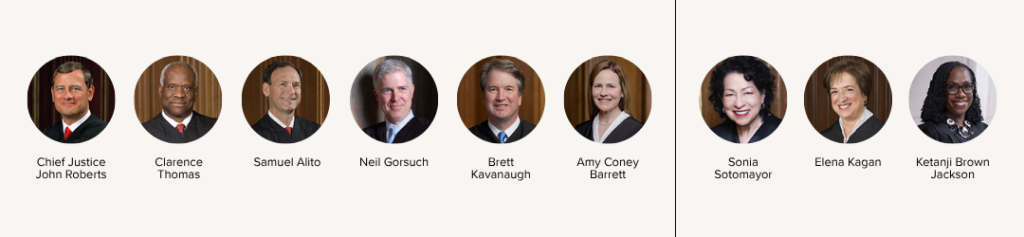
- Louisiana v. Callais – The Court struck down Louisiana’s second Black-majority congressional district. The decision significantly narrowed Section 2 of the Voting Rights Act and opened the doors to a systematic stripping of Black political power by southern states.
- Mullin v. Doe – The conservative majority allowed the expelling of at least hundreds of thousands of immigrants who entered the country legally under Temporary Protected Status. The decision expanded executive branch power over immigration enforcement, regardless of statutory violations.
- Trump v. Slaughter – The Court ended the nearly century-old system of independent agencies — nonpartisan bodies of experts that regulate industry to ensure Americans breathe clean air, drink clean water, have safe workplaces, and are shielded from Wall Street excesses that can wipe out savings.
- NSRC v. FEC – The conservative majority unleashed limitless political party spending in coordination with candidates, making it easier for wealthy donors and corporations to influence electoral outcomes.
The “Major Donors Doctrine”
In the tariffs case of Learning Resources Inc. v. Trump, justices split over the “major questions doctrine” — a principle the Court has increasingly invoked in separation of powers cases where major ideological questions are at play and the executive may burden corporations. Given the pattern of the Court’s rulings, it may be more accurate to call its overall approach the “major donors doctrine,” as the Court consistently protects favored moneyed interests. The Court ruled that tariffs, which economists agree threw corporate interests into disarray, could not stand on the pretextual emergency basis the president had invoked. While the media painted this as the Court’s willingness to strike down one of the president’s signature policies, the only party before this Court that wins more than, or repeatedly defeats, the administration is corporate America.
The “major donors doctrine” — big corporations win big, even against the president — struck again in the companion cases of Slaughter and Cook. Slaughter ended the nearly century-old system of independent agencies — nonpartisan bodies of experts that regulate industry to ensure Americans breathe clean air, drink clean water, have safe workplaces, and are shielded from Wall Street excesses that can wipe out savings. To justify overturning decades of precedent, the Court embraced the au courant strong “unitary” executive theory, which posits that the Founders wanted to grant the president a virtually blank check to reshape the executive branch at will. Scholars who see the theory’s upsides and staunch originalists alike have rigorously documented how the unitary executive is a myth. Now it’s the law.
Cook, Slaughter’s twin, carved out the Federal Reserve Board from independent agency destruction. To be sure, a politicized central bank is bad for everyone. In saving the Fed, Roberts wrote that it “operates at a deliberate remove from the ordinary political process,” a characterization that was equally true of all independent agencies. In other cases this term, the Court burrowed into how to define one or two words with a seeming indifference to the consequences (e.g. mass deportation as an unacknowledged consequence of Mullin v. Doe). In Cook, the consequences were front and center. Justice Kavanaugh writes that “even temporary uncertainty about the status of the Federal Reserve could spark political upheaval… as well as turmoil in the U.S. and world economies.” There’s no easy way to square the circle of enthroning an all-powerful unitary executive but then protecting only the money supply from that all-powerful unitary executive. But the Court declares it so.
Lesser-known opinions further carved out protections for corporations at the expense of individuals: the Monsanto case shielded companies from state tort claims, in this case a $1.25 million jury verdict for failing to put cancer warnings on the infamous herbicide Roundup. Justice Thomas, who worked at Monsanto in the 1970s and has helped issue rulings in favor of the company, voted with the majority and wrote an expansive concurring opinion. The Court also shielded Cisco (and any company in the future) from liability for allegedly building China a mass surveillance system to persecute and torture religious minorities.
The major donors doctrine was most manifest on the last day of the term, when headlines focused on Barbara v. Trump, the birthright citizenship case. But the Court also issued National Republican Senatorial Committee v. Federal Election Commission, unleashing limitless political party spending in coordination with candidates. The decision makes it easier for wealthy donors and corporations to influence electoral outcomes and, by extension, the composition of the Court that will hear their cases. Before Citizens United, billionaire donors’ campaign spending was 0.3 percent of campaign contributions. In 2024, it was 19 percent. The NRSC decision comes at a time when, across all political affiliations, 9 in 10 voters view government corruption as a big problem.
The same week the Court finished releasing its blockbuster opinions, it also released the justices’ annual financial statements that “are so broad that it is impossible to determine any justice’s overall wealth,” with Chief Justice Roberts “the only sitting member of the Court not to report any gifts or travel reimbursements.” Recent investigative reporting has uncovered how some justices are not always forthright on these disclosures: Justice Thomas secretly accepted trips and gifts for over two decades from Republican donor Harlan Crow, who funds dark money groups. Justice Alito went on a luxury fishing trip organized by Federalist Society leader Leonard Leo, who operates a network that shapes judicial appointments and funds amicus brief farms that signal which direction major benefactors want cases decided.
Dismantling Voting Rights
This term, the Court completed its decades-long erosion of the Voting Rights Act in Callais. In 1982, while working at DOJ as a special assistant to the Attorney General, Chief Justice Roberts memorialized his views:
“violations of §2 should not be made too easy to prove, since they provide a basis for the most intrusive interference imaginable by federal courts into state and local processes.”
This term, that view from more than 40 years ago became Court doctrine. The path was a slow burn. In 2013 (Shelby County) and 2021 (Brnovich), the Court dismantled parts of the landmark legislation that was the culmination of the Civil Rights movement. The Court’s decisions prior to Callais created a racial turnout gap that amounted to 9 million votes in 2020. Now, in the Callais decision, the Court claimed that it was not dismantling Section 2, the last viable section of the VRA. Instead, it only “update[s] the framework” that plaintiffs must meet when they challenge racist electoral maps. How difficult would it be to clear the new bar?
The Court answered quickly. Weeks later, in Allen v. Milligan, it stayed the order of a three-judge panel (two Trump appointees and one Reagan appointee) that had applied the new Callais test and concluded — in a 102-page opinion that re-reviewed extensive evidence in the record which included a full trial — that Alabama’s proposed map “intentionally discriminated against Black voters based on race in violation of the Constitution.” The panel’s decision would have preserved the status quo and prevented Alabama from implementing a map that courts have repeatedly found was discriminatory, mere weeks before absentee voting was to begin for Alabama’s special primary. Instead, the Supreme Court’s unsigned shadow docket order in Milligan clarified not only that an extensive trial record demonstrating that maps were racially motivated was insufficient to meet Callais’s “updated” framework, but also that the Supreme Court could upend state election logistics close to an election (contra its repeated invocation of the Purcell principle in recent years). Southern states have since rushed to draw racist maps for this year’s midterms, potentially handing Republicans up to 17 congressional seats. The aftershocks of this ensuing redistricting will also eventually affect state and local races.
Watson, which said that states may count mail-in ballots cast by but received after election day, is considered a win. As in Slaughter, the Court was offered a fringe theory (about what “election” means) that would have upended the settled law of about 30 states. But this time it did not bite. However, four of the justices dissented.
Though Watson was the headliner, the under-the-radar USPS v. Konan this term defanged the ability to hold the Postal Service accountable for failing to deliver mail, even if it does so intentionally. This comes at a time when the president is pressuring the USPS, including by executive order, to play an enlarged role in deciding which voters do or do not receive ballots. While the major donors doctrine this term ensured that money could further distort electoral outcomes, the voting rights cases meant that certain people’s votes shouldn’t count towards those outcomes.
Birthright Citizenship: One Justice Away from Revisiting Dred Scott
Barbara had the most at stake: the Fourteenth Amendment and birthright citizenship. In 1857, the Supreme Court issued its ruling in Dred Scott, a precipitating cause of the Civil War that repudiated birthright citizenship for enslaved people and is commonly considered the worst Supreme Court decision in history. Born out of the fires of our bloodiest war, the Fourteenth Amendment finally codified the founding promise of liberty and justice for all, that “[a]ll persons born or naturalized in the United States, and subject to the jurisdiction thereof, are citizens of the United States.” The Court reviewed this straightforward constitutional text that, as Justice Jackson described, was part of “an anticaste, antisubordination reset for the Nation.”
It was low-hanging fruit for the Court. But the same four justices who voted against mail-in ballots also broke from the majority that ruled birthright citizenship is in the Constitution.
Chief Justice Roberts wrote for the majority that:
“In a Nation of immigrants — an ‘asylum for mankind,’ in Thomas Paine’s words — jus soli [birthright citizenship]’s broad scope took on particular importance.”
How ironic, then, that the Court in two other opinions this term obliterated the ability of immigrants — in particular those seeking asylum and fleeing dangerous conditions in home countries — to stay in or even enter the country. In Mullin v. Doe, the Court blessed expelling at least hundreds of thousands of immigrants who, because of unsafe conditions in their home countries, entered and work in the country legally with Temporary Protected Status. The executive branch terminated TPS without meeting statutory requirements, but the Court placed the administration’s decision process beyond judicial review. Since the buck stops with the Court, the illegal can become legal. In Al Otro Lado, the Court approved the CBP practice of physically preventing people from approaching the border, even if they are fleeing persecution and are therefore entitled to mandatory legal processing. The impact of these decisions is similar to those in the voting rights context: limit pluralism and preserve a vision of a white United States.
The Shadow Docket
The Court’s shadow docket continues to offer a vehicle for the Court to act with limited briefing and reasoning, at a greater rate than ever before. In Malliotakis, for example, six justices blocked a New York trial court order that had found the lines of a Republican-held district discriminated against minority voters. The Court intervened before state appellate courts and New York’s highest court could weigh in. This is unprecedented. The U.S. Supreme Court’s jurisdiction in these contexts has always been limited to final judgments from a state’s highest court. Here the Court instituted its preferred map without first letting the state courts attend to the case.
When we set aside contrived culture wars, most Americans — left, right, and center — agree on where this country should go, and it isn’t down the path the Court is taking us.
So, What Can Be Done?
Naming and framing this problem is the first step. The Court has an arsenal of certain tools — among them arcane legalese and new tests that it applies unevenly — that were on full display this term. As Justice Sotomayor wrote in one dissent this term, such tools enable an approach that boils down to “Rules for thee, but not for me.” There is a cogent trajectory the Court’s decisions are tracing for us that is not bending toward justice: money, not votes, determining election outcomes and driving economic and social inequality; unbridled laissez-faire at the expense of our air, water, and food; a new Jim Crow in southern polling places; and an imagined “ideal” American nuclear family with the “right” family values.
The step after awareness is reform. The Court hasn’t always looked like this. At one point, the Court had 10 justices, not today’s nine, and justices used to “circuit ride,” traveling domestically and working in the nation’s trial courts instead of exclusively sitting in the ivory tower, chastising those lower courts, and then jetting off on all-expenses-paid summer holidays abroad. During Reconstruction, Republicans in the House succeeded in passing a bill mandating that the Supreme Court would need a supermajority vote in order to invalidate federal legislation, though it never became law. Many of the most devastating decisions this term were 6-3, so the Court currently sits comfortably at this supermajority threshold.
Term limits could prevent the gamesmanship of appointing the youngest possible justice to serve for the longest possible time. Limited terms could operate on regular staggered timelines, with additional mechanisms to protect against former Senate Majority Leader Mitch McConnell’s move of stonewalling a nominee entirely. Congress could require even minimal levels of transparency: livestreaming oral arguments and submitting to meaningful ethics enforcement are two prominent examples.
When we set aside contrived culture wars, most Americans — left, right, and center — agree on where this country should go, and it isn’t down the path the Court is taking us. We can have another 250 years, if we can keep it.
Jacob Kovacs-Goodman is counsel, legal strategy and operations, at Democracy Defenders Fund.


