Trump’s Crypto Connections
Since returning to office, Trump has aggressively promoted the expansion of cryptocurrency. He has loosened enforcement and reshaped regulatory oversight of stablecoins, all while profiting from crypto ventures he and his family control. Download
Introduction
Since his election to a second term, President Donald J. Trump has immersed himself in the crypto ecosystem — unleashing a torrent of deregulatory, pro-crypto policies and pardons, while simultaneously amassing extraordinary amounts of wealth from these ventures for himself and his family that raise the appearance of public office for private gain to new presidential heights. By virtue of his major stakeholdings in World Liberty Financial Inc. (World Liberty Financial) and CiC Digital LLC (CiC Digital), President Trump is expected to benefit from approximately $1 billion in crypto revenue earned by these entities since the November 2024 election, mostly from foreign sources.
If it hasn’t already happened, President Trump’s crypto businesses are on the verge of surpassing the value of his legacy real estate, hotel and golf resort businesses, which Forbes estimates to be worth $2.5 billion. Although valuing President Trump’s crypto businesses is immensely challenging due to lock-in restrictions, fluctuating markets and limited transparency, the Wall Street Journal in August estimated that the combined value of President Trump’s crypto businesses was $4.5 billion, while other estimates range between $2.9 billion and $7.1 billion. President Trump’s bitcoin holdings in Trump Media & Technology Group (Trump Media), which earlier this year were worth approximately $2 billion, are now worth an estimated $800 million less based on a bitcoin sell off beginning in August. Notwithstanding this volatility, these valuations are still gobsmacking amounts given that President Trump’s crypto ventures did not exist until just before his 2024 election – a little more than a year ago.
Even more shocking is the amount of income derived from President Trump’s businesses and who is providing it. Co-founded in October 2024 just prior to the presidential election by President Trump with certain of his family members, along with President Trump’s now Special Envoy for the Middle East Steve Witkoff and his sons, World Liberty Financial’s primary crypto products include the $WLFI token and the USD1 stablecoin. Since its release just prior to the November 2024 election, the $WLFI token appears to have generated at least $675 million in revenue, most of which is derived from transaction fees from foreign sources. Until recently, the $WLFI token, President Trump’s largest crypto income generator, was only available for purchase to persons outside of the United States.
President Trump next released the $TRUMP memecoin on January 17, 2025, a few days before his inauguration. Since then, $TRUMP sales are believed to have generated more than $320 million in revenue for President Trump’s CiC Digital business. It appears that a significant portion of $TRUMP memecoin’s revenue is derived from Justin Sun, the subject of a U.S. Securities and Exchange Commission market manipulation enforcement proceeding that has been indefinitely postponed since the Trump Administration took office.
On March 25, 2025, World Liberty Financial announced the issuance of the USD1 stablecoin. Within a few weeks, USD1’s biggest deal was announced involving a $2 billion purchase by a United Arab Emirates (UAE) investment fund, MGX, which was then used to finance a $2 billion investment in Binance, one of the world’s largest crypto exchanges. The USD1-MGX-Binance deal has proved particularly controversial since it involved a UAE state-owned entity that is expected to generate an estimated $80 million in annual income for President Trump’s World Liberty Financial. It also preceded the announcement to transfer advanced U.S. AI technology to the UAE and the pardon of Binance’s co-founder Changpeng “CZ” Zhao. The deal raises the specter of corruption, including the “appearance of pay for play”, a possible foreign influence campaign, and questions about whether President Trump may have abused his pardon authority.
This report largely focuses on President Trump’s crypto conflicts of interest that appear to pose the greatest threat to the U.S. financial system. In particular, we focus on World Liberty Financial’s USD1 stablecoin, which is inextricably linked to the U.S. Treasury market making it a unique target for foreign adversaries and other bad actors. Other controversial crypto deals involving Justin Sun and Alt5 Sigma are also described below.
By selling $2 billion USD1 stablecoins to MGX, World Liberty Financial appears to have led the American people into a potentially volatile deal with Binance — a crypto coin exchange that pleaded guilty to violating anti-money laundering and sanctions laws designed to protect American national security and the integrity of the international financial system. By entering into a deal with MGX and Binance, President Trump and World Liberty Financial are not only integrating crypto into the U.S. financial markets, but also appear to be normalizing corruption — sending a clear message that crypto actors who invest in his companies are unlikely to be prosecuted or held accountable by the U.S. government, regardless of whether they may pose a threat to the safety and security of the U.S. financial system and U.S. national security.
In preparing this report, the authors gratefully acknowledge their reliance on Democracy Defenders Fund’s newly-released Trump Crypto Tracker and reporting by Bloomberg, CBS News, Forbes, Fortune, New York Times, Reuters, Wall Street Journal, Wired, and numerous other invaluable news sources and academic studies. This report builds on Democracy Defender Fund’s Trump’s Crypto Conflicts of Interest Report (April 23, 2025) issued last year.
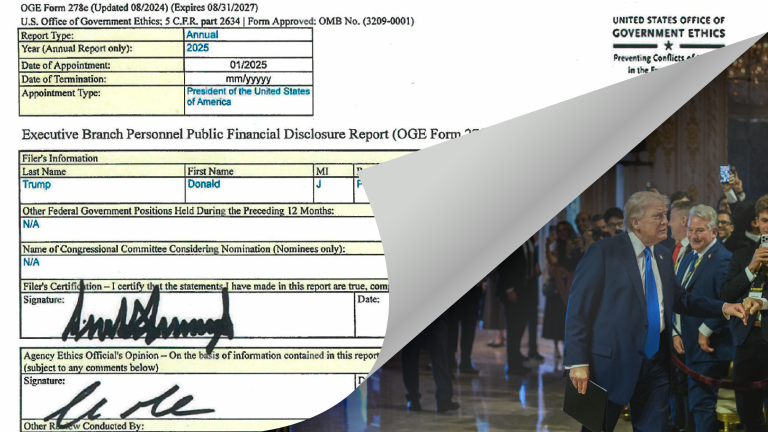
Also, included at the end of this report is Appendix A, which provides more detailed information about President Trump’s financial interests in his crypto business ventures and the methodology and sources used to determine income and asset valuations. For example, as explained in greater detail in Appendix A, Trump and his family members are expected to benefit from World Liberty Financial’s token sales, USD1 interest income, and $TRUMP memecoin sales based on fee-sharing agreements and other financial arrangements with Trump-owned pass-through businesses, including DT Marks DeFi LLC and CiC Digital LLC. DT Marks DeFi LLC has a fee-sharing arrangement to receive fees “equal to 75% of $WLFI token sale proceeds after deduction of agreed reserves, expenses and other amounts.” Similarly, Trump is expected to benefit from interest earned on USD1 reserve assets and from transaction fees earned from $TRUMP memecoin sales, although the size of personal Trump’s share of profits and fees from these ventures is not yet publicly known. Because President Trump is required to file a public financial disclosure report, additional financial details about his crypto ventures are expected to be disclosed on his 2025 annual report, which is due to be filed on May 15.
USD1’s $2 Billion Deal with Binance and MGX
Less than six weeks after USD1’s launch, a UAE investment fund, MGX, announced its purchase of $2 billion worth of USD1 stablecoin to finance its investment deal with Binance, one of the world’s largest crypto exchanges. World Liberty Financial had less experience, liquidity, and capitalization than its biggest competitors, such as Tether (USDT) and Circle (USDC), and consequently, the choice of using USD1 for the deal made little sense when it was announced since the stablecoin had not existed prior to March 2025. A direct cash payment from MGX to Binance would seem to have posed less risk and controversy. Even if Binance expressed a preference for settling the deal in cryptocurrency, MGX’s subsequent explanation that USD1 offered greater stability than other options due to its reserve assets and “compliance history” rings hollow given that USD1 came into existence only a few weeks before the deal was announced. Therefore, USD1 lacked much, if any, “compliance history” and it had virtually no money deposited in its cash demand deposit accounts as of May 15, 2025. The unusual choice of USD1 raises concerns that World Liberty Financial was brought into the MGX-Binance deal so as to garner favor with President Trump and his family members.
Because World Liberty Financial was cut in on the MGX deal, President Trump and his family members are expected to profit from an estimated $80 million a year in interest income for as long as the 2 billion USD1 stablecoins are not redeemed by Binance or subsequent holders. Income from USD1 is derived primarily from interest and yields earned from its reserve assets. According to World Liberty Financial’s press release, each USD1 is “100% backed by short-term U.S. government treasuries, U.S. dollar deposits, and other cash equivalents” and “each token is intended to maintain a value of $1 USD.” Those assets are then held in reserve on a one-to-one ratio until an investor seeks redemption on their outstanding shares. Shortly after the deal was announced, USD1 started trading on Binance.com on May 22, 2025, which also likely enhanced its marketability and availability to a broader customer base. On October 29, USD1 gained direct access to the U.S. customer base when it began trading on Binances’s U.S. website, Binance.us.
Does the USD1-MGX-Binance Deal Give Binance Leverage Over World Liberty Financial and the Trump Family?
Theoretically, Binance could hold its $2 billion worth of USD1 in abeyance indefinitely, assuming it retains ownership or control of those tokens. If so, World Liberty Financial would be expected to continue to derive profits from interest income or yields on investments earned from maintaining the reserve assets. Under section 4 of the GENIUS Act, no interest or yields earned on stablecoin reserve assets can be paid out to the holder. Rather, income from the reserve assets are usually retained by the issuer for profit. This dynamic seemingly gives Binance tremendous leverage over World Liberty Financial. Last year, President Trump’s World Liberty Financial had yet to sell a single stablecoin and now it is expected to generate $80 million annually in revenue from the USD1-MGX-Binance deal alone.
According to Forbes, Binance now holds about 75% of the stablecoin’s market cap. USD1’s most recent financial statement, indicates that as of September 30, 2025, $2.296 billion of its reserves were invested in a Fidelity government money market fund (Fidelity Investments Money Market Government Portfolio, CUSCIP No. 31607A703 (FRGXX)), and $391 million in cash and cash equivalent demand deposit accounts. This particular Fidelity fund has 37.81% of its assets invested in U.S. Government repurchase agreements, 35.18% in U.S Treasury Bills, 18.69% in agency floating-rate securities; 6.28% in agency fixed -rate securities, and 3.76% in U.S. Treasury Coupons, as of November 30. In 2024, that fund had a total annual return of 5.21%. This year’s return as of September 30, is 4.43%, which would result in an annual return of approximately $98 million.
Given its significant USD1 holdings, Binance could adversely impact World Liberty Financial’s profitability by redeeming its share of outstanding stablecoins currently held. For example, if the Trump Administration imposed tighter regulatory oversight and imposed more vigorous enforcement over the U.S. cryptocurrency industry, including its U.S. affiliate (Binance.us), those actions could be viewed as adverse to Binance’s business interests motivating it to redeem en masse the outstanding $2 billion USD1 stablecoins it still holds. A redemption of USD1 would result in a corresponding sell off of reserve assets by World Liberty Financial, which would likely adversely impact profits that otherwise would flow to President Trump, his family members, and similar stakeholders.
Could a Sell Off of USD1 and Other Stablecoins Cause a Significant Market Risk?
The resulting harm from an en masse redemption of USD1 could not only adversely affect World Liberty Financial’s profits, it also could affect the U.S. Treasury market depending on the size of U.S. Treasury redemptions it triggered and the liquidity of the market at the time of the sell off. In this light, President Trump’s financial interest in a stablecoin operation not only makes him more beholden to Binance for profits, but also could make the U.S. Treasury market potentially vulnerable to a large sell-off if Binance and other major investors redeem their USD1 holdings.
As explained in a recent academic study, there is an “emerging interdependence between the Treasury market and the U.S. dollar stablecoin ecosystem”. This dynamic carries both benefits and risks, including the possibility that a mass redemption of stablecoins could generate large Treasury sell-off orders in a low-liquidity market that could destabilize prices and create “significant downside risk”. Vanderbilt Professor of Law Yesha Yadav and Bretton Woods Committee member Brendan Malone explain these vulnerabilities in their 2025 article entitled Stablecoins and the US Treasury Market:
Disruptions within the U.S. Treasury market can negatively impact the moneyness of stablecoin claims. … U.S. Treasuries trading has suffered from concerning bouts of illiquidity where requests by investors to buy and sell Treasuries have been met with a deeply degraded capacity to meet demand.
Operationally, U.S. Treasuries trading does not enjoy ample liquidity at all times of the day. Even though stablecoin claims are redeemable 24/7/365, trading in U.S. Treasuries can be more unpredictable depending on the hour. For example, secondary trading in U.S. Treasuries is typically less liquid when markets in New York are closed, and where the major open forums for trading are in farther-off financial centers such as Japan or London. These logistical frictions come with outsize consequences. Where a large buy/sell order is transmitted into a less liquid market, it can exert a destabilizing impact on prevailing prices, potentially impacting what sellers or buyers are able to earn from their trade.
Importantly, illiquidity within the Treasury market creates a transmission channel that can result in a stablecoin issuer suffering crisis. In the face of mass redemption requests, if the U.S. Treasury market is malfunctioning or is insufficiently liquid, a stablecoin issuer will have to consider tapping other sources of funding in order to meet customer demand. For example, it may have to borrow on emergency terms, sell its assets, or otherwise face the reality that it is unable to pay customers at the expected redemption rate. Ultimately, this kind of outcome can spell doom for the stablecoin industry where faith in stablecoins as a credible form of money ends up (systematically) eroded.
Conversely, trouble in the stablecoin industry can trigger spillover harms for the U.S. Treasury market. For example, where an issuer experiences some idiosyncratic internal crisis requiring it to sell Treasuries en masse, the U.S. Treasury market can end up depleted in its ability to function. In other words, the U.S. Treasury market has to ensure there is sufficient liquidity to mitigate the risk created by a stablecoin issuer, or possibly a slew of issuers where customers stage a wider run on stablecoin reserve assets. To be sure, the Treasury market is expected to function as a general-purpose safe haven to contain any number of emergency scenarios. Nevertheless, with stablecoin issuers relying so directly on the U.S. Treasury market for their very existence, it looks set to be implicated in any crisis facing the stablecoin industry. [emphasis added.]
If this analysis is accurate, a massive sell off could have a contagion effect based on timing and market conditions that could possibly threaten the U.S. Treasury market. To prevent such an event and mitigate against systemic risk, adequate capital requirements and rigorous oversight and enforcement measures would need to be in place.
Because stablecoins operate on global permissionless networks, as was recently noted in a speech by Federal Reserve Governor Michael S. Barr, it “creates particular challenges for preventing money laundering and terrorist finance, since bad actors can purchase stablecoins in secondary markets that may not have customer identification requirements” that help prevent criminals and terrorists from accessing the U.S. financial system. The New York Times reported that one blockchain analysis firm “estimated that up to $25 billion in illicit transactions involved stablecoins last year”. As was recently noted by federal Judge Jed S. Rakoff, “[c]ryptocurrency has largely managed to remain free of government regulations, and as a result has become a vehicle for fraud and criminality.”
As President of the United States, it would seem that President Trump’s entry into the stablecoin business creates a unique opportunity for foreign adversaries and other bad actors to exploit his Administration’s friendly crypto ecosystem. By gaining entry into the U.S. Treasury market through USD1 and other stablecoins, foreign adversaries and other bad actors theoretically could seek to pursue strategies that undermine the U.S. Treasury market as a global safe haven.
This leads to several critical questions that need immediate answers:
- Whether sufficient capital requirements and anti-money laundering protections are currently in place to prevent possible spillover and contagion effects;
- If there were large-scale redemptions of USD1 in a low-liquidity market and World Liberty Financial did not have sufficient emergency funds to prevent a market event, would the American taxpayer or other market participants be called upon to bailout USD1’s stablecoin investors given Trump’s role as President; and
- Could a significant market event triggered by large redemptions of USD1and other stablecoins adversely impact the global safe haven status of the U.S. Treasury market?
As was recently explained in a commentary published by Reuters, there are “no shortage of triggers that could precipitate a [crypto] bailout”, including the possibilities of a run on stablecoin similar to a bank run or or the failure of a cryptocurrency exchange. That commentator also predicts that since “Donald Trump and his family are deeply enmeshed with crypto … if another FTX-style meltdown happens in the coming year, expect the current occupant of the Oval Office to step in.”
Regulation of Stablecoins under the GENIUS Act
Unfortunately, when Congress passed the GENIUS Act this past summer, legalizing the sale of stablecoins in the United States, it failed to address President Trump’s stablecoin conflicts of interest and the market risks that could result from them. Section 17 of the GENIUS Act expressly excludes the Securities and Exchange Commission (SEC) and Commodity Futures Trading Commission (CFTC) from regulating “payment stablecoins”. Instead, the GENIUS Act framework provides for a multitude of different federal and state agencies that can serve as the primary regulator and supervisor for stablecoin issuers, which could create a dynamic that incentivizes “regulatory arbitrage.”
When Congress passed the GENIUS Act, it tasked the Treasury Department with “issuing regulations that encourage innovation in payment stablecoins while also providing an appropriately tailored regime to protect consumers, mitigate potential illicit finance risks, and address financial stability risks.” Treasury recently sought public comments on potential regulations to determine how AI technology could be used to detect illicit activity, but AI adoption “brings in new unique cyber risks and privacy issues”.
It is not at all clear that President Trump’s appointees leading the Treasury Department, the Office of the Comptroller Currency, or any of the various other federal regulatory agencies that could serve as a primary federal regulator are sufficiently incentivized to adopt a robust regulatory and enforcement framework with the necessary guardrails so to protect the U.S. financial system from foreign adversaries and bad actors. The fact that World Liberty Financial is now in business with Binance and President Trump pardoned its co-founder and former CEO sends a strong message that he is not adverse to persons and entities that have engaged in sanctions and anti-money laundering violations. President Trump appoints loyalists who seem unlikely to implement policies that could adversely affect Trump’s business interests, and President Trump would likely seek to get them fired if they attempted to take actions that would be viewed as adverse to his interests. To this end, we note that, without any apparent basis, President Trump has repeatedly threatened the independence of the Federal Reserve by calling for Chairman Jerome Powell’s resignation. President Trump’s recent attempt to fire Federal Reserve Board Governor Lisa Cook is currently pending before the U.S. Supreme Court.
In sum, Binance’s acquisition of $2 billion in USD1 stablecoins through its deal with MGX gives it tremendous leverage over World Liberty Financial and its profitmaking. A sizable redemption of USD1 stablecoins by Binance could not only adversely affect President Trump’s profits, but potentially, under low-liquid market conditions, could trigger a larger sell off in the U.S. Treasury market making it a likely target for foreign adversaries and other bad actors. Unfortunately, robust capital requirements and rigorous regulatory oversight and enforcement to address these downside risks seems unlikely for an administration led by a President with what seems like obvious financial conflicts of interest.
President Trump’s Pardon of Changpeng “CZ” Zhao
World Liberty Financial’s $2 billion USD1-MGX-Binance deal has also led to the appearance of a pay-to-play scheme stemming from President Trump’s October 2025 decision to pardon Binance’s co-founder Changpeng “CZ” Zhao. Zhao, a UAE citizen, pleaded guilty in 2023 to anti-money laundering (AML) violations related to U.S. sanctions and AML violations by Binance when Zhao served as its CEO. When the Department of Justice announced these guilty pleas, its press release accused Zhao and Binance of “willful violations of anti-money laundering and sanctions laws [that] threatened the U.S. financial system and our national security”. Binance’s violations allowed Iran, Cuba, and other sanctioned actors to move billions of dollars through Binance’s exchange. Binance’s guilty plea resulted in a $4.6 billion fine that also barred Zhao from the company. Zhao’s own guilty plea resulted in a $50 million fine and a four-month prison sentence. On the same day that Binance and Zhao entered into their plea agreements with the Department of Justice, Binance entered into a $3.4 billion settlement agreement with the Department of the Treasury’s Financial Crimes Enforcement Network (FinCEN), and a $968 million civil penalty by the Office of Foreign Assets Control (OFAC). The settlement with FinCEN, OFAC, and the IRS Criminal Division addressed Binance’s failure to:
implement programs to prevent and report suspicious transactions with terrorists — including Hamas’ Al-Qassam Brigades, Palestinian Islamic Jihad (PIJ), Al Qaeda, and the Islamic State of Iraq and Syria (ISIS) — ransomware attackers, money launderers, and other criminals, as well as matching trades between U.S. users and those in sanctioned jurisdictions like Iran, North Korea, Syria, and the Crimea region of Ukraine.
By failing to comply with AML and sanctions laws, FinCEN concluded that Binance under Zhao’s leadership enabled a range of illicit actors to transact freely on its platform.
Unfortunately, President Trump’s pardon of Zhao also reinforces a fundamental change made by the Department of Justice (DOJ) when bringing charges that involve crypto assets. Under the Trump Administration, DOJ’s Deputy Attorney General Todd Blanche issued a new crypto prosecution policy in April 2025 stating that it would disband its National Cryptocurrency Enforcement Team (NCET) and would only pursue illicit financing charges by the “individuals and enterprises themselves…involving digital assets”, but “will not pursue actions against the platforms that these enterprises utilize to conduct their illegal activities.”
By taking away this enforcement tool, DOJ created a type of “safe harbor” for crypto exchanges who can now seemingly turn a blind eye when their customers use these platforms to facilitate transactions involving sanctions violations, terrorist financing, child porn and narcotics trafficking without any apparent fear of being prosecuted for violating anti-money laundering laws. This policy makes little sense because the most serious underlying crimes are uncovered by virtue of robust AML compliance programs required by the Bank Secrecy Act, which established program, recordkeeping, reporting requirements and customer identification requirements. While civil liability may still be possible, it likely will be more difficult to investigate and hold accountable those engaged in more serious underlying criminal activity absent the threat of prosecution hanging over those who choose to act as their financial enablers.
Corrupt Pardons and the U.S. Constitution
Zhao’s pardon also raises significant questions about whether it is an abuse of the president’s Constitutional authority. Under Article 2, Section 2, Clause 1 of the Constitution, a president has extremely broad authority to pardon crimes and offenses against the United States, but that power may not be exercised corruptly. For example, the president cannot sell pardons for cash in violation of the federal bribery statute. It would also seem to be an abuse of authority if the president uses his Constitutional authority to grant a pardon as a reward for including him and other family members in an extraordinarily generous business deal.
In this case, it is not clear what President Trump actually knows about the basis for Zhao’s pardon. When asked about it in a recent CBS 60 Minutes interview, President Trump inexplicably stated, “I don’t know who he is,” and “I know he got a four-month sentence or something like that. And I heard it was a Biden witch hunt.” In previous comments about the Zhao pardon, President Trump stated:
“A lot of people said that he wasn’t guilty of anything … I don’t know him. I don’t believe I’ve ever met him, … He had a lot of support, and what they said that he did is not even a crime. It wasn’t a crime. That he was persecuted by the Biden administration. And so I gave him a pardon at the request of a lot of very good people.”
President Trump
Comments on pardoning Changpeng Zhao
By disavowing knowledge of Zhao and his wrongdoings, President Trump appears at best to be out of touch, and at worse, to have turned a blind eye to Zhao’s CEO role when his company gave access to persons in Iran, Cuba, Syria and parts of Ukraine in violation of sanctions instituted under the International Emergency Economic Powers Act (IEEPA) and failed to report suspicious transactions involving terrorists organizations, child porn and drug traffickers and other bad actors.
According to Binance’s plea agreement (paragraphs 79-80), Binance violated U.S. law by “willfully causing at least 1.1 million trades, totaling at least $898,618,825 between Binance’s U.S. customers and its customers ordinarily resident in Iran.” In addition, “between August 2017 and October 2022, Binance caused millions of dollars of transactions between U.S. users and users in comprehensively sanctioned jurisdictions, including Cuba, Syria, and the Ukrainian regions of Crimea, Donetsk, and Luhansk.”
As noted above, Binance also entered into a $3.4 billion settlement agreement with FinCEN based on a determination that it failed to establish, implement, and maintain an effective AML program and “willfully” failed to report more than 100,000 suspicious transactions involving terrorist organizations, including Al Qaeda, ISIS, Hamas, and Palestinian Islamic Jihad, as well as transactions devoted to selling “child sexual abuse materials”; and various frauds and scams dealing in “illegal narcotics, counterfeit and fraud-related goods and services”.
More recently, in February 2024, Binance was sued by two Americans who were held hostage in Gaza and then later released or murdered in connection with Hamas’s October 7th attack. Their lawsuit, joined by family members, alleges Binance along with Iran and Syria provided material support to terrorists in connection with their attack on Israel. Just recently, a civil lawsuit was filed on November 22, 2025, by American citizens whose family members were also “murdered, maimed or taken hostage” during the October 7 attacks. This lawsuit accuses Zhao and Binance to “have knowingly provided ‘substantial assistance’ to militant groups including Hamas… helping them conceal the movement of funds.” These payments were allegedly laundered by Binance even after it entered into its November 2023 plea agreement with the Department of Justice.
Zhao’s pardon may be part of a pattern of crypto pardons. On his first full day in office, President Trump pardoned Ross Ulbricht, who had been sentenced to life in prison on May 29, 2015, after being convicted by a jury on multiple counts of drug trafficking. Ulbricht enabled users to buy and sell illegal drugs anonymously via a “bitcoin-based payment system” he created and operated known as the “Silk Road” website. Following behind the pardons granted to Zhao and Ulbricht, there are recent reports that Sam Bankman-Fried, who had been convicted in federal district court in the Southern District of New York, on October 3, 2023, on several counts of fraud, is now believed to be seeking a pardon from President Trump. Bankman-Fried was “convicted of orchestrating one of the largest frauds in history, stealing more than $8 billion” from his crypto exchange, FTX.com, and “ billions of dollars of FTX customer money to his cryptocurrency trading firm.”
Foreign Influence and President Trump’s AI Advanced Technology Deal with the UAE
President Trump’s financial interest in World Liberty Financial and its deal with MGX and Binance gives rise to the very type of foreign influence that the Framers sought to prevent when they inserted the Foreign Emoluments clause, Article 1, Section 9, Clause 8, into the U.S. Constitution. The Foreign Emoluments Clause bars the President and other persons holding an “office of profit or trust” from accepting any “emolument” from any foreign state. A federal court held during the first Trump Administration that the President is subject to the Foreign Emoluments Clause of the Constitution and that the term “emolument”’includes “profit, gain or advantage” of more than de minimis value, although that case was later dismissed as moot after President Trump lost his 2020 bid for re-election.
The Framers rightly feared that these types of payments from foreign state actors could lead government officials to sell out U.S. interests to the detriment of the American people. This threat of foreign influence is exemplified by the agreement to transfer U.S. advanced AI technology to the UAE. The New York Times highlighted the national security risks when it reported that the “White House agreed to allow the UAE access to hundreds of thousands of the world’s most advanced and scarce computer chips, a crucial tool in the high-stakes race to dominate artificial intelligence” and that “many of the chips would go to G42 … despite national security concerns that the chips could be shared with China.” At the same time that MGX was negotiating its $2 billion USD1 deal with World Liberty Financial and Binance, the head of MGX, Sheikh Tahnoon bin Zayed Al Nahyan, was reportedly engaged in negotiations involving the transfer of U.S. advanced AI technology to the UAE, which is expected to largely benefit G42, a UAE technology firm reportedly under the control of Sheikh Tahnoon. These deals, thus, “blurred the lines between personal and government business” raising questions about “whether U.S. interests were served”. According to one observer, this “legal twilight zone enabled USD1 to function as a privatized monetary instrument: issued offshore, collateralized with U.S. public debt, and controlled not by a central bank—but by a Trump family firm, a Gulf monarchy, and a cartel of crypto-based oligarchs.”
Not only was Sheik Tahnoon personally involved in both sets of negotiations, but different members of the Witkoff family were as well. President Trump’s Special Envoy to the Middle East, Steve Witkoff, led the trade negotiations on behalf of the United States, while their co-founder sons, Zach Witkoff and Eric Trump, announced the $2 billion USD-MGX-Binance deal. Prior to joining the Administration, Steve Witkoff was a co-founder and co-investor with President Trump in World Liberty Financial. Although both have since resigned from that business, President Trump retains a financial interest in the company and Witkoff may have yet to have divested his financial interest, although Witkoff has indicated through a World Liberty Financial spokesperson that he is in the “process of fully divesting”.
A review of Witkoff’s June 30 public financial disclosure report filed with the White House, suggests that he has not yet divested his financial interest in World Liberty Financial (item 41.8.1), and it appears he still held this interest when he was in negotiations with the UAE. President Trump announced his $2 trillion agreement with the UAE on May 15 in Abu Dhabi. If Witkoff had not divested from World Liberty Financial, his involvement in negotiating the AI technology agreement with the UAE raises significant conflict of interest concerns. Furthermore, Witkoff’s sons Zach and Alex remain with World Liberty Financial along with President Trump’s own sons, Eric, Barron, and Donald Trump Jr. All are expected to profit from the $2 billion USD1-MGX-Binance deal.
No reasonable person could view Witkoff as having the requisite impartiality necessary to represent U.S. interests in advanced AI technology negotiations with the UAE when a UAE state investment fund, MGX, was the source of capital behind the USD1-Bianance-MGX negotiated by his son. The possibility that Witkoff did participate in negotiations to transfer advanced AI technology to the UAE under these circumstances raises serious questions about whether he may have violated the Standards of Ethical Conduct for Employees of the Executive Branch, at 5 C.F.R. 2635.502, which absent authorization would likely have barred his participation. And no federal ethics official would likely grant him authorization to participate, especially if Witkoff had not yet divested from his own financial interest in World Liberty Financial. A $2 billion private deal from which he could potentially profit would be viewed as a possible inducement or reward for his official activity, and would raise possible illegal gratuities concerns under 18 U.S.C. § 201 and financial conflicts of interest under 18 U.S.C. § 208.
Securities and Exchange Commission (SEC) Enforcement Actions
Pay-to-play concerns also arise from a decision made by the U.S. Securities and Exchange Commission (SEC) in May 2025 to voluntarily drop its pending lawsuit against Binance. This decision came days after Binance announced that it would begin to list World Liberty Financial’s USD1 stablecoin on its platform. Before it was dropped, the SEC case accused Binance of violating federal securities laws by failing to restrict high net worth U.S. individuals from the platform, misleading investors about trading controls and commingling funds routed to a third party. The SEC later sought to drop those charges in the “exercise of its discretion and as a policy matter”.
Beginning in April 2025, the SEC began to relax oversight of the crypto markets when the Division of Corporate Finance announced its view that stablecoins should not be considered securities. Following the July 30, 2025 release of the President’s Working Group on Digital Asset Markets Report calling for the SEC and the CFTC to use their existing rulemaking and exemption authorities to enable the trading of digital assets, President Trump’s new SEC Chairman Paul Atkins announced he would be undertaking “Project Crypto” to create a new “regulatory framework” for crypto asset securities.
Atkins reiterated this goal in a November 12 speech, explaining he believes “that most crypto tokens trading today are not themselves securities.” As part of the SEC’s review, Atkins announced he would be proposing “in the coming months … a package of exemptions to create a tailored offering regime for crypto assets that are part of or subject to an investment contract.” However, this proposal has been met with opposition by the World Federation of Exchanges (WFE), whose members include NASDAQ. WFE wrote the Commission that the “broad use of such relief presents risks to investors and market integrity.” In their November 21, 2025 letter to the SEC, WFE stated:
“Exemptive relief would not be appropriate where relief would merely be more convenient or less burdensome or would provide a competitive advantage. Likewise, it would not be appropriate where the Commission has reasonable grounds for concluding that the relief requested would confer advantages only on one or a subset of market participants at the expense of others, or where the relief would undermine investor protections or otherwise place investors at undue risk of harm.”
The SEC is following the President’s lead on promoting favorable crypto policies. Beginning on January 23, 2025, President Trump issued an Executive Order creating the Presidential Working Group on Digital Asset Markets comprised of senior White House and government officials, headed by his Special Advisor for AI and Crypto David Sacks, to pursue policies that expand public access to digital assets, including U.S. dollar backed stablecoins. He subsequently issued a March 6, 2025 Executive Order creating a strategic bitcoin reserve and an August 7, 2025 Executive Order expanding retirees’ access in their 401k plans to alternative assets, including holdings in actively managed investment vehicles that are investing in digital assets.
A separate pay-to-play issue arose from the SEC’s handling of a pending enforcement action against one of President Trump’s biggest $WLFI token investors, Justin Sun, a “Chinese national and crypto asset entrepreneur” who is believed to live in Singapore and/or Hong Kong. When he first invested in $WLFI tokens, Sun had been the subject of a pending SEC enforcement action for alleged market manipulation involving the sale of certain crypto assets.
The SEC alleged that Sun and three of his companies (Tron Foundation Limited, BitTorrent Foundation Ltd., and Rainberry Inc.) were engaged in unregistered offerings involving the sale of crypto asset securities Tronix (TRX) and Bit Torrent and fraudulently manipulated the secondary market for TRX through “extensive wash trading.” Wash trading is the “simultaneous or near-simultaneous purchase and sale of a security to make it appear that it is being actively traded without an actual change to beneficial ownership.” In February 2025, Sun, joined by the SEC, obtained a stay in the proceeding.
On November 25, 2024, Sun made an initial $30 million investment in $WLFI tokens, and later, in January 2025, made an additional $15 million investment, for a total purchase of $45 million of $WLFI tokens. In addition, Sun made a separate $100 million investment in $TRUMP memecoin becoming the largest memecoin holder to attend President Trump’s gala dinner held for his top memecoin holders at his northern Virginia golf club in May 2025. These investments in President Trump’s crypto ventures total $200 million.
Sun’s initial investments in $WLFI were key since they were in an amount sufficient to cover an operating reserve threshold that had to be met before revenues could be shared with President Trump, his family members and other investors. In addition, Sun’s investment bolstered World Liberty Financial’s financials, which until October 30, 2024, only amounted to $2.7 million $WLFI token sales to 348 investors.
Direct investment by a foreign national in a U.S. president’s personal business provides an easy way for foreign nationals to obtain potential access and influence. Sun and his companies appear to have obtained access to President Trump via the memecoin gala and benefited, at least temporarily, from changes in SEC leadership and enforcement decisions following President Trump’s election and inauguration, including by having his lawsuit stayed since February with the joint concurrence of the SEC. It remains to be seen, however, whether the SEC will ultimately agree to a full dismissal of his case.
Other major investments in $WLFI tokens came from UAE sources, including a “mysterious” UAE-based fund, Aqua 1 Foundation, which announced on June 26, that it had purchased $100 million in $WLFI governance tokens. And on June 4, web3 investor and crypto market maker, DWF Labs, announced a $25 million investment. Little is publicly known about either Aqua 1 Foundation or DWF Labs. Reuters has reported that its review of Aqua 1 Foundation’s digital profile and other public information has revealed “almost nothing about the source of its capital or the person it named as its founding partner, Dave Lee.”
According to the New York Times, the SEC is “no longer actively pursuing a single case against a firm with known Trump ties” and is only pursuing crypto cases against “little-known defendants without clear ties to Trump.”
Alt5 Sigma Invests $1.5 billion in $WLFI
On August 11, Alt5 Sigma Inc. (ALTS), a small publicly traded financial technology company, announced a $1.5 billion deal with World Liberty Financial to purchase its tokens as part of a strategy to stockpile $WLFI. As reported by Bloomberg, the deal was expected to result in a $500 million “windfall” for the Trumps who were entitled to keep 75% of the proceeds from WLFI token sales. As part of that deal, Zach Witkoff became Chairman of ALTS’s board of directors. Eric Trump also was initially designated to join the board of directors, but thus far has not and apparently will not do so.
However, since that deal was announced the company has reported several troubling developments. On August 29, the company announced that a subsidiary of ALTS was found by a Rwandan court to be criminally liable for illicit enrichment and money laundering, along with one of its principals who was made subject to imprisonment, although both matters are being appealed. In October, the company announced that it had suspended and removed its CEO. In November, ALTS made a series of disturbing announcements in multiple SEC filings, including informing the SEC it would not be filing its financial results for the quarter ending September 27, 2025 due in part to the criminal cases in Rwanda; announcing the departure of its Chief Financial Officer (who had also been serving as Acting Chief Executive Officer) who was departing “without cause”; and the departure of its Chief Operating Officer who would be leaving at the conclusion of his consulting agreement.
ALTS’s most recent filing indicates that the sole member of the company’s independent registered public accounting firm had resigned. In its filing, the company attempted to deflect questions about this development by stating that the resignation was “not related to any disagreements with the Company on any matter of accounting principles or practices, financial statement disclosure, or auditing scope of procedure.”
The company’s stock is trading near $1.70 as of December 1, which is well below $6.06, its closing price on August 11, the day World Liberty Financial and ALTS announced their $1.5 billion deal. It’s also below the strike prices for most of the warrants issued to World LIberty Financial as part of the deal. However, there are three tranches of warrants of 99,000,000 each that have a strike price of $0.001 that have been granted to World Liberty Financial, but do not yet appear to have been exercised even though they vested on October 16. If exercised, it would appear to net World Liberty Financial close to approximately $450 million. Given ALTS’s recent disclosures, it appears that World Liberty Financial is now entangled with a company that appears to have drawn the attention of at least one national shareholder rights law firm.
Conclusion
Unfortunately, because of crypto’s pseudonymous nature, little is known about the other income sources that feed into the Trump family’s crypto ventures or their possible influence on U.S. policy. What we do know is more than troubling. President Trump and his family members are seemingly making enormous profits, bringing in an estimated $1 billion in revenue in the past year, from alleged market manipulators and persons or entities who have pleaded guilty to criminal charges of anti-money laundering and sanctions violations. At least one individual received a presidential pardon from Trump for criminal activity related to the sanctions violations and anti-money laundering charges and another person appears to have benefited from favorable agency treatment for market manipulation charges raising serious pay-to-play concerns. Recent private lawsuits indicate that some illicit financial payments involving a pardoned individual may have been made to support Hamas in connection with the October 7 attacks in Gaza. Other deals raise foreign influence concerns that may compromise U.S. national security based on the decision to transfer U.S. advanced AI technology overseas. Most concernedly, President Trump’s financial interest in the USD1 stablecoin may have contributed to more lax regulatory and prosecution policies for crypto assets creating a unique opportunity for foreign adversaries and other bad actors to gain entry into the U.S. financial system.