
Seven Critical Revelations From President Trump’s Financial Disclosure Report
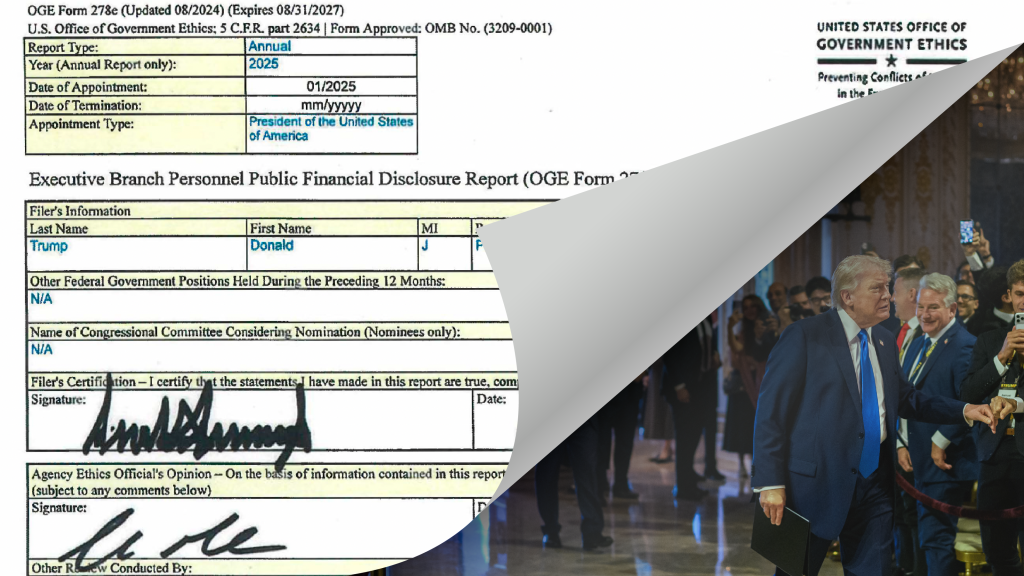
President Trump’s 927-page 2025 financial disclosure, which is nearly 700 pages longer than his last annual filing, reveals critical findings that raise unprecedented ethical, legal and national security concerns.
Overview
On June 30, 2026, President Trump filed his legally required annual financial disclosure report, which reveals the president’s unprecedented increase of wealth between Jan. 1, 2025 and Dec. 31, 2025. During that time, Trump reportedly took in $2.2 billion in income. As former White House ethics lawyers recently wrote in MS NOW, this massive increase in wealth poses profound conflicts of interest as it arises “from industries his administration regulates” and from foreign powers who may be seeking to influence the administration.
There is even more to the story than just conflicts of interest, however. Trump’s financial disclosure shows that the majority of his wealth was harvested from crypto ventures that yielded a massive payday for him while investors lost money. Trump then appears to have moved these cryptocurrency proceeds into traditional assets.
In fact, Trump reported more than 21,000 trades in mutual funds, bonds and stocks, including in companies he oversees. He reported many of these trades past the statutory deadline for disclosure, a flagrant violation of the Stop Trading on Congressional Knowledge Act of 2012.
Finally, Trump continues to serve as the president of Mar-a-Lago, for which he received more than $77 million in “resort related revenue” and reported an astounding $372,000 in gifts.
Over the next few weeks, more will be gleaned from Trump’s report. But these initial revelations should raise serious alarm bells for everyone, from Congress to the average American.
President Trump’s annual financial disclosure report finally puts hard numbers on what many in the good governance space have been raising concerns about for over a year: that the president is using his office and the inherent trust placed in him as president for personal gain.
Seven Critical Revelations
1. Trump Profited $1.4 Billion From Crypto Ventures While Investors Lost More Than $3.8 Billion
In 2025, Trump reported receiving $2.2 billion in income with about $1.4 billion of that from his crypto ventures. He also holds significant shares of WLFI. These holdings, about 15.75 billion tokens, are worth around $932 million. No modern president has ever come close to this level of outside income. In contrast to the immense wealth that President Trump has harvested from these crypto ventures, regular investors have suffered. While Trump made $636 million from a licensing agreement related to the $TRUMP memecoin, nearly all other investors lost massive amounts of money. In fact, the New York Times recently reported that 988,905 regular investors lost a total of $3.8 billion. Meanwhile, WLFI, the governance token of World Liberty Financial, Inc., is currently trading at around $0.06, about 88% below its all-time high when the asset was introduced. A hypothetical investor who purchased $10,000 of WLFI at its inception would have seen a loss today of nearly $9,000.
2. Trump Quietly Shifted to Traditional Investments While Promoting Crypto
Trump made massive profits off various crypto ventures, but it doesn’t appear that he has reinvested those proceeds back into cryptocurrency. Trump’s report shows holdings in cryptocurrency through CIC Digital LLC, DT Marks Defi LLC, DT Marks SC LLC, DTTM Operations, LLC, and Stablecoin HoldCo: companies set up to harvest the proceeds of various presidentially aligned crypto ventures. Within those accounts he has amassed a large amount of bitcoin, ether, and other digital assets. He doesn’t, however, report owning cryptocurrency personally or through his investment accounts.
While Trump reported significant investment in stocks, bonds and mutual funds — in fact, eight investment accounts held more than 5,600 former or current positions in stocks, bonds, and funds — it appears that not a single investment in those accounts was in cryptocurrency.
The result is that unlike everyday investors in the Trump-aligned crypto ventures who have suffered massive losses over the past year, Trump appears to be shifting his own money away from crypto. He called for a “Golden Age of Crypto” while moving his money out of digital assets. That is not a resounding endorsement of cryptocurrency or of his own crypto ventures.
3. Trump Appears to be Leveraging His New Assets to Avoid Taxes
Typically, liabilities are a bad thing. This is not the case when you are as rich as Trump. In 2025, he reported a Pledged Asset Line from Charles Schwab Bank. That line of credit allows Trump to pledge assets (like his new stocks and bonds) as collateral for a cash loan. This is a tool that wealthy people often use to leverage their financial assets without incurring a tax liability as they would if they outright sold the asset. In other words, the PAL gives Trump immediate income (the exact thing that crypto was supposed to replace) without him being required to sell any of his stocks and bonds and incur capital gains tax. Ordinary people do not have access to these complex financial instruments, which allow extraordinarily rich people to avoid taxes to substantially reduce their effective tax rates.
If Trump keeps the loans until he dies, his heirs would receive the assets without having to pay taxes. This tax loophole is referred to as the “Buy-Borrow-Die” strategy because it can be used to benefit his family members and others who inherit those assets from the taxpayer on a stepped-up basis, allowing them to avoid potentially significant capital gains treatment.
4. Trump Reported 21,235 Transactions of Stocks, Bonds, Securities, Many Very Late
In 2012, Congress passed the Stop Trading on Congressional Knowledge Act of 2012. The STOCK Act accelerated the timeframe for federal officials to report purchase and sales of stocks, bonds, and other securities, which previously were reported on an annual basis. Under the STOCK Act, securities transactions must be reported within 30 days (but in no event more than 45 days after the transaction occurs). This prompt reporting requirement means that a government official who sells Apple on July 1 usually has until July 31 to report the transaction. In 2025, government officials across the entire executive branch filed a total of 21,780 periodic transaction reports.
President Trump’s annual financial disclosure report alone identifies 21,235 transactions that occurred in 2025 that were not reported within the 30-day reporting window as required under the STOCK Act. This is nearly as many transactions as filed by all other officials in the entire Executive Branch over the same time period. (The same day Trump’s annual report was released, OGE also released a periodic transaction report filed by Trump that disclosed another 1,150 trades that occurred in May 2026.)
Some of these 21,235 transactions were not legally required to be reported promptly under the STOCK Act, which exempts transactions of “excepted investment funds,” like mutual funds, as well as transactions of the underlying holdings of those funds. Notwithstanding, a large percentage of transactions disclosed are purchases and sales of individual securities, bonds and stocks, that would be required to be promptly reported.
Under the STOCK Act, filers who fail to timely report transactions incur a late filing fee of $200. If Trump had incurred a late filing fee for each late transaction reported, we would expect the federal government to recover millions of dollars on his late transactions. Guidance from the U.S. Office of Government Ethics, however, effectively caps most annual liability for untimely filing at $2,400. How? Because the late filing fee applies to “reports.” OGE has taken the position that an individual who reports multiple late transactions on a single report only has to pay one $200 late fee. Further, OGE has said that an agency can aggregate all transactions that could have fit into one report and charge one fee for all those transactions. For example, an official who failed to report 100 transactions in May would only have to pay one $200 late filing fee because all of those transactions could have fit on a single report. Given the time Trump was in office and the timing of his transactions, he likely wouldn’t be required to pay the full $2,400.
Let’s be clear: a penalty of $2,400 (or less) is nothing for Trump, who made over $2 billion last year in revenue, most of it from cryptocurrency ventures. Less than a rounding error, that number certainly isn’t enough to deter late reporting, which is the purpose of the late filing fee.
The president is fond of saying that he is not covered by the conflict of interest laws. He is, however, prohibited from engaging in insider trading as is explicitly clear under the STOCK Act. He also is prohibited from using nonpublic government information for personal gain, which is also made clear in the STOCK Act. Much can and should be said about the timing of these thousands of trades while the president sits at the apex of the federal government and has access to some of the most important, material and market-moving information across every sector of industry. It is enough to say that we, the American public, should never be in the position of guessing whether the president is gaming the system.
5. Trump Reported Zero Transactions of Cryptocurrency
While Trump earned more than $550 million from sales of WLF tokens, and reported 21,235 transactions of bonds, stocks and funds, not a single purchase or sale of cryptocurrency tokens is reported on the 686 pages of transactions. Until President Trump took office, the Securities and Exchange Commission took aggressive action to enforce securities laws for any cryptocurrency that appeared to meet the definition of an investment contract under the Securities Act of 1933. Since the beginning of the Trump administration, the SEC has filed numerous “interpretations” that effectively exclude cryptocurrency from the SEC enforcement authority. For example, staff guidance from Feb. 27, 2025, took the position that meme coins like $TRUMP aren’t securities. And the SEC’s final interpretive rule on the “taxonomy” of cryptocurrencies took the position that governance tokens were digital commodities, not securities.
The upshot is that when Trump sold cryptocurrency assets he did not file any corresponding transaction reporting, presumably relying on the SEC’s new interpretations.
But, here’s the issue: at least some cryptocurrencies that the president has an interest in likely qualify as securities under even the SEC’s highly permissive test. As Lee Reiners, Lecturing Fellow at Duke and a highly respected expert on cryptocurrency, wrote a few months ago, World Liberty Financial, Inc. has all of the trappings of a traditional security “investment contract” under the Securities Act of 1933. But Trump knows that neither the SEC nor OGE are going to start a fight about the status of WLFI as a security, particularly not when the president has already given himself final authority over legal interpretation within the Executive Branch pursuant to Executive Order 14215, and when the heads of these agencies are appointed by, and can be fired at will, by the president. As a result, even if the tokens that Trump sells are securities, no one in the Executive Branch is going to make him report those transactions.
6. Trump Is Still President of Mar-a-Lago AND Made 19,270% More as President of Mar-a-Lago Than as President of the United States
As president of the United States, Donald Trump is entitled to a salary of $400,000. But that number pales in comparison to the $77,482,488 Trump made in resort-related revenue from his ownership of Mar-a-Lago Club, L.L.C. All in all, President (Mar-a-Lago) Trump made 19,370% more than President (United States) Trump.
Unlike when he took office the first time, Trump has not resigned as “president” of Mar-a-Lago, even though no modern president has held any outside position with a for-profit entity, no less an executive officer position collecting millions of dollars a year.
Unlike when he took office the first time, Trump has not resigned as “president” of Mar-a-Lago, even though no modern president has held any outside position with a for-profit entity, no less an executive officer position collecting millions of dollars a year. Since passage of the Ethics Reform Act in 1989, high-level officials in the Executive (except the president), Legislature, and Judiciary have been subject to numerous limitations on their outside relationships with for-profit companies. For example, the Ethics Reform Act places a statutory cap on how much a covered official can receive each year from outside employment (that amount was $33,285 in 2025) and prohibits receipt of any outside compensation for serving as a corporate officer.
If President Trump was covered by the Ethics Reform Act he would be barred from serving as president of Mar-a-Lago. Unlike members of Congress, judges, and cabinet secretaries, however, the president is not covered by the outside earned income limitations.
Beyond his exceptional revenue haul as president of Mar-a-Lago, there are serious issues with a sitting U.S. president running an outside business. As a private organization, the American public does not have access to information about the financial condition of Mar-a-Lago, about the contracts it has with vendors, or about where any of the money comes from that makes up the “resort related revenue” Trump reports on his OGE Form 278e. That is to say that we have no insight into the economic relationships the president may have with parties through Mar-a-Lago. These are all leverage points. Given the administration’s penchant for rewarding President Trump’s friends and donors (see, Reflecting Pool Mess) the risk that Mar-a-Lago donors, vendors, and even foreign government visitors, may get special treatment is very real.
7. Trump Reported $372,000 of Gifts Including 115 Sports Tickets
In addition to investments, public financial disclosure filers like President Trump are required to report all gifts they receive in the reporting period that aggregate to over $480 from a single source. Filers are required to report qualifying gifts even if their acceptance violated another law (like the Federal bribery or illegal gratuities statute, 18 U.S.C. § 201, or the federal gift ban, 5 C.F.R. § 2635.202).
Most government employees are subject to onerous limitations on the types of gifts they can accept. Not so much for the president. A longstanding exemption for the president allows him to accept “any gift on their own behalf or on behalf of any family member, provided that such acceptance does not violate § 2635.205(a) or (b), 18 U.S.C. 201(b) or 201(c)(3), or the Constitution of the United States.” That is a broad allowance. Yet, while the exception for the president accepting gifts is broad, it is not unlimited. The president may accept “any gift on their own behalf or on behalf of any family member” so long as it is not a bribe or illegal gratuity and the president did not “use, or permit the use of, [his] Government position, or any authority associated with public office, to solicit or coerce the offering of a gift.” 5 C.F.R. § 2635.204(j)(emphasis added).
President Trump reported 11 gifts. The first was a $250,000 bronze statue of Trump provided by New York Republican Anthony Constantino who is seeking to fill retiring Rep. Elise Stefanik’s seat. The other 10 gifts were packages of anywhere between five and 15 tickets to attend sporting events, many hosted by friends of the president like Dana White and FIFA head Gianni Infantino. In total these tickets amount to nearly $122,000.
While the president’s report doesn’t provide a legal justification for the acceptance of these gifts, it is likely that the president was relying on the special exemption.
The bronze statute may have met the special exemption, but it appears very unlikely that the 115 tickets to 10 events were solely for the president and his own family members. For example, President Trump attended the 2025 FIFA World Cup Final with his wife, but Pam Bondi, Sean Duffy, and Kristi Noem were also in attendance. To date, the Office of Government Ethics has not released the termination or annual financial disclosure reports of Bondi, Duffy, and Noem. But if Trump was given tickets to hand out to anyone except for his own family, or asked for tickets for anyone except his family, including other government officials, the special exception for gifts to the president would not apply.
Policy Recommendations
There are several things that Congress can do in response to the abusive practices identified on the president’s financial disclosure report:
- Require that the president divest of all interests in stocks, bonds and cryptocurrency.
- Prohibit the president from issuing, promoting, or sponsoring financial instruments, such as cryptocurrency, while in office.
- Update the STOCK Act to increase the late filing fee and attach the fee to each late transaction.
- Clarify that the requirement to promptly report securities transactions includes sales, purchases and exchanges of cryptocurrency.
- Expand the Ethics Reform Act prohibition on outside earned income and outside compensated positions to the president.
- Prohibit the president from receiving gifts other than those permitted by other officers and employees, judges and members of Congress.
Conclusion
President Trump’s annual financial disclosure report finally puts hard numbers on what many in the good governance space have been raising concerns about for over a year: that the president is using his office and the inherent trust placed in him as president for personal gain. What is clear from the report is that unlike any other president in the modern era, Trump has retained extensive business holdings, taken valuable gifts and utilized his name to secure untold wealth all while holding high office.
Were that the end of the story, it would raise unprecedented concerns. But there is another story told by President Trump’s financial disclosure report, a deeply unsettling story about a president who appears to be callously profiting off the trust placed in him to build an empire of wealth — an empire that may eventually be passed down tax free to his own children — while everyday investors in Trump-aligned crypto ventures bear the burden of their financial losses. Congress can, and should, step up to take action to prevent further abuses in the future.