
Executive Summary
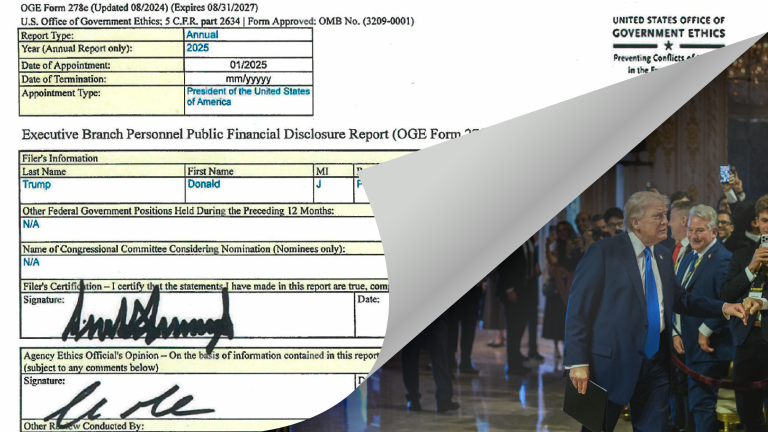
Since retaking office, President Trump has nearly doubled his net worth. Much of that can be traced to his family’s forays into cryptocurrency, an industry he and his family entered into earnestly only days before his second term.
World Liberty Financial Inc. (WLFI), is one of those presidentially-aligned companies. WLFI was formed by Zachary Folkman, Chase Herro and the families of Donald J. Trump and White House advisor Steven Witkoff in 2024. Since its inception, WLFI has produced over $1.4 billion for Trump and Witkoff’s families. As of writing, WLFI’s proprietary U.S. dollar-denominated stablecoin, USD1, has become the third biggest stable coin by market capitalization.
As described in this report, WLFI and USD1’s success is not coincidental, nor is it the result of a healthy, normal, and competitive marketplace.
Rather, the financial windfall of WLFI and USD1 cannot be explained without understanding the coordinated effort, by actors in government, the private sector, and foreign countries, to create economic conditions that were favorable to the success of these presidentially-aligned crypto enterprises.
Within government, President Trump has spearheaded an immense deregulatory effort through the President’s Working Group on Digital Asset Markets and heavy-handed oversight at the Commodity Futures Trading Commission and the Securities and Exchange Commission that has created a permissive environment for cryptocurrency markets. Outside of government, WLFI and USD1 have benefited from an unprecedented $2.5 billion infusion of foreign state-linked capital and preferential treatment from dominant market intermediaries, including Binance, whose former CEO, Changpeng Zhao, had pleaded guilty to failing to maintain an effective anti-money laundering (AML) program in violation of the Bank Secrecy Act but was pardoned by President Trump.
The result, as outlined in this report, is not only presidential self-enrichment at a level nearly inconceivable only a year ago, but a deeply distorted and anticompetitive stablecoin market that favors the President and his family over other competitors, disadvantages compliant U.S. firms, and introduces new risks into the financial system.
Most importantly, building off of Democracy Defenders Fund’s April 2025 report, Trump’s Crypto Conflicts of Interest, January 2026 report Trump’s Crypto Connections and the Trump Crypto Tracker, this report explains how USD1 has become the quintessential example of one of the gravest risks the president poses to the American economy: the replacement of fair and competitive markets with an economic system skewed towards those with political power.
I. Introduction
This report examines how President Trump and his family’s extensive cryptocurrency business interests are shaping federal financial regulation and distorting competition in digital asset markets. Although the Trump family’s crypto-related activities span a wide range of ventures – including non-fungible tokens (NFTs), memecoins, and Bitcoin mining – this report focuses on a discrete and particularly consequential case: World Liberty Financial (WLFI) and its proprietary U.S. dollar-denominated stablecoin, USD1.
USD1 sits at the intersection of three domains that are ordinarily governed by strict public safeguards: foreign capital flows, core market infrastructure, and federal financial regulation. In the months following its launch in early 2025, USD1 became the vehicle for a remarkable $2 billion transaction in which MGX, an investment fund backed by the United Arab Emirates, used USD1 to acquire a stake in Binance, the world’s largest cryptocurrency exchange. That transaction – involving an exchange that had previously pleaded guilty to criminal violations of U.S. anti-money laundering laws – instantaneously vaulted a newly created, politically affiliated stablecoin into the top tier of the global stablecoin market, conferring scale, liquidity, and credibility that competing issuers typically require years – and substantial expense – to attain.
This report treats the USD1–MGX–Binance transaction as a focal case study because it provides a uniquely clear window into how presidential financial interests, foreign state-linked capital, and regulatory decision making can converge in ways that distort competition and undermine the integrity of U.S. financial markets. By channeling a massive foreign investment through a Trump-linked digital currency, the deal generated substantial, ongoing revenue for the President’s private enterprise while simultaneously disadvantaging competing stablecoin issuers that lack comparable political access or sovereign backing.
While USD1 is the centerpiece of this analysis, it does not exist in isolation. President Trump’s broader foray into digital assets provides essential context for understanding the incentives at work. His cryptocurrency interests are structured through a complex web of personally owned limited liability companies and public equity stakes that entitle him to significant transaction-based revenue. World Liberty Financial, the President’s most prominent crypto venture, is structured so that DT Marks DeFi LLC – an entity primarily owned by the President – held a 38 percent equity stake in the project’s parent company as of August 2025, while retaining a service agreement that entitles Trump-affiliated entities to 75 percent of net protocol revenues from token sales and operations.
More insight into World Liberty Financial’s ownership and capitalization emerged on January 31, 2026, when The Wall Street Journal reported that four days before Donald Trump’s inauguration, Sheikh Tahnoon bin Zayed Al Nahyan, an Abu Dhabi royal and the head of the UAE’s state-backed investment firm MGX, acquired a 49 percent stake in World Liberty Financial for $500 million through an entity he controlled, Aryam Investment 1. Half of the purchase price was paid upfront, resulting in approximately $187 million immediately flowing to Trump-affiliated entities, including DT Marks DeFi LLC, with an additional $31 million directed to entities affiliated with Steve Witkoff, a World Liberty co-founder who weeks earlier had been named U.S. Special Envoy to the Middle East. Despite having no operating products at the time and no known outside investors beyond its founders, World Liberty Financial became dominated by a single foreign state-linked investor, which emerged as the firm’s largest shareholder and primary source of capitalization. The investment also directly enabled the launch of USD1, as the proceeds were split between two World Liberty entities – one responsible for issuing and operating the stablecoin, and the other managing the remainder of the firm – underscoring how foreign capital tied to sovereign actors played a decisive role in jumpstarting USD1’s market presence.
In the memecoin and digital collectibles space, Trump operates through CiC Digital LLC, a company he owns outright, which holds an 80 percent collective interest (alongside partners) in the $TRUMP memecoin and NFT ventures and is explicitly structured to receive trading-based revenue. President Trump also maintains a controlling interest in Trump Media & Technology Group through his ownership of approximately 115 million shares, a company that has recently pivoted toward accumulating significant cryptocurrency holdings through partnerships with the crypto exchange Crypto.com.
Collectively, these ventures have generated approximately $1.4 billion in crypto-related revenue during Trump’s second term, according to Bloomberg. This level of personal enrichment raises serious and well-documented concerns about conflicts of interest, as the President of the United States is profiting directly from an industry that his administration is responsible for regulating. But USD1 is distinct. Unlike memecoins or NFTs, whose economic impact is largely confined to speculative retail markets, USD1 is embedded in the plumbing of the financial system.
Stablecoins are designed to function as cash-equivalent instruments; are increasingly integrated into payments, settlement, and treasury operations; and are tightly linked to U.S. dollar funding markets and short-term government debt. As a result, distortions in the stablecoin market have consequences that extend far beyond crypto-native users, affecting banks, payment firms, and the broader financial system.
Crucially, USD1’s rapid ascent is not intelligible without first understanding how the regulatory environment governing digital assets was softened and reshaped during the second Trump administration. This report therefore begins by examining developments at the two federal agencies most directly responsible for crypto oversight: the Commodity Futures Trading Commission (“CFTC”) and the Securities and Exchange Commission (“SEC”). At both agencies, longstanding regulatory positions were abandoned, enforcement actions were paused or dismissed, and institutional safeguards were weakened in ways that materially altered the competitive landscape.
At the CFTC, unilateral deregulatory actions expanded crypto trading and collateral practices beyond the agency’s traditional statutory remit, allowing politically connected firms to consolidate market power with minimal supervision. At the SEC, a rapid retreat from enforcement – combined with new guidance narrowing the agency’s jurisdiction – removed legal constraints that had previously limited the ability of major exchanges and cryptocurrency issuers to operate at scale. These changes coincided with, and in several instances directly benefited, firms and individuals with financial ties to the President’s crypto ventures, including Binance and major investors in WLFI-issued tokens.
Legislative developments further reinforced these dynamics. The enactment of the Guiding and Establishing National Innovation for U.S. Stablecoins Act (GENIUS Act) in mid-2025 created a federal framework that legitimized private stablecoin issuance while leaving critical gaps around conflicts of interest and third-party incentive programs. At the same time, President Trump’s personal involvement in the crypto sector emerged as a central obstacle to passage of a broader crypto market-structure bill, with proposed ethics safeguards repeatedly diluted or blocked during negotiations. This legislative impasse reflects a broader breakdown in governance, in which financial policymaking has become increasingly intertwined with presidential self-enrichment.
Against this backdrop, USD1’s growth was neither accidental nor market-driven. Its scale and distribution were achieved through mechanisms unavailable to ordinary competitors: a $2 billion infusion of foreign state-linked capital, preferential treatment from dominant market intermediaries, and a regulatory posture that favored politically aligned firms. In practical terms, this allowed a stablecoin with no meaningful operating history to bypass the costly, incremental process that governs entry and competition in regulated financial markets.
The analysis that follows demonstrates that USD1’s rise has distorted competition in the stablecoin market, disadvantaged compliant U.S. firms, and introduced new risks into the financial system. More broadly, it shows how the convergence of presidential self-enrichment, regulatory rollback, and foreign capital has produced a market structure in which political power functions as a substitute for competition on the merits.
II. Regulatory Capture at the Commodity Futures Trading Commission
The Commodity Futures Trading Commission has classified Bitcoin and Ether – and, by extension, other similarly structured cryptocurrencies – as commodities. While the CFTC regulates commodity derivatives markets, it does not supervise commodity spot markets, though it retains enforcement authority over fraud and manipulation in those markets. Because U.S.-based cryptocurrency exchanges contend that they list only commodities and have thus far largely resisted enforcement actions by the SEC, no federal agency currently exercises comprehensive, ongoing supervisory authority over crypto spot exchanges. Instead, these platforms are subject primarily to registration requirements imposed by the Financial Crimes Enforcement Network (FinCEN) and to state-level money transmitter licensing regimes.
This regulatory gap has significant consequences. In the absence of federal spot-market supervision, cryptocurrency exchanges are permitted to combine functions that are strictly segregated in traditional securities markets, simultaneously operating as brokers, market makers, exchanges, clearing agencies, and custodians. As demonstrated by the collapse of FTX, the commingling of these functions within a single intermediary creates acute conflicts of interest and exposes investors to heightened risk. Most critically for market participants, the lack of federal spot-market regulation means that customers of failed crypto intermediaries are often treated as unsecured creditors in bankruptcy proceedings, leaving them with little recourse when an exchange collapses.
This structural weakness in the regulation of digital asset markets and the need to address it has been widely acknowledged by former SEC Chair Gary Gensler, former CFTC Chairs Rostin Behnam and Timothy Massad, industry participants, and members of Congress. The central policy question, however, remains unresolved: which federal agency should be granted authority over digital asset spot markets and how expansive should that authority be?
The cryptocurrency industry has long advocated for legislation that would designate the CFTC as its primary regulator by extending the agency’s jurisdiction to crypto spot markets. The rationale is largely pragmatic. The SEC operates with an annual budget of approximately $2 billion and a workforce of roughly 5,000 employees, whereas the CFTC’s requested budget for FY’26 (excluding the Office of Inspector General) was approximately $400 million, with around 640 full-time staff. Moreover, despite the Trump administration’s stated interest in expanding the CFTC’s authority over crypto spot markets, there is no corresponding plan to provide the agency with additional resources to perform this role. As the CFTC’s Office of Inspector General recently observed, “The agency’s FY 2026 President’s Budget request does not appear to estimate or include funds necessary to regulate the digital asset marketplace.” More troubling still, the CFTC’s capacity to pursue misconduct in crypto markets has been significantly weakened under the current administration. On February 10, 2026, Barron’s reported that while the agency’s Chicago office remains operational, its enforcement division – once staffed by approximately 20 enforcement attorneys – no longer has any enforcement lawyers assigned to it. This is particularly consequential because Chicago is widely regarded as the “spiritual home” of U.S. futures markets, and that office previously led high-profile crypto cases, including those against Binance and its CEO Changpeng Zhao, as well as FTX. As one recently departed enforcement attorney told Barron’s, if he “was a different person,” he “would launch a crypto scam right now, because there’s no cops on the beat.”
From the industry’s perspective, regulation by a smaller, less resourced agency is inherently preferable. Moreover, the CFTC has comparatively limited experience overseeing retail-oriented markets like crypto. Even SEC Commissioner Hester Peirce, often referred to as “Crypto Mom” for her support of industry-friendly regulation, has acknowledged these limitations. In a 2023 speech, she observed:
“Some people within crypto would prefer to see regulatory authority over token disclosures and spot markets given to the Commodity Futures Trading Commission (‘CFTC’). The CFTC’s retail experience is more limited than the SEC’s. Moreover, if the CFTC were given regulatory authority over crypto spot markets, would there soon be calls for the CFTC to regulate other spot markets, such as wheat, oil, and corn markets? Adding crypto to the CFTC’s remit also would stretch the small agency’s resources.”
Beginning with the CFTC’s decision to permit the listing of Bitcoin futures in 2017, the agency has given the crypto industry much of what it has asked for. During the first Trump administration, CFTC Chairman Chris Giancarlo was such an outspoken advocate of cryptocurrency that the industry dubbed him “Crypto Dad,” a moniker he readily embraced, referring to himself by that name on social media and using it as the title of his 2021 memoir. These actions further cemented the CFTC as the crypto industry’s preferred regulator and help explain why convicted felon Sam Bankman-Fried was an outspoken advocate for the Digital Commodities Consumer Protection Act (DCCPA), which would have created a new federally recognized asset class called “digital commodities” and placed digital commodity markets under CFTC oversight. The CFTC was also actively considering granting FTX’s application to amend its order of registration as a Derivatives Clearing Organization (“DCO”), which would have revised FTX’s existing non-intermediated model to permit the clearing of both margined and fully collateralized trades. Had this proposal gone into effect, the damage from FTX’s failure would likely have been more severe and more broadly felt.
The extent of the crypto industry’s influence over the CFTC became more widely understood following an unseemly episode in the summer of 2025 that traced back to the launch of Bitcoin futures contracts in 2017. On Friday, December 1, 2017, the Chicago Mercantile Exchange Inc. (“CME”) and the Cboe Futures Exchange (“CFE”) self-certified new contracts for cash-settled Bitcoin futures. The regulations defining the self-certification process, set out at 17 C.F.R. § 40.2, allow designated contract markets (“DCMs”) to list new derivative products one day after submitting written notice to the CFTC that the product complies with the Commodity Exchange Act (“CEA”) and CFTC regulations. As part of this process, the listing exchange must verify that the contract is not readily susceptible to manipulation. At the time, however, there was ample evidence – ignored by the CFTC – that Bitcoin, and therefore Bitcoin futures, were susceptible to manipulation.
The CFTC later acknowledged this problem when it filed a civil complaint in 2022 against the cryptocurrency exchange Gemini for “making false or misleading statements of material facts or omitting to state material facts to the CFTC in connection with the self-certification of a bitcoin futures product.” According to the complaint, in the months leading up to the December 2017 self-certification of the CFE cash-settled Bitcoin futures contract, Gemini engaged in a systematic effort to deceive the CFTC about trading volume on the Gemini exchange and in the Gemini Bitcoin Auction. This trading volume was critical because the CFE’s Bitcoin futures contract settled based on prices generated by the Gemini Bitcoin Auction, making the integrity of that volume directly relevant to the contract’s susceptibility to manipulation.
The CFTC’s complaint noted that one measure Gemini used to inflate trading volume was the provision of unsecured loans of “digital assets controlled by Gemini Principal-1 and Gemini Principal-2 from an entity they controlled” to certain market-maker customers, for the express purpose of increasing “trading on the Gemini Exchange and/or the Gemini Bitcoin Auction.” Gemini was founded and is owned by Cameron and Tyler Winklevoss. On January 13, 2025, Gemini agreed to pay $5 million to settle with the CFTC and was “permanently restrained, enjoined, and prohibited from making false or misleading statements or omitting to state material facts” to the agency.
In February 2025, President Trump nominated Brian Quintenz, a former CFTC Commissioner and then–global head of policy at a16z Crypto, the cryptocurrency arm of the venture capital firm Andreessen Horowitz, to serve as Chair of the CFTC. After initially expressing public support for Quintenz’s nomination, the Winklevoss twins contacted the President and other White House officials in July 2025 and argued that Quintenz was not aligned with the administration’s crypto agenda. In a last-ditch effort to salvage his nomination, Quintenz shared screenshots on X of what he described as messages between himself and Tyler Winklevoss. In those messages, Winklevoss forwarded a letter Gemini had sent to the CFTC’s Inspector General in June 2025, accusing CFTC enforcement lawyers of “selectively and unfairly” weaponizing the Commodity Exchange Act during the agency’s investigation and enforcement action related to Gemini’s conduct preceding the launch of Bitcoin futures. In one message, Winklevoss accused the CFTC of engaging in “seven years of lawfare trophy hunting,” and in another stated that he would “like to understand your thoughts on this and how you plan to align with President Trump and the Administration’s mandate to end the lawfare and make amends for it.”
The Winklevoss twins no doubt felt confident in their ability to influence the nominee to chair the CFTC given their substantial financial support for President Trump’s candidacy and political agenda. In August 2025, the twins announced that they were “pouring $21 million into a new group aimed at supporting conservative candidates who are friendly toward the digital assets industry.” Earlier, in June 2024, Tyler and Cameron Winklevoss each publicly donated $1 million in Bitcoin to Donald Trump’s presidential campaign, though the campaign later refunded amounts that exceeded federal contribution limits. In January 2025, the twins donated more than $2 million to MAGA Inc. They are also listed among high-profile contributors to the White House ballroom project.
The crypto industry’s long-standing goal of being regulated primarily by the CFTC has moved significantly closer to reality during the second Trump administration. On July 17, 2025, the House of Representatives passed the Digital Asset Market CLARITY Act of 2025 (CLARITY). The bill would place oversight of most cryptocurrencies – defined as “digital commodities” – and crypto market intermediaries under the CFTC’s jurisdiction. Later that month, the President’s Working Group on Digital Asset Markets endorsed CLARITY, stating that it “represents an excellent foundation for digital asset market structure in the United States.”
Shortly after CLARITY passed the House, the Senate Banking Committee and the Senate Agriculture Committee released their own discussion drafts of crypto market structure legislation, reflecting their respective jurisdictions (the Banking Committee oversees the SEC, while the Agriculture Committee oversees the CFTC). These proposals have not yet been consolidated into a single legislative package, and as of this writing, negotiations in the Senate are still ongoing. Nevertheless, President Trump recently asserted in a speech at the World Economic Forum in Davos, Switzerland, that “Congress is working very hard on crypto market structure legislation … which I hope to sign very soon, unlocking new pathways for Americans to reach financial freedom.” A principal obstacle to Senate agreement, however, remains the President’s egregious conflicts of interest related to his personal involvement in the cryptocurrency sector.
On September 9, 2025, a group of 12 Senate Democrats – who otherwise support granting the CFTC exclusive jurisdiction over cryptocurrencies that are not securities – released a framework for market structure legislation organized around seven pillars. Pillar Six, titled “Preventing Corruption and Abuse,” states that “President Trump has turned to digital asset projects to enrich himself and his family, abusing his office for corruption with no modern precedent,” and that the President’s “actions have also undermined confidence in the broader digital asset industry.” The Senators called for legislation that would limit elected officials and their families from issuing, endorsing, or profiting from digital assets while in office; codify requirements to disclose digital asset holdings in officials’ financial disclosures; and require promoters of a digital asset to disclose any compensation received or ownership stake held in the asset.
These concerns and recommendations were not incorporated into subsequent revisions of the legislative text, despite bipartisan progress on other aspects of the Senate Banking Committee’s bill. As a result, Senate Democrats released a counteroffer in early December 2025 “to close out negotiations in a fair and equitable manner.” The counteroffer reiterated the same conflict-of-interest concerns and proposed the same safeguards outlined in the September framework.
Senator Cynthia Lummis (R-Wyo.), one of the chief Republican negotiators on the Senate Banking Committee’s market structure bill, has served as an intermediary between the White House and her Senate colleagues. Speaking at the Blockchain Association’s policy summit on December 9, 2025, Senator Lummis said that when she brought the ethics language she had negotiated with Senator Ruben Gallego (D-Ariz.) to the White House, it was “kicked back” with the response, “You can do better than this.” According to Senator Lummis, the provision “was unacceptable to the White House.” Shortly before the Senate Banking Committee released their latest version of market structure legislation in mid-January 2026, Patrick Witt, executive director of the President’s Council of Advisors for Digital Assets, said that “we’re not going to allow any targeting of the President, of his family members … I think most people on the Hill understand that.” Witt subsequently characterized Democratic senators’ proposals to prohibit the President from profiting from cryptocurrency ventures as “completely outrageous.”
President Trump’s crypto-related conflicts also played a central role in derailing bipartisan agreement in the Senate Agriculture Committee, which advanced the portion of the market structure bill addressing the CFTC’s authority on a 12–11 party-line vote on January 29, 2026. During the committee’s markup, all Republican members voted against an amendment offered by Senator Michael Bennet (D-Colo.) that “would have barred federal officials and their families from issuing or endorsing digital assets.” That the White House would allow comprehensive market structure legislation to stall in the Senate – despite intense lobbying from the crypto industry – rather than accept any limits on President Trump’s personal involvement in cryptocurrency speaks volumes about the administration’s priorities.
While Capitol Hill has dominated the headlines, a quieter and more deliberate effort at the SEC and the CFTC has already advanced many of the objectives that market structure legislation is intended to achieve. This campaign began on the day President Trump was sworn in for a second term and gained momentum with the July 30, 2025 release of the President’s Working Group on Digital Asset Markets report (the “PWG Report”).
The PWG Report offered few genuinely new ideas. Instead, it largely validated long-standing industry proposals that have appeared in various industry-friendly bills over the years, while adding a handful of “additional factors” the White House sought to include in a final legislative package. Arguably its most consequential – and least discussed – recommendation was the directive that the Securities and Exchange Commission and the Commodity Futures Trading Commission should use their “existing authorities” to “immediately enable the trading of digital assets at the federal level.”
The SEC and CFTC have taken this directive to heart, rolling out a series of new policies and initiatives that allow crypto firms to preserve and expand existing business practices with minimal oversight. In doing so, the agencies have effectively implemented much of what market structure legislation is designed to accomplish, without waiting for Congress to act.
President Trump appointed then-CFTC Commissioner Caroline Pham as Acting Chair of the agency upon taking office on January 20, 2025. Prior to that appointment, Commissioner Pham’s most notable public moment was a now-deleted post on her Twitter account featuring a photo of her standing between Sam Bankman-Fried and Mark Wetjen – FTX’s head of policy and a former CFTC Commissioner – with the caption: “Yes @SBF_FTX’s hair is better than mine and yes @MarkWetjen really is that tall. Thanks for coming to talk with me today!”
Former Acting Chair Pham subsequently pursued a unilateral course that effectively undercut the case for new legislation. On September 3, 2025, she became the sole Commissioner on what is supposed to be a five-member bipartisan Commission. Immediately following the release of the PWG Report, Pham launched a “crypto sprint” to implement its recommendations, including a request for public comment on how the CFTC might permit the listing of “spot crypto asset contracts” on DCMs under its purported “existing authority.” This move surprised many observers, who view the Commodity Exchange Act as conferring no such authority.
The Futures Industry Association (“FIA”), which has long maintained a close relationship with the CFTC, underscored this point in its comment letter: “The CEA does not grant the Commission authority to adopt rules to regulate spot transactions for commodities, with the limited exception of retail spot commodity transactions within the scope of section 2(c)(2)(D) of the Act,” which covers retail commodity transactions financed by leverage, margin, or similar arrangements. The FIA further noted that “[t]he Commission and courts have long interpreted the CEA’s comprehensive provisions regulating futures markets as inapplicable to transactions in spot contracts for the sale of a commodity, i.e., contracts calling for delivery within two days or such other short time consistent with cash market practices for the commodity.”
On December 4, 2025, former Acting Chair Pham announced that “listed spot cryptocurrency products will begin trading for the first time in U.S. federally regulated markets on CFTC-registered futures exchanges.” The CFTC’s press release heralded the move as “a significant step forward in the Trump Administration’s pledge to usher in a Golden Age of Innovation and make America the ‘crypto capital of the world.’” Pham’s announcement did not specify which cryptocurrencies would be available or which CFTC-registered exchanges would be permitted to list such products, but media reports indicated that the first exchange to offer spot crypto trading would be Bitnomial Exchange, LLC. This designation makes Bitnomial the first CFTC-registered Designated Contract Market (“DCM”) to “serve spot crypto trading under its federal mandate.”
The announcement generated widespread confusion and raised serious questions about the CFTC’s legal authority to permit spot crypto trading on CFTC-registered platforms. The nonprofit Better Markets warned that “such trading would not be regulated by the CFTC under current law and that DCMs would not have the obligation or authority to enforce rulebooks related to such trading.” Bitnomial’s approval also opens the door for other cryptocurrency exchanges that already hold DCM licenses – such as Coinbase – to consolidate their full suite of crypto products and services within a single federally regulated entity, thereby achieving one of the central objectives of market structure legislation without congressional action.
Shortly after assuming the role of Acting Chair, Pham convened a “CEO Forum of industry-leading firms to discuss the launch of the CFTC’s digital asset markets pilot program for tokenized non-cash collateral, such as stablecoins.” This was followed in September 2025 by an announcement that the CFTC was seeking public feedback on the “use of tokenized collateral, including stablecoins, in derivatives markets.” On December 6, 2025, less than two weeks after the comment period closed, the CFTC announced a pilot program permitting the use of stablecoins, Bitcoin, and Ether as collateral in derivatives markets.
As with earlier crypto-related press releases issued during Pham’s tenure, the announcement featured quotes from multiple crypto industry executives, as though they were speaking on behalf of the agency that had just adopted policies directly benefiting their firms. For example, the press release quoted Coinbase Chief Legal Officer Paul Grewal as saying, “The CFTC’s decision confirms what the crypto industry has long known: that stablecoins and digital assets can make payments faster, cheaper, and reduce risk.” Crypto.com Co-Founder and CEO Kris Marszalek was quoted as stating, “Today marks an important milestone in the history of the crypto industry—we have been given regulatory certainty for the future.”
Another product U.S.-based crypto exchanges are eager to offer is perpetual futures, or “perps.” These contracts allow traders to speculate on the price of a cryptocurrency and, as the name suggests, hold the position indefinitely so long as margin requirements are met. Their appeal lies in the ability to take large, leveraged bets with relatively little upfront capital, making perps enormously popular, with trading volumes more than four times larger than spot crypto transactions. Until recently, however, they were available only outside the United States.
On April 21, 2025, former Acting Chair Pham announced that the CFTC was “getting back to basics” by seeking public input on the potential uses, benefits, and risks of perpetual derivatives, including those tied to digital assets. Perpetual futures effectively had been off-limits in the U.S. because they sat in a gray zone of overlapping regulatory jurisdiction, lacked explicit recognition under the Commodity Exchange Act, and could not be listed on CFTC-registered venues without meeting extensive compliance, margin, and clearing requirements that most crypto-native platforms were ill-equipped to satisfy. Under the Biden administration, regulators also viewed the highly leveraged, 24/7 nature of perps as posing out-sized risks to retail investors and market stability, while CFTC enforcement actions against overseas exchanges serving U.S. customers reinforced the legal jeopardy of offering these products domestically.
The timing of the CFTC’s request for comment on perpetuals was striking. Just two days later, on April 23, 2025, Bitnomial self-certified a bitcoin perpetual futures contract after more than a year of discussions with staff on methodology, pricing, and funding. Speaking at a conference in June 2025, former Acting Chair Pham said that Bitnomial “worked with the CFTC and our staff for over a year on what was the methodology, what was the pricing, what was the funding.” If the agency had already invested such effort in reviewing perpetuals, why solicit public comment on the product’s risks and uses in April? The regulatory push quickly accelerated. On June 26, 2025, Coinbase Derivatives, another CFTC-registered DCM, filed self-certifications for Bitcoin and Ether perpetuals, which went live on Coinbase Financial Markets on July 21, 2025.
On August 28, 2025, the CFTC further opened the door to regulated crypto trading by issuing an advisory clarifying how “foreign platforms can register as so-called foreign boards of trade, provided they are fully licensed to offer derivatives in regulatory regimes that the CFTC deems comparable to U.S. levels of oversight.” Former Acting Chair Pham framed the move as offering “American companies that were forced to set up shop in foreign jurisdictions to facilitate crypto asset trading” a “path back to U.S. markets.”
Under the advisory, a foreign board of trade (“FBOT”) registered with the CFTC need not be designated as a Designated Contract Market (“DCM”) to serve U.S. customers. This position stands in tension with the CFTC’s 2023 enforcement action against Binance and its founder, Changpeng Zhao, which charged the firm, among other violations, with failing to register as a DCM. As a practical matter, the advisory could allow U.S.-based fund managers and investors to directly access foreign crypto exchanges such as Binance.
On December 11, 2025, the CFTC withdrew its 2020 interpretive guidance on the determination of when “actual delivery” has occurred in the context of leveraged retail commodity transactions in cryptocurrencies (Virtual Currency Delivery Guidance). When a spot commodity is offered on a leveraged, margined, or financed basis, it is regulated as a futures contract under the Commodity Exchange Act, but there is an exception for transactions that result in actual delivery of the commodity with 28 days “or such other longer period as the Commission may determine by rule or regulation based upon the typical commercial practice in cash or spot markets for the commodity involved.”
The 2020 Guidance clarified the CFTC’s view that the 28-day delivery window applied to cryptocurrencies that were commodities. This meant that leveraged crypto transactions that did not result in actual delivery within 28 days had to be conducted on CFTC-registered platforms. However, the PWG Report called on the CFTC to “consider expanding upon prior guidance on ‘actual delivery’ of virtual assets”, and former Acting Chair Pham was happy to oblige.
The CFTC’s notice of withdrawal did not specify the specific regulatory or industry developments that prompted the Commission to rescind the 2020 Guidance, and the CFTC has not put forth another view on when “actual delivery” in leveraged crypto transactions occurs, although the press release indicates that it will consider whether to issue updated guidance or FAQs on the topic. The end result is that this decision opens up more types of crypto trading on U.S. platforms without requiring these platforms to register with the CFTC and comply with the CEA. But we still have no idea what the CFTC thinks actual delivery means, or who must register.
On November 25, 2025, former Acting Chair Pham announced that she was seeking nominations for the CFTC’s CEO Innovation Council. In the announcement, former Acting Chair Pham stated that “[t]he CFTC stands ready to carry out our mission over expanded markets and products, including crypto and digital assets,” and that “[i]n order to hit the ground running, it is critical that the CFTC drives public engagement with the support of expert industry leaders and visionaries who are building the future.” When the first slate of CEO Innovation Council participants was announced on December 10, 2025, all 12 CEOs represented companies involved in cryptocurrency or blockchain markets to some degree, including the CEOs of Bitnomial, Crypto.com, Kraken, as well as Gemini CEO Tyler Winklevoss. That same day, former Acting Chair Pham posted on X: “Thanks to these leaders who are joining the @CFTC CEO Innovation Council to share their expertise on tokenization, crypto, 24/7 trading, perpetuals, prediction markets, blockchain and more.”
On December 17, 2025, it was reported that former Acting Chair Pham would take on a new role as Chief Legal and Administrative Officer at the crypto payments firm MoonPay. Pham had previously stated that she would leave the CFTC once the Senate confirmed a permanent chair; her successor, Mike Selig, was scheduled for Senate confirmation later that week. In a statement to the crypto news outlet Crypto in America, Pham said she was “excited to join MoonPay at a pivotal moment.” The announcement was not a surprise. Pham was first reported to be headed to MoonPay in August 2025, contingent on the confirmation of a new chair. In the intervening months, as detailed above, Pham spearheaded a number of initiatives that benefited the crypto industry, including MoonPay.
MoonPay has also played a pivotal role in facilitating President Trump’s accumulation of crypto-related wealth. The firm processed payments for the $TRUMP memecoin and Melania Trump’s 2021 NFT ventures. And, shortly after attempting to donate $250,000 to Trump’s inaugural committee – funds that were ultimately diverted to scammers – MoonPay secured a prominent partnership tied to the Trump memecoin. Although the FBI later recovered approximately $40,000 (roughly 16% of the stolen sum) through seizure requests to Tether and Binance, the incident underscores an uneven enforcement landscape. Political allies of the administration appear to benefit from proactive federal intervention even in relatively minor fraud cases, while ordinary investors, many of whom suffer substantial losses in memecoin schemes promoted by the same insiders, are left without recourse or restitution.
On December 18, 2025, Bloomberg reported that Intercontinental Exchange Inc. (ICE), the parent company of the New York Stock Exchange, was in talks to invest in MoonPay at a valuation of approximately $5 billion. Eight days earlier, on December 10, 2025, ICE CEO Jeff Sprecher had been appointed to the CFTC’s CEO Innovation Council. ICE was likely in negotiations with MoonPay well before former Acting Chair Pham appointed Sprecher to the Council. Moreover, given that Pham had been rumored for months to be considering a move to MoonPay, she was also likely aware that ICE was exploring a potential investment in the company when she made the appointment.
Concerns about Pham’s conduct, however, extend beyond any single appointment or transaction. Benjamin Schiffrin, Director of Securities Policy at Better Markets, captured these broader concerns in commenting on Pham’s decision to join MoonPay, stating: “That she has now formally admitted and disclosed what was reported for months—that she will become an executive in the crypto industry herself—makes a number of these actions appear more aligned with the interests of the industry she planned to join than with those of the American people she was sworn to serve.”
On January 14, 2026, Democracy Defenders Fund (DDF) called for a formal investigation into former Acting Chair Pham over potential criminal ethics violations. As DDF notes in their letter, the federal ethics laws recognize that “[t]he lure of a lucrative job following government employment is often great” and therefore that “it is essential that a quarantine on official dealings with prospective employers be established as soon as future employment becomes a matter of discussion or understanding.”
As for Mr. Selig, prior to his nomination by President Trump to serve as Chair of the CFTC, he was Chief Counsel to the Securities and Exchange Commission’s Crypto Task Force and a senior advisor to SEC Chairman Paul Atkins. Before joining the SEC, Selig advised cryptocurrency companies as a partner at Willkie Farr & Gallagher LLP, where he worked alongside former CFTC Chair Chris Giancarlo (aka Crypto Dad). At his confirmation hearing before the Senate Agriculture Committee, Selig was introduced by Giancarlo, who stated that “Mike Selig has all the characteristics that will allow him to succeed in this important role.” Writing in The Washington Post on January 20, 2026, Selig stated that if Congress succeeds “in making America the crypto capital of the world and sends digital asset market structure legislation to the president’s desk,” the CFTC “will ensure that these markets flourish at home with tailored regulatory frameworks that keep American markets the best in the world.” Selig delivered his first public remarks as Chair on January 29, 2026, at a joint SEC–CFTC event focused on harmonizing the agencies’ approaches to crypto regulation, where he announced that the CFTC would partner with the SEC on the SEC’s “Project Crypto” to “advance a clear crypto asset taxonomy, clarify jurisdictional lines, remove duplicative compliance requirements, and reduce regulatory fragmentation.” Chairman Selig also rebranded former Acting Chair Pham’s CEO Innovation Council as the Innovation Advisory Committee and added additional members from the crypto industry, including the CEOs of Coinbase, Uniswap Labs, Ripple, and Solana Labs. In announcing the appointments, the CFTC emphasized that the “committee will help the Commission keep pace with how breakthrough innovations, such as artificial intelligence and blockchain technologies, are transforming markets, enabling the agency to develop adaptive regulations and maintain robust financial oversight in a world where change is constant.”
On February 17, 2026, Chairman Selig entered the contentious debate over the regulation of prediction markets – also known as event contracts – by publishing an op-ed in The Wall Street Journal asserting that the CFTC has exclusive jurisdiction over such markets. In the same piece, he announced that the Commission would file an amicus brief in the U.S. Court of Appeals for the Ninth Circuit in support of Crypto.com’s challenge to state-level restrictions. That same day, Selig posted a video on X declaring: “To those who seek to challenge our authority in this space, let me be clear – we will see you in court.” His intervention was welcomed by the crypto industry, particularly large exchanges such as Coinbase and Gemini that offer event contracts. Several states, however, are currently litigating against these platforms, arguing that sports-related event contracts constitute gambling under state law and fall within their regulatory authority. Utah Governor Spencer Cox reposted Selig’s video, writing: “Mike, I appreciate you attempting this with a straight face, but I don’t remember the CFTC having authority over the ‘derivative market’ of LeBron James rebounds. These prediction markets you are breathlessly defending are gambling—pure and simple.”
Selig’s aggressive posture stands in stark contrast to his testimony before the Senate Agriculture Committee on November 19, 2025, where he described it as “irresponsible” to prejudge whether sports-related contracts constitute gaming and stated that he would approach the issue with a “blank slate.” When asked directly whether betting on the outcome of a professional football game is gambling, he responded, “I would look to the courts.” His rapid shift from professed neutrality to categorical assertions of exclusive federal authority is particularly consequential given the financial interests of the President and his family in this sector.
By filing an amicus brief in support of Crypto.com in its litigation against the State of Nevada, Chairman Selig is intervening on behalf of a firm that has entered into a substantial commercial partnership with Trump Media & Technology Group (TMTG), the parent company of Truth Social. Under that arrangement, Crypto.com agreed to support the integration of the Cronos (CRO) token into the Truth Social ecosystem and facilitate the development of crypto-linked exchange-traded funds. The partnership also includes plans to launch prediction markets on Truth Social. In addition, as of this writing, Crypto.com has donated $35 million to a pro-Trump super PAC over the past year. Furthermore, Donald Trump Jr. is a paid advisor to Kalshi and an investor in, and unpaid advisor to, Polymarket, two of the largest prediction market platforms operating today. Against this backdrop, it strains credulity to view the CFTC’s forceful intervention in ongoing prediction-market litigation as detached from the President’s financial interests.
Although Chairman Selig has been at the CFTC only briefly, these early actions suggest a continuation – and intensification – of the agency’s reliance on industry leadership to shape policy in areas that directly intersect with the President’s private commercial ventures. When federal regulatory authority is deployed in ways that materially advantage firms with financial ties to the sitting President, the resulting distortion is not merely theoretical. It reshapes competitive dynamics, undermines state regulatory authority, and risks converting public enforcement discretion into a tool for private gain.
III. The Securities and Exchange Commission’s Crypto Rollback
Prior to the second Trump administration, the SEC’s stance on cryptocurrency was clear and consistent. Both Jay Clayton, who served as SEC Chairman during the first Trump administration, and his successor under the Biden administration, Gary Gensler, stated that most cryptocurrencies are securities that must be registered with the Commission. As John Reed Stark, the former head of the SEC’s Office of Internet Enforcement, noted, critics of the SEC’s stance toward cryptocurrency overlook an important aspect of U.S. securities law — “securities regulation is not meant to be precise but is instead intentionally drafted to be broad and all-encompassing.” This is why the definitions of “security” in Section 2(a)(1) of the Securities Act of 1933 (Securities Act), 15 U.S.C. 77b(a)(1) and Section 3(a)(10) of the Securities Exchange Act of 1934 (Exchange Act), 15 U.S.C. 78c(a)(10) include not only conventional securities, such as “stock[s]” and “bond[s],” but also the more general term “investment contract.” In the seminal case SEC v. Howey, the Supreme Court found that the term “investment contract:”
“[E]mbodies a flexible, rather than a static, principle, one that is capable of adaptation to meet the countless and variable schemes devised by those who seek the use of the money of others on the promise of profits.”
The Howey test defines an investment contract as a contract, transaction, or scheme involving (1) an investment of money, (2) in a common enterprise, (3) with an expectation of profits to be derived from the efforts of others. Courts apply this test by examining the economic realities of a transaction rather than its formal labels, and Howey has long been the cornerstone for analyzing whether various cryptocurrency offerings constitute the sale of “securities.” Notably, the Howey test is fact-driven and flexible, allowing it to adapt to the “countless and variable schemes” devised by those seeking to raise funds.
Federal courts have repeatedly confirmed the SEC’s jurisdiction in numerous crypto-related enforcement actions. In fact, the SEC has brought over 160 crypto-related enforcement actions and has won, or settled, the vast majority of them. In most of these cases, the SEC has applied the Howey test to determine whether the cryptocurrency in question is an investment contract, and therefore a security subject to SEC registration and disclosure requirements.
Courts have dismissed industry arguments that crypto assets are inherently different from traditional securities, emphasizing that the economic reality of these transactions – not labels or novel technology – determines their legal status. In case after case, from SEC v. Telegram to SEC v. LBRY to SEC v. Coinbase, judges have held that crypto issuers and platforms are engaged in the unregistered offer and sale of securities. Even in cases where rulings have varied on the specific facts – such as SEC v. Ripple – the underlying legal principle remains unchanged: when investors purchase tokens with the expectation of profits derived from the efforts of a centralized entity, those tokens meet the definition of a security.
Given the existence of tens of thousands of cryptocurrencies and the SEC’s limited resources, the Commission adjusted its enforcement strategy in 2023 – after providing the industry with ample warning – by bringing enforcement actions against several large cryptocurrency exchanges where most U.S. crypto investors bought and sold their tokens.
In complaints against Binance and Coinbase, the SEC alleged that these companies combined the functions of an exchange, broker, dealer, and clearing agency without complying with the registration provisions of the federal securities laws applicable to any of those functions. The SEC made similar allegations against Kraken in November 2023. Central to all three cases is the assertion that these exchanges were listing at least one unregistered security. While the SEC chose to dismiss these cases during the second Trump administration (more below), most of their initial charges survived motions to dismiss, with the respective judges once again affirming the applicability of Howey to cryptocurrency offers and sales.
Upon being sworn in for a second term, President Trump appointed Mark Uyeda, one of the SEC’s Republican commissioners, as the agency’s acting chairman until the president’s nominee, Paul Atkins, received Senate approval. During his brief tenure as acting chairman, Uyeda made several moves that were welcomed by the crypto industry.
In late-January 2025, former Acting Chairman Uyeda transferred Jorge G. Tenreiro, Chief Litigation Counsel for the Division of Enforcement “who had overseen a half-dozen lawsuits against crypto exchanges and other platforms” to the I.T. department, according to The Wall Street Journal. In February 2025, the SEC repurposed the Crypto Assets and Cyber Unit as the Cyber and Emerging Technologies Unit and reduced its staff from 50 to 30.
In January 2025, Former Acting Chairman Uyeda announced the formation of a Crypto Task Force and appointed fellow Republican Commissioner Hester Peirce to lead it. While the Task Force’s stated purpose is to develop a “comprehensive and clear regulatory framework for crypto assets,” the Commission has effectively front-run the Task Force by dismissing or pausing nearly every outstanding crypto-related enforcement action and investigation, often with prejudice. In multiple court filings stipulating the dismissal of ongoing crypto litigation, as well as in press releases announcing those dismissals, the Commission has justified its actions by citing the work of the Crypto Task Force in “helping the Commission develop the regulatory framework for crypto assets.” Given that neither the SEC nor the Crypto Task Force has yet to formalize any crypto-specific rules through notice-and-comment rulemaking, the Task Force’s principal function to date appears to be providing a post hoc justification for the Commission’s retreat from crypto-related enforcement.
Although some of the crypto-related cases the SEC has paused or dismissed involved only registration violations, others included serious and credible allegations of fraud and misconduct. In March 2023, the Commission charged Justin Sun and three of his wholly-owned companies, including Tron Foundation Limited, for the unregistered offer and sale of crypto asset securities (TRX and BTT) and for “fraudulently manipulating the secondary market for TRX through extensive wash trading.” For several years, Sun allegedly avoided traveling to the United States due to legal concerns, in part because the Department of Justice had reportedly been investigating him for suspected financial crimes since 2021.
After President Trump was reelected in November 2024, Sun invested $30 million in the World Liberty Financial governance token, later raising his stake to $45 million. In February 2025, Sun’s counsel and the SEC submitted a joint letter requesting that the federal judge overseeing the Commission’s 2023 case stay the proceedings while the parties “consider a potential resolution,” a request the court granted. Sun subsequently attended a private dinner at President Trump’s Virginia golf course after becoming the largest holder—at more than $18 million—of the $TRUMP memecoin, and he later invested an additional $100 million in the token.
In June 2025, Sun took Tron public through a reverse merger with SRM Entertainment, a small Nasdaq-listed company that sells toys and souvenirs to theme parks. The merged company announced plans to buy and hold the Tron token (TRX), joining a growing cohort of so-called digital asset treasury companies. The reverse merger was arranged by Dominari Securities, a boutique investment bank whose advisory board includes Donald Trump Jr. and Eric Trump.
As of this writing, the SEC has not announced a resolution of its original 2023 complaint. However, in a January 15, 2026, letter to SEC Chairman Paul Atkins, several Democratic members of the House Financial Services Committee urged the Commission to “revisit its request to stay its litigation against Sun and renew that action” to ensure that “investors harmed by Sun’s fraudulent activities may be made whole.”
In June 2023, the Commission filed 13 charges against Binance entities and founder Changpeng Zhao. In the press release, the SEC noted that “Zhao and Binance exercise control of the platforms’ customers’ assets, permitting them to commingle customer assets or divert customer assets as they please”; that Binance “misled investors about non-existent trading controls over the Binance.US platform”; and that another Binance entity “engaged in manipulative trading that artificially inflated the platform’s trading volume.”
In May 2025, the SEC and Binance filed a joint stipulation to dismiss the case against both the company and its founder, Changpeng Zhao. The stipulation noted that the SEC’s former Acting Chairman, Mark Uyeda, had “launched a crypto task force dedicated to helping the Commission develop a regulatory framework for crypto assets.” The dismissal came several weeks after it was disclosed that Binance had received a $2 billion investment from Abu Dhabi–based MGX – an entity backed by Abu Dhabi’s sovereign wealth fund – in the form of World Liberty Financial’s stablecoin, USD1. As detailed below, that transaction is poised to generate tens of millions of dollars annually for the Trump family. Binance also lists President Trump’s memecoin as well as World Liberty Financial’s stablecoin and governance token on its platform.
On October 23, 2025, President Trump granted a pardon to Changpeng Zhao, who had pleaded guilty to failing to maintain an effective anti-money laundering (AML) program at Binance in 2023 and served four months in federal prison.
Crypto.com is another cryptocurrency firm that appears to have benefited from regulatory leniency following high-profile business deals with Trump-affiliated companies. In 2025, the company established a strategic partnership with Trump Media & Technology Group (TMTG), involving the integration of the Cronos (CRO) token into the Truth Social platform and plans to develop cryptocurrency-based exchange-traded funds (ETFs). As part of the agreement, TMTG acquired approximately 684.4 million CRO tokens—roughly 2% of the circulating supply—through a combination of cash and stock. These tokens were subsequently staked using Crypto.com’s custody services, generating revenue for TMTG, which also formed a new entity, Trump Media Group CRO Strategy, Inc., to manage the assets in coordination with a special purpose acquisition company (SPAC). TMTG further announced plans to launch prediction markets on Truth Social in partnership with Crypto.com.
In addition to these commercial arrangements, Crypto.com emerged as a major political contributor, donating $1 million to President Trump’s inaugural committee and providing $10 million to the pro-Trump Super PAC, MAGA Inc. On March 27, 2025 – days after the TMTG partnership was publicly announced – Crypto.com disclosed that the SEC had formally closed its investigation into the company. This marked a notable reversal from the SEC’s earlier posture, as the firm had received a Wells Notice from the agency in October 2024.
On January 22, 2026, the SEC agreed to dismiss its case against the crypto exchange Gemini relating to its unregistered crypto lending program. In the court filing, the SEC stated that the dismissal was based on Gemini’s settlement with the New York State Department of Financial Services, the full recovery of customer crypto assets, the formation of the Crypto Task Force, and the agency’s discretion. Gemini is the eighth crypto firm to have an SEC enforcement action dismissed since President Trump began his second term.
On December 14, 2025, The New York Times published the results of a detailed investigation into the SEC’s retreat from previously filed cryptocurrency enforcement cases. After President Trump returned to office, the SEC paused, softened, or dismissed more than 60 percent of the crypto enforcement actions that were pending at the time. As the Times reported, “All told, the Trump S.E.C. inherited 23 crypto cases — 21 from the Biden years and two from the first Trump term. It pulled back from 14 of them,” eight of which involved defendants with business ties to the president or his family. Although the SEC has since brought several cases for crypto-related scams, its case load is significantly smaller than it was under the prior Administration.
Even before the SEC formally paused or dismissed many of its crypto enforcement actions, leading figures in the crypto industry were already signaling that they expected retribution against the individuals who had brought those cases. Following President Trump’s reelection, prominent crypto executives publicly threatened retaliation against SEC enforcement lawyers, most notably by warning law firms that they would lose crypto business if they hired former SEC officials who had worked on crypto matters. For example, in December 2024, Coinbase CEO Brian Armstrong posted on X that the company had “let all the law firms we work with know that if they hire anyone who committed these bad deeds in the (soon to be) prior administration, we will no longer be a client of theirs.” This posture extended beyond law-firm hiring. Gemini co-founder Tyler Winklevoss similarly posted that “As long as MIT has any association with [former SEC Chairman] Gary Gensler, Gemini will not hire any graduates from this school. Not even interns for our summer intern program.”
Beyond dropping enforcement actions, the SEC has moved quickly to roll out a series of policy statements that benefit the cryptocurrency industry and, in some cases, President Trump himself. For example, on February 27, 2025, the SEC’s Division of Corporation Finance issued a staff statement asserting that “[i]t is the Division’s view that transactions in the types of meme coins described in this statement, do not involve the offer and sale of securities under the federal securities laws.” Then-Democratic SEC Commissioner Caroline Crenshaw responded by warning that the statement “advances an incomplete, unsupported view of the law to suggest that an entire product category is outside the bounds of SEC jurisdiction.”
The memecoin statement is not an outlier. During the second Trump administration, the SEC has issued several similar staff statements and guidance documents that collectively signal a more permissive regulatory posture toward the crypto industry. This includes a statement clarifying the Division of Corporate Finance’s view that stablecoins “designed to maintain a stable value relative to the United States Dollar …do not involve the offer and sale of securities.” Crenshaw responded by noting that the statement was riddled with “legal and factual flaws” that “do a real disservice to USD-stablecoin holders.”
On April 21, 2025, Paul Atkins was sworn in as the 34th Chairman of the SEC, and his ambitions for cryptocurrency regulation are expansive. Atkins had previously advised many cryptocurrency firms at Patomak Global Partners, a financial services consulting firm he founded and led. On July 31, 2025 – the day after the President’s Working Group report was released – Chairman Atkins unveiled “Project Crypto” in a speech at the America First Policy Institute. According to Atkins, Project Crypto “will be the SEC’s north star in aiding President Trump in his historic efforts to make America the ‘crypto capital of the world.’” He described the initiative as a Commission-wide effort to modernize securities laws and regulations to enable U.S. financial markets to move “on-chain,” referring to the use of blockchain technology, and framed it as consistent with the SEC’s long-standing role in supporting market innovation. His remarks highlighted forthcoming rulemakings on crypto asset distributions, custody, and trading, and outlined proposals that, if implemented as anticipated, would allow a broader range of crypto products to trade on SEC-registered entities.
Like former Acting Chair Pham, Chairman Atkins has advanced a set of initiatives aimed at allowing cryptocurrency and related products to trade on as many venues as possible, thereby weakening the case for comprehensive market-structure legislation. For example, on September 2, 2025, the SEC’s Division of Trading and Markets and the CFTC’s Divisions of Market Oversight and Clearing and Risk issued a joint statement announcing a cross-agency initiative to “coordinate efforts” to enable “certain spot crypto asset products” to trade on regulated exchanges. The joint statement asserted that, in the divisions’ view, existing law does not prohibit SEC- or CFTC-registered exchanges from facilitating trading in these spot crypto asset products. The agencies continued this coordination on January 29, 2026, when they hosted a public event on regulatory harmonization, including the evolution of Project Crypto into a joint SEC–CFTC initiative and efforts to advance the Trump administration’s stated objective of making the United States the “crypto capital of the world.”
On February 19, 2026, the SEC’s Division of Trading and Markets issued a new FAQ clarifying, among other things, how broker-dealers should treat proprietary positions in payment stablecoins under the net capital rule. The FAQ states that the staff would not object if a broker-dealer applied a 2 percent haircut to such positions, rather than the 100 percent haircut some firms had previously used. In an accompanying statement, Commissioner Peirce observed that “stablecoins will make it feasible for broker-dealers to engage in a broader range of business activities relating to tokenized securities and other crypto assets.” By aligning the haircut for payment stablecoins with the treatment afforded to government money market funds, the SEC is effectively creating a regulatory incentive for broker-dealers to hold stablecoins, including USD1, on their balance sheets.
Taken together, these developments mark a sharp and consequential departure from the SEC’s long-standing approach to cryptocurrency regulation. An agency that for years consistently applied settled securities law principles to crypto – through enforcement actions grounded in Howey and sustained by repeated judicial validation – has rapidly shifted toward enforcement forbearance, policy statements, and potential exemptive relief that narrow the scope of its own jurisdiction.
This retreat has not occurred in a vacuum. It has coincided with, and in several instances directly benefited, crypto firms and executives with significant financial and political ties to President Trump and his family. By pausing or abandoning enforcement actions alleging serious misconduct, weakening institutional capacity, and signaling a willingness to accommodate crypto markets through exemptions rather than rulemaking or congressional authorization, the SEC has materially altered the regulatory landscape. The result is a market environment in which politically connected actors face diminished scrutiny, competitive advantages accrue to favored firms, and investor protections embedded in the federal securities laws are increasingly subordinated to the administration’s broader effort to promote cryptocurrency adoption.
IV. The Market Distorting Impact of USD1
a. Introduction
The ratification of the Guiding and Establishing National Innovation for U.S. Stablecoins Act (GENIUS Act) was heralded as a watershed moment for the integration of crypto into the formal American financial system. Proponents argued that the legislation would foster competition, enhance consumer protection, and cement the U.S. dollar’s hegemony in the digital age by creating a regulated pathway for private stablecoin issuers to compete on the merits of liquidity, trust, and technological utility. However, the subsequent emergence and meteoric rise of USD1, the proprietary stablecoin issued by World Liberty Financial (WLFI), a so-called decentralized finance protocol with substantial equity held by the Trump family, has fundamentally subverted these legislative intentions.
This section analyzes the market-distorting impact of USD1, positing that its ascent is not the result of technical innovation or superior product design, but rather the consequence of unprecedented regulatory arbitrage, political rent-seeking, and non-market capital flows. Unlike incumbent issuers such as Circle Internet Group (Circle) or Paxos, which operate under the constraints of commercial viability and compliance costs, USD1 appears to function as a “political asset,” leveraging the executive power of the presidency to secure distribution channels and attract sovereign capital that would otherwise be inaccessible to a private market participant.
The analysis identifies a bifurcated market structure emerging under the current administration.
On one side are compliant, commercially funded issuers subject to the strictures of the GENIUS Act and the operational realities of the federal funds rate. On the other side is USD1, an asset that benefits from subsidized liquidity from foreign state-linked entities and preferential treatment from market infrastructure providers seeking political accommodation. This distortion threatens not only the competitive equilibrium of the cryptocurrency sector but also poses systemic risks to the integrity of the U.S. banking system and the efficacy of American financial statecraft.
The stablecoin sector has grown rapidly and is now dominated by a small number of large issuers, with little meaningful product differentiation among them. Major U.S. dollar–pegged stablecoins such as Tether’s USDT and Circle’s USD Coin (USDC) are designed to function as digital cash equivalents: each token is backed on a one-to-one basis by reserve assets such as cash and U.S. Treasury securities and is redeemable on demand by select institutional counterparties.
As a result, stablecoins compete primarily on trust, liquidity, and network reach rather than on unique technical features. This dynamic has produced a highly concentrated market. As of January 2026, Tether’s USDT – at approximately $187 billion in circulation – and Circle’s USDC – at roughly $75 billion – account for more than 80 percent of total stablecoin market capitalization. This concentration reflects powerful early-mover advantages, strong network effects, and economies of scale: larger stablecoins benefit from deeper liquidity and broader acceptance, making it difficult for new entrants to gain traction. The history of USDT illustrates this dynamic particularly well.
Tether launched USDT in 2014 as a dollar-pegged token designed to allow crypto traders to move U.S. dollar–equivalent value quickly across exchanges without relying on the traditional banking system. USDT grew to dominance by becoming deeply embedded in global crypto trading infrastructure – especially on offshore and crypto-native exchanges – benefiting from early exchange integration, widespread acceptance, and sustained demand for a dollar proxy during periods of market volatility and banking stress.
Tether’s rapid growth is also attributable, in significant part, to its willingness to operate outside of established regulatory frameworks. The company has been subject to sustained controversy and regulatory scrutiny, particularly with respect to the quantity and quality of the reserves backing USDT and the token’s role in illicit finance. Investigations by the New York Attorney General and the Commodity Futures Trading Commission found that, for several years prior to February 2019, Tether did not maintain sufficient fiat reserves to fully back its outstanding tokens. These actions resulted in approximately $60 million in penalties and a permanent prohibition on Tether’s operations in New York. More recently, in November 2025, S&P Global Ratings downgraded its assessment of Tether’s reserve quality to “weak,” citing an increased reliance on higher-risk assets. Despite these well-documented deficiencies in governance and transparency, Tether has retained its position as the dominant stablecoin issuer due to deep liquidity and entrenched network effects, amounting to a first-mover advantage that has proven difficult for competitors to overcome.
In short, most stablecoins function as interchangeable dollar tokens, with scale and market trust emerging as the key competitive advantages in an otherwise commoditized market. This context helps explain how President Trump’s USD1 stablecoin was able to scale rapidly through strategic partnerships and distribution agreements, despite offering no meaningful technical innovation relative to existing stablecoins.
- What Does a Competitive Stablecoin Market Look Like?
To assess the market-distorting effects of USD1, it is necessary to establish the economic baseline for a regulated stablecoin issuer operating in a competitive market. The stablecoin business model is conceptually simple but operationally complex: issuers accept fiat currency from users, invest those funds in high-quality liquid assets (HQLA) such as short-term U.S. Treasury bills or reverse repurchase agreements, and retain the resulting net interest margin (NIM) as revenue.
A stablecoin’s utility increases with each additional exchange, crypto wallet, or merchant that accepts it, reflecting a classic network effect that favors early movers. Economies of scale are substantial: while operating costs do not rise proportionally with size, greater scale significantly enhances liquidity, price stability, and user confidence. As a result, new entrants must overcome the entrenched liquidity and brand trust enjoyed by incumbents such as USDT and USDC, especially in the absence of major distribution partners or costly user incentives.
Even for established stablecoin issuers, profitability remains tightly constrained by distribution expenses and regulatory compliance costs.
- Circle Provides a Helpful Example
The financial disclosures of Circle Internet Group, Inc – a publicly traded company – provide a useful benchmark for the standard stablecoin issuer model. In 2024, Circle reported $1.66 billion in revenue on average reserve balances of $33.3 billion, implying a reserve return of approximately 5 percent. That yield closely tracks the Secured Overnight Financing Rate (SOFR), net of transaction and operating costs. Crucially, Circle’s revenue is derived almost entirely from reserve income, with less than 1 percent coming from transaction or technology-related services.
This heavy reliance on reserve yields exposes a structural constraint: stablecoin issuers are price takers in the market for government debt. They cannot meaningfully increase revenue without assuming additional credit or duration risk – practices expressly prohibited under section 4 of the GENIUS Act, which requires reserves to consist of specified low-risk assets, including U.S. dollars and Federal Reserve notes; funds held at certain insured or regulated depository institutions; short-term U.S. Treasuries and Treasury-backed reverse repurchase agreements; and qualifying money market funds. As a result, the principal lever available to an issuer seeking to increase profitability is to scale the size of its reserve base, or “float.”
Scaling the reserve base requires widespread adoption, which in turn depends on securing distribution partnerships with exchanges, wallets, and payment processors. Circle’s operating expenses demonstrate that customer acquisition is not a discretionary marketing expense but a structural cost of doing business. In 2024, Circle reported more than $1 billion in “Distribution, Transaction, and Other Costs,” representing over 60 percent of total revenue.
These costs consist primarily of revenue-sharing payments to distribution partners such as Coinbase. Circle’s S-1 repeatedly describes its distribution arrangement with Coinbase. Under both its pre-2023 and post-2023 agreements, Circle compensates Coinbase based on the amount of USDC held on the platform. This structure creates a direct financial incentive for Coinbase to take affirmative steps to increase customer USDC balances. Consistent with that incentive, Coinbase prominently markets “3.50% rewards by simply holding USDC on Coinbase” to select customers. As a result, Circle paid Coinbase $907.9 million in distribution fees in 2024. These payments – funded directly from interest earned on USDC reserves – function economically as interest sharing with Coinbase.
Circle has pursued a similar strategy with Binance. In late 2024, Circle entered into an agreement with Binance to integrate USDC more deeply into Binance’s ecosystem, including a commitment that Binance would maintain at least $3 billion of its own treasury in USDC. Circle paid Binance an upfront fee of $60.25 million and agreed to ongoing monthly incentive payments tied to USDC balances held by Binance and its users. In exchange, Binance agreed to actively promote USDC.
These distribution arrangements require Circle to relinquish a substantial share of its gross margin in order to secure liquidity and market access. In a competitive market, this dynamic acts as a natural constraint on growth: issuers must weigh the high cost of acquiring liquidity against the incremental revenue it generates. For new stablecoin entrants without deep financial resources or political backing, replicating such arrangements presents a formidable barrier. The need for integration with major exchanges, wallets, and payment processors creates high fixed costs of entry, and absent immediate large-scale adoption, a new stablecoin cannot readily achieve the liquidity or trust needed to displace incumbents. In short, economies of scale and network effects in the stablecoin market strongly favor the status quo. The case of USD1 illustrates how political influence – rather than technical or economic innovation – can enable a new entrant to vault these otherwise prohibitive barriers.
- Stablecoin Compliance Costs are Substantial
The GENIUS Act further raises barriers to entry by imposing substantial compliance costs. Issuers must prepare audited financial statements, publish monthly reserve attestations, maintain 1:1 backing with approved assets, and establish robust anti–money laundering (AML) and sanctions compliance programs. These requirements – and the costs associated with meeting them – mark a departure from how certain incumbents, most notably Tether, historically operated. This divergence helps explain Tether’s launch of a new dollar-pegged stablecoin, USAT, in late January 2026. USAT is issued by Anchorage Digital Bank and structured to comply with the GENIUS Act, and its leadership includes Bo Hines, the former Executive Director of the White House Crypto Council, who now serves as CEO of Tether USAT.
These largely fixed compliance costs create significant economies of scale that advantage large incumbents over new entrants. Circle provides a useful illustration. Shortly after the GENIUS Act was signed into law, Circle claimed it was already operating “in alignment” with the statute’s core provisions. In its S-1 registration statement, the company disclosed that it has “devoted significant resources to our risk management and compliance infrastructure – approximately 20% of our employees are dedicated risk or control specialists, ensuring deep subject-matter expertise throughout the organization.” In 2024, compensation expenses were Circle’s second-largest cost category after distribution costs, totaling $263.4 million. Applying the 20% figure implies roughly $52.7 million in annual compensation devoted to risk and compliance functions alone.
Compliance-related expenses extend well beyond personnel. Circle’s third-largest cost category –general and administrative expenses – totaled $137.3 million. These costs include professional services fees for legal, accounting, and consulting support, as well as other direct regulatory and compliance expenditures. Taken together, these figures underscore the magnitude of the fixed compliance burden associated with operating a large-scale stablecoin issuer.
In a neutral regulatory environment, a prospective stablecoin issuer thus faces a steep uphill battle: it must build market trust, secure costly distribution arrangements, and absorb substantial compliance expenses well before reaching profitability. USD1, by contrast, has bypassed this entire economic lifecycle.
- Overview
World Liberty Financial, Inc. (WLFI) launched its governance token ($WLFI) and subsequent stablecoin, USD1, in an environment defined not by market demand but by political affiliation. The company, co-founded by President Donald Trump and his sons, structurally integrates the financial interests of the First Family with the success of the venture. This direct beneficial ownership creates a “political premium” on the asset – a non-monetary value attribute derived from the perception that holding or utilizing USD1 aligns a counterparty with the administration’s interests.
- The Capitalization Anomaly: MGX and the $2 Billion Injection
The most striking evidence of market distortion in USD1’s short existence is the capitalization event involving MGX, a state-backed investment firm based in Abu Dhabi. In May 2025, MGX used USD1 to settle a $2 billion equity investment in the cryptocurrency exchange Binance. Although the transaction was publicly announced on March 12, 2025, World Liberty Financial did not unveil USD1 until March 25, 2025 – leaving the token with virtually no operational track record or compliance history at the time the deal was structured. Reporting by Forbes revealed that Binance requested the transaction be settled in USD1, and in a response to a letter from Senators Elizabeth Warren and Jeff Merkley, WLFI’s counsel confirmed that absent USD1, the transaction “would have otherwise been settled in a foreign currency, most likely UAE dirhams.”
MGX appears to have been more than willing to accommodate Binance’s request. As the Wall Street Journal reported on January 31, 2026, just four days before Donald Trump’s inauguration in January 2025, an entity controlled by Sheikh Tahnoon bin Zayed Al Nahyan – an Abu Dhabi royal and the head of MGX – secretly agreed to purchase a 49 percent equity stake in World Liberty Financial for $500 million, making the UAE-backed investor the company’s largest shareholder and primary source of capitalization. Half of that amount was paid upfront, resulting in approximately $187 million immediately flowing to Trump-affiliated entities, alongside tens of millions more directed to entities affiliated with Steve Witkoff, a World Liberty co-founder who weeks earlier had been named U.S. envoy to the Middle East. The Journal had previously reported that Abu Dhabi’s royal family had a “keen interest in enabling Trump’s crypto ambitions,” a finding that aligns with separate reporting by The New York Times showing that, while MGX was negotiating its $2 billion USD1 transaction with World Liberty Financial and Binance, Sheikh Tahnoon was simultaneously engaged in negotiations over U.S. approval to transfer advanced AI chips to the United Arab Emirates – an effort expected to primarily benefit G42, a UAE technology firm he controls. According to The Times, Steve Witkoff “advocated to give the Emirates access to the chips at the same time that his and Mr. Trump’s family business was landing the crypto investment,” despite concerns from some within the administration that G42’s ties to China could give the Chinese access to the chips. In addition, The Times reported that a “senior executive based in the U.A.E. worked simultaneously for World Liberty and Sheikh Tahnoon’s G42, creating a link between the two companies as the Emiratis were pushing to gain access to A.I. chips.” In April 2025, President Trump fired several National Security Council staff members who opposed the G42 transaction, an action that further heightens the appearance of a conflict of interest by eliminating national security objections while Emirati royal interests were providing decisive financial support to USD1.
Beyond national security implications, the MGX-USD1-Binance transaction is anomalous in several respects and represents a clear departure from ordinary market behavior. In a conventional cross-border equity transaction of this scale, settlement would typically occur in U.S. dollars or another highly liquid currency transmitted through established banking channels. The decision to settle in USD1 – a newly launched stablecoin with negligible organic liquidity – strongly suggests a non-economic motivation. By requiring the acquisition of $2 billion in USD1 to consummate the deal, the transaction functioned as a de facto sovereign subsidy for World Liberty Financial, artificially jumpstarting USD1’s circulation and credibility in a manner unavailable to market-based competitors.
The economic impact of this single transaction on WLFI is profound. Under the standard reserve yield model, a $2 billion expansion of the float generates approximately $90 million to $100 million in annualized risk-free revenue for the issuer, assuming a 4.5% to 5.0% yield on underlying Treasuries.
For any other stablecoin startup, acquiring $2 billion in new reserves would require substantial commercial effort, likely involving tens of millions of dollars in marketing spend and revenue-sharing agreements that would strip away 50-60% of the generated income. WLFI, however, acquired this capital at near-zero marginal cost. The “customer acquisition cost” in this instance appears to be the political capital associated with the Trump brand, rather than a commercial expenditure.
This creates a distortion in the cost of capital. WLFI has effectively received a nine-figure annual revenue stream from a foreign state-linked entity, which it can now use to subsidize operations and undercut competitors who must pay market rates for their distribution. This violates the principle of fair competition, as no private U.S. firm can compete with a rival whose liquidity is underwritten by the strategic interests of a foreign sovereign seeking diplomatic favor.
- Binance Jumpstarts USD1
- Overview
While the MGX transaction supplied the initial capital for USD1, the cryptocurrency exchange Binance provided the distribution infrastructure necessary to displace incumbents. The symbiotic relationship between Binance and the Trump-backed stablecoin represents a second major vector of market distortion.
Binance is the largest cryptocurrency exchange in the world by trading volume. By partnering with World Liberty Financial, Binance has therefore provided USD1 with unparalleled distribution, reach, and growth potential from the moment of its launch. But Binance’s support has extended well beyond simply listing USD1 on its platform.
The Wall Street Journal reported that after Donald Trump won the presidential election in November 2024, “Binance formed a high-level task force to strike a deal with the Trumps’ nascent cryptocurrency venture, World Liberty Financial, that Binance could leverage into clemency for [Changpeng] Zhao,” Binance’s founder and former CEO who served a four-month prison sentence in 2024 after pleading guilty to failing to maintain an AML compliance program. According to the Journal, in the lead-up to USD1’s launch in March 2025, “Binance deployed a team of over a dozen engineers to build the technology behind the currency.” Binance has denied that they have assisted, facilitated, or influenced President Trump’s decision to give Zhao a presidential pardon.
- Binance, Stablecoins, and the Erosion of State Regulatory Authority
Binance’s aggressive push of USD1 cannot be separated from its checkered history with regulators and the apparent insulation it now enjoys via its partnership with President Trump’s enterprise.
Prior to 2024, Binance relied heavily on Binance USD (BUSD), a stablecoin issued in partnership with Paxos, to provide dollar liquidity on the exchange. But in February 2023 the New York State Department of Financial Services (NYDFS) ordered Paxos Trust Company (Paxos), the issuer of Binance-branded stablecoin BUSD, to halt new issuance of BUSD, “as a result of several unresolved issues related to Paxos’ oversight of its relationship with Binance.”
In essence, regulators were worried that Binance’s use of BUSD was not sufficiently monitored for illicit finance risks. The following year, NYDFS’s investigation found Paxos had indeed failed to institute adequate anti-money laundering controls in its Binance partnership. In August 2025, Paxos agreed to a $48.5 million settlement with NYDFS for these compliance failures, which included a $26.5 million fine and a mandate to beef up its AML program. In short, Binance’s prior stablecoin venture was marred by serious regulatory breaches, leading a state regulator to clamp down.
This episode underscores the importance of robust state-level enforcement to uphold consumer-protection and financial laws in the cryptocurrency sector. At the same time, it highlights the dilemma states now face with respect to USD1 and Binance. If state authorities determine that World Liberty Financial and/or Binance are in violation of state law, they may be reluctant to pursue enforcement actions out of concern that doing so could invite retaliation from the Trump Administration, given President Trump’s financial stake in WLFI.
The result is a stark disparity. Whereas a state regulator such as the NYDFS previously took decisive action against Binance’s BUSD stablecoin over compliance risks, Binance’s new USD1 arrangement appears to operate with implicit federal approval. By late 2025, rather than facing heightened scrutiny, Binance was reportedly meeting with U.S. Treasury officials to discuss relaxed oversight stemming from several court-appointed monitorships imposed as part of the company’s 2023 criminal settlement with the U.S. Department of Justice and FinCEN for longstanding AML and sanctions violations. The optics – and substance – suggest that by aligning itself with the President’s stablecoin, Binance has effectively acquired a form of “regulatory invisibility,” undermining state-level enforcement.
New York’s efforts to hold Binance accountable have thus been effectively mooted by the exchange’s pivot to a federally favored stablecoin over which NYDFS lacks jurisdiction. Looking forward, similar enforcement efforts by other states may be further constrained by federal preemption under the GENIUS Act, which tilts toward federal primacy for non-state-issued stablecoins. State regulators are therefore left with an uncomfortable reality: the world’s largest cryptocurrency exchange is now entangled with the President’s own venture, creating a political environment in which state enforcement is not only more difficult, but potentially subject to federal override or retaliation from the executive branch.
- Binance Pivots to USD1
After Binance discontinued support for BUSD at the end of 2024, the exchange faced a strategic vacuum. Binance required a U.S. dollar–denominated asset to function as a base trading pair and as collateral for derivatives and other leveraged products. In a well-functioning market, that role would ordinarily be filled by the most liquid and trusted alternatives – most plausibly USDT or USDC. Instead, Binance appears to have made a deliberate pivot toward USD1.
That pivot began subtly. In June 2025, World Liberty Financial and PancakeSwap announced a partnership aimed at accelerating USD1 adoption. PancakeSwap is a decentralized exchange that operates primarily on Binance Smart Chain (BSC), a blockchain developed and maintained by Binance. At the time, it had not yet been publicly disclosed that PancakeSwap was created by Binance employees. According to a Wall Street Journal report from August 2025, beginning in late May 2025, “USD1 trading exploded on PancakeSwap, rocketing from a few tens of millions of dollars a day to regularly over $1 billion.” The Journal attributed this surge to investors “chasing prizes worth up to $1 million for generating as much USD1 trading as possible” as part of a so-called “Liquidity Drive.” One PancakeSwap user summarized the prevailing view at the time: “The main narrative in the ecosystem is that Binance is supporting USD1.”
By December 2025, Binance formalized this support through a sweeping integration of USD1 into its exchange operations. Binance listed major USD1 trading pairs – including BNB/USD1, ETH/USD1, and SOL/USD1 – thereby embedding USD1 as a base currency for some of the most actively traded crypto-assets. These listings significantly expanded USD1’s use cases and inserted it directly into trading flows previously dominated by USDT and USDC. Binance simultaneously waived trading fees for USD1/USDT and USD1/USDC pairs, effectively removing friction for users to convert incumbent stablecoins into USD1.
Binance went further still, announcing that it would convert all reserves backing its BUSD-pegged “B-Token” into USD1. In effect, Binance chose to collateralize one stablecoin with another. According to BUSD’s latest attestation at the time, this meant $55 million was converted to USD1. This decision embedded USD1 within Binance’s core collateral, lending, and liquidity infrastructure, immediately boosting demand for USD1 as a strategic asset on the platform while displacing billions of dollars in potential demand that would otherwise have accrued to USDC or other competing stablecoins.
The anomalous nature of Binance’s embrace of USD1 becomes clearer when contrasted with a contemporaneous decision by the established, technology-driven brokerage firm Interactive Brokers. In December 2025, Interactive Brokers announced that clients could fund brokerage accounts 24/7 using USDC, with plans to expand support to stablecoins issued by Ripple and PayPal. Each of these issuers has an established operating history and demonstrated compliance infrastructure in payments and digital assets. Interactive Brokers’ decision to rely exclusively on these incumbent stablecoins – rather than USD1 – underscores the degree to which Binance’s preferential treatment of USD1 departs from ordinary commercial practice and reflects considerations beyond liquidity, trust, or operational maturity.
- The Boost Program, Airdrop Campaign, and Yield Distortion
The most aggressive market-distorting tactic employed by Binance was the launch of the “USD1 Boost Program” on December 23, 2025. The program offered users an annualized percentage rate (APR) of up to 20% on USD1 balances of up to 50,000 tokens, and USD1’s market capitalization increased by approximately $150 million within 24 hours of the announcement. Although U.S. users are currently unable to access the primary Binance platform on which the Boost Program operates, Binance maintains a U.S. affiliate that offers a more limited suite of products and that the firm intends to expand. Nothing in principle prevents Binance from offering similar reward programs to U.S. customers should it choose to do so.
The 20% yield offered on USD1 is entirely divorced from the asset’s underlying economics. According to USD1’s most recent financial statement, as of September 30, 2025, $2.297 billion of its reserves were invested in a Fidelity government money market fund (Fidelity Investments Money Market Government Portfolio, CUSIP No. 31607A703 (FRGXX)), with an additional $391 million held in cash and cash-equivalent demand deposit accounts. That fund generated a total return of approximately 4.2 percent over the past year. As a result, the remaining 15.76 percentage points of the USD1 “boost” program’s yield must be funded through explicit subsidies from World Liberty Financial or Binance, through Binance’s deployment of customers’ USD1 into materially riskier activities, or through some combination of the two. Binance escalated these incentives on January 23, 2026, announcing a four-week promotional campaign under which $10 million worth of $WLFI – the project’s governance token – would be distributed each week to users holding USD1 in eligible Binance accounts.
On February 7, 2026, The New York Times reported that approximately 85 percent of the roughly $5 billion USD1 in circulation was held on Binance and provided additional detail on how these incentive programs are funded. A World Liberty Financial spokesperson told the Times that the company financed the promotional incentives by providing “a marketing budget to Binance and other non-U.S. digital asset exchanges, which they spent entirely at their own discretion.”
Although the precise contours of World Liberty’s arrangement with Binance remain opaque, the structure bears superficial resemblance to Circle’s distribution agreement with Coinbase. There is, however, a critical distinction. Coinbase has asserted that the rewards it offers customers for holding USDC are independent of the payments it receives from Circle, whereas World Liberty has acknowledged that it is at least indirectly funding the rewards Binance customers earn for holding USD1. At present, these Binance rewards programs are offered only on the company’s primary overseas platform and are not available to U.S. customers, meaning they do not currently violate the GENIUS Act’s prohibition on the payment of interest or yield by a stablecoin issuer to token holders. Nevertheless, this arrangement raises serious legal and policy questions about the status of such programs should Binance extend them to U.S. users, particularly given that the enhanced “boost” yield for holding USD1 is paid in USD1 rather than U.S. dollars. In that event, Binance could be distributing additional USD1 from its initial $2 billion allocation under the MGX transaction or from supplemental issuances supplied by World Liberty Financial, suggesting that the incentive program may not be funded through conventional cash outlays.
Regardless of how the Binance rewards programs are funded, these arrangements look like predatory pricing – the practice of offering a product below cost to drive competitors out of the market. In other stablecoin reward programs, where a crypto exchange pays users for holding a particular stablecoin on its platform, rewards are generally tethered to prevailing market interest rates. For example, Coinbase offers select users 3.5% in “rewards” for holding USDC on Coinbase, a rate that is closely linked to the seven-day yield of the BlackRock Circle Reserve Fund (USDXX), which holds the majority of USDC reserves. As discussed previously, Coinbase is effectively passing through a portion of the revenue it receives from Circle under their distribution arrangement to its customers. By contrast, neither Coinbase nor any other crypto exchange or stablecoin issuer could offer a 20% yield on stablecoin holdings without incurring substantial losses. Binance, with World Liberty’s help, is instead effectively paying users to abandon apparently compliant U.S. platforms in favor of the President’s token.
- We’ve Seen These “Reward” Programs Before and it Didn’t End Well
The 20 percent annualized yield offered through Binance’s USD1 “Boost Program” is not a novel innovation. It closely resembles a class of crypto “yield,” “earn,” or “rewards” programs that proliferated during the 2020–2021 crypto bull market and collapsed spectacularly in 2022. In that cycle, crypto platforms routinely promised double-digit returns to retail users on ostensibly low-risk products that were marketed as analogues to savings or money-market accounts. In reality, these returns were generated through a combination of highly leveraged lending, opaque proprietary trading, rehypothecation of customer assets, or – at times – outright fraud. When crypto asset prices declined and counterparties failed, these programs proved unsustainable, resulting in widespread customer losses, platform insolvencies, and numerous enforcement actions by federal and state regulators.
- Voyager
Voyager Digital began offering its “Voyager Earn Program” in 2019, advertising yields of up to 12 percent on deposited crypto-assets. Voyager pooled customer assets and deployed them into lending arrangements with institutional counterparties, proprietary trading, and other risk-bearing activities. As the Commodity Futures Trading Commission later alleged, Voyager took “excessive risks with customer assets,” including unsecured loans to high-risk counterparties such as Three Arrows Capital (3AC). When 3AC defaulted in mid-2022, Voyager was rendered insolvent and filed for bankruptcy shortly thereafter.
State securities regulators, including New Jersey, had already warned prior to Voyager’s collapse that such interest-bearing crypto accounts constituted unregistered securities. In March 2022, the New Jersey Bureau of Securities issued a cease-and-desist order alleging that Voyager’s Earn Accounts were securities sold in violation of state law.
- BlockFi
BlockFi offered “BlockFi Interest Accounts” (BIAs), which at times promised yields exceeding 9 percent. In February 2022 – months before BlockFi’s eventual bankruptcy – the SEC charged BlockFi with failing to register the offer and sale of BIAs, finding that they constituted investment contracts under federal securities laws. BlockFi agreed to pay $100 million in combined federal and state penalties and to cease offering the product.
Despite the settlement, BlockFi collapsed later that year following the failure of FTX, to which it had substantial exposure, and entered bankruptcy in November 2022.
- Celsius Network
Celsius marketed its “Earn Rewards” program by advertising yields frequently ranging from 10 to 18 percent, portraying the product as a safe and reliable means for retail users to generate passive income. In practice, however, Celsius set its reward rates based not on the returns it actually earned from investing customer assets, but on the rates it believed were necessary to outperform competitors. The yield generated from Celsius’ investment activities was consistently insufficient to support the rewards promised to customers.
To bridge this gap, Celsius progressively assumed greater risk, deploying customer assets into leveraged trading strategies, unsecured and undercollateralized loans, and speculative decentralized finance (DeFi) positions. As market conditions deteriorated, these strategies proved unsustainable. In June 2022, Celsius abruptly froze customer withdrawals, citing “extreme” market conditions, and filed for bankruptcy the following month. A court-appointed examiner later concluded that “the business model Celsius advertised and sold to its customers was not the business that Celsius actually operated.”
In July 2023, the Securities and Exchange Commission charged Celsius and its former CEO, Alex Mashinsky, alleging that the Earn program constituted an unregistered securities offering and that the company had materially misled investors regarding the source and sustainability of customer yields. In May 2025, Mashinsky was sentenced to 12 years in prison for fraud and market manipulation.
- Gemini Earn and Genesis
Under the Gemini Earn program, retail customers lent crypto-assets to Genesis Global Capital through the Gemini platform in exchange for promised yields. Genesis pooled these assets and lent them to institutional borrowers, including 3AC. After 3AC’s collapse, Genesis suspended withdrawals and later filed for bankruptcy in January 2023.
In January 2023, the SEC charged Gemini and Genesis with the unregistered offer and sale of securities through the Gemini Earn program; as described earlier, the SEC has since moved to dismiss that enforcement action. In October 2023, the New York Attorney General separately sued Gemini, Genesis, and Digital Currency Group for defrauding investors of more than $1 billion.
- Terra/Anchor Protocol
Perhaps the most extreme example was Terraform Labs’ Anchor Protocol, which promised a near-constant 19-to-20 percent yield on deposits of the UST “algorithmic stablecoin.” These returns were not generated organically; instead, Terraform repeatedly injected reserve funds to subsidize payouts when revenues fell short. When confidence in UST collapsed in May 2022, the entire Terra ecosystem imploded, wiping out tens of billions of dollars in value.
In subsequent civil litigation, a federal court concluded that the Anchor program involved the unregistered offer and sale of securities, and in a separate criminal proceeding, Terraform Labs’ founder pleaded guilty to multiple charges, including securities fraud, and was sentenced to 15 years in prison.
- Binance’s Own Yield Products
Notably, Binance itself previously offered yield products that regulators have alleged were unregistered securities. In its June 2023 complaint – since dismissed – the SEC alleged that Binance’s “Simple Earn” and “BNB Vault” programs – some of which advertised yields approaching 19 percent – constituted unregistered securities. As with Voyager and Celsius, Binance pooled customer assets and exercised full discretion over how those assets were deployed to generate returns.
- Lessons for USD1
The common pattern across these programs is unmistakable. Eye-catching yields were used to rapidly attract retail funds, creating the appearance of sustainable, low-risk income products. In reality, the returns were either subsidized, dependent on rising crypto prices, reliant on opaque leverage, or generated through undisclosed counterparty risk. When market conditions deteriorated, these structures failed and customers bore the losses.
Against this backdrop, Binance’s 20 percent yield on USD1 looks similar to the type of discredited business model that regulators and courts have repeatedly found to be unlawful and dangerous. The historical record demonstrates that such yields are neither durable nor consistent with a stablecoin’s purported function as a low-risk, cash-equivalent instrument. Instead, they signal either unsustainable subsidy, excessive risk-taking, or both – precisely the dynamics that precipitated the 2022 crypto crash.
In January 2026, Binance provided a further boost to USD1 when the prediction market platform Myriad announced that it would integrate the Trump-affiliated stablecoin as a settlement asset on its platform. Prediction markets are online platforms that allow participants to trade contracts based on the outcome of future events – such as elections, economic indicators, or sporting events – and they have grown rapidly in popularity in recent years as retail participation and on-chain trading infrastructure have expanded. Myriad operates across several blockchains, including BNB Chain, a blockchain developed and actively supported by Binance.
Myriad launched USD1-denominated markets on January 14, 2026, and announced plans to “transition its BNB prediction markets to operate exclusively using USD1 as the base settlement asset during the first quarter of 2026, consolidating liquidity and standardizing market infrastructure across the platform.” Prior to this change, users could participate in Myriad’s markets only using USDC. As a result, Circle’s USDC is being directly displaced by USD1 through a platform-level design decision rather than through user preference or product differentiation.
This migration is not neutral. By making USD1 the exclusive settlement asset for prediction markets operating on BNB Chain, Myriad is effectively hard-coding demand for USD1 into a fast-growing financial niche. This mirrors Binance’s broader strategy of embedding USD1 as default collateral and base currency across its ecosystem, thereby forcing liquidity migration away from incumbent stablecoins through infrastructure control rather than competition on price, trust, or compliance.
USD1’s entry into prediction markets is particularly troubling given the unsettled regulatory status of event-based contracts in the United States. Prediction markets are currently at the center of an active jurisdictional conflict between federal regulators – most notably the Commodity Futures Trading Commission – and state authorities, who argue that certain sports and politics-based contracts constitute unlicensed gambling under state law.
By embedding USD1 into this legally contested sector, World Liberty Financial is effectively inserting the President’s personal financial interests into an area of ongoing regulatory scrutiny. This creates a potential conflict for regulators. Enforcement actions against platforms that prominently rely on USD1 could be perceived – fairly or not – as actions taken against the President’s own commercial venture. Although this concern is presently hypothetical given that Myriad does not serve U.S. users, the mere prospect of such entanglement risks regulatory hesitation, selective enforcement, or implicit forbearance, each of which distorts the competitive landscape and undermines the credibility of financial oversight.
The alignment between Binance and USD1 should not be analyzed in isolation from the legal and political position of Binance’s leadership. In October 2025, President Trump pardoned Changpeng Zhao (CZ), Binance’s former CEO, who had previously pleaded guilty to failing to maintain an effective anti-money laundering (AML) program. Reporting by The Wall Street Journal indicates that Zhao had developed close personal and business ties to the United Arab Emirates’ ruling family, including Sheikh Tahnoon bin Zayed Al Nahyan, and had relocated to Abu Dhabi, obtained Emirati citizenship, and aligned Binance’s strategic ambitions with the UAE’s efforts to establish itself as a global crypto and financial hub. According to the Journal, people close to the Emirati royal family urged the Trump administration to pardon Zhao, viewing clemency as a means of facilitating Binance’s return to the U.S. market and securing full regulatory licensing for the exchange in the UAE. These relationships place Zhao’s pardon within a broader nexus of UAE state interests, Binance’s regulatory rehabilitation, and the Trump-affiliated crypto ecosystem in which USD1 played a central role.
Although Binance has denied any quid-pro-quo occurred, the sequence of events creates the unhealthy appearance that leniency could have been exchanged for commercial support of the President’s financial interests:
November 2023: Binance and CZ plead guilty to federal charges for failing to maintain an effective anti-money laundering (AML) program
January 2025: UAE-backed company purchases 49% stake in World Liberty Finance for $500 million.
March 2025: WLFI launches USD1. Binance reportedly deployed a team of over a dozen engineers to build the technology behind the currency
May 2025: MGX invests $2 billion in Binance using USD1.
October 2025: President Trump pardons CZ.
December 2025: Binance launches the 20% APR Booster Program for USD1 and integrates it as primary collatera
The potential consequences of even the appearance of such an arrangement are profound. First, it erodes the credibility of federal law enforcement by signaling that criminal exposure can be mitigated not through remediation and compliance, but through political alignment and financial partnership. Second, it distorts market incentives: firms seeking regulatory relief may rationally conclude that cultivating commercial ties to politically connected enterprises is more effective than investing in robust compliance systems. Third, it weakens deterrence across the crypto ecosystem, particularly in areas implicating national security and sanctions enforcement.
The risks are not theoretical. On February 13, 2026, Fortune reported that in late 2025 at least five investigators on Binance’s compliance team were dismissed after identifying evidence that “entities tied to Iran had received more than $1 billion through the exchange from March 2024 through August 2025, in potential violation of sanctions laws.” On February 23, 2026, The Wall Street Journal and The New York Times published additional reporting detailing this activity. The Times reported that “people in Iran had gained access to more than 1,500 accounts on the Binance platform over the previous year” and that $1.7 billion had “flowed from two Binance accounts to Iranian entities with links to terrorist groups,” one of which allegedly belonged to a Binance vendor. The Journal further reported that Binance failed to act after its intelligence team determined that sailors in Russia’s “shadow fleet” – vessels used to transport sanctioned cargo, including oil from Russia and Iran – were receiving salary payments through Binance accounts.
Rather than reinforcing internal controls while operating under two separate court-appointed monitors pursuant to its plea agreements with the Department of Justice and FinCEN, Binance appears to have reduced compliance staffing at a moment of heightened legal sensitivity. That posture is difficult to reconcile with a firm genuinely seeking rehabilitation, but it is consistent with a company that believes it enjoys political insulation. If market participants conclude that presidential affiliation can substitute for regulatory compliance, the result is competitive distortion and the normalization of sanctions evasion risk within a system increasingly intertwined with U.S. financial infrastructure.
On January 14, 2026, SC Financial Technologies, an “affiliated entity” of World Liberty Financial, signed a memorandum of understanding (MoU) with Pakistan’s Ministry of Finance to “explore innovation in digital finance, particularly the use of stablecoins for cross-border transactions.” The CEO of World Liberty Financial, Zach Witkoff – who also serves as CEO of SC Financial Technologies – signed the MoU in the presence of Pakistan’s Prime Minister and the Chief of Defense. Witkoff is the son of Steve Witkoff, a U.S. special envoy and longtime associate of President Donald Trump. According to Reuters, SC Financial Technologies will collaborate with Pakistan’s central bank to integrate the USD1 stablecoin into a regulated digital payments structure, allowing the token to operate alongside the nation’s sovereign digital currency infrastructure.
Pakistan’s decision to elevate USD1 cannot be explained by product differentiation, technological superiority, or pricing efficiency. USD1 offers no functional capabilities unavailable from incumbent dollar-denominated stablecoins such as USDC or USDT, nor does it provide unique settlement, compliance, or liquidity features that would justify preferential treatment by a sovereign government. Rather, Pakistan’s embrace of USD1 is best understood as an exercise in geopolitical signaling and political rent-seeking, driven by the country’s desire to curry favor with the Trump administration.
In November 2025, The New York Times reported extensively on Pakistan’s concerted efforts to improve its standing with President Trump following his reelection. These efforts included signing “a series of high-priced contracts with prominent Washington lobbying firms,” undertaken just weeks before the White House announced favorable tariff policies that granted Pakistan one of the most advantageous trade arrangements globally. Pakistan further nominated President Trump for a Nobel Peace Prize, entered into a $500 million mineral extraction agreement with U.S. firms, and expanded market access for American agricultural exports. Viewed in this broader diplomatic context, Pakistan’s decision to integrate USD1 into its payments infrastructure appears less like a neutral technology choice and more like an extension of a broader campaign to align itself with the financial interests of the U.S. President.
Pakistan’s endorsement of USD1 carries significant competitive consequences that extend well beyond its borders. By elevating a politically connected private stablecoin into a quasi-official role within a national payments framework, Pakistan is effectively conferring state-level distribution advantages on USD1 that other payments providers cannot replicate. This distorts competition both within the stablecoin market and across the broader cross-border payments ecosystem in several ways.
First, traditional payment firms and stablecoin issuers (such as Circle or Paxos) compete on the basis of transaction fees, settlement speed, and regulatory transparency. By contrast, USD1 appears to have secured a massive, state-sanctioned distribution channel through “political rent-seeking.” No private-sector firm, regardless of its technological utility, can compete with a rival whose primary value proposition is access to the U.S. executive branch.
Second, Pakistan’s embrace of USD1 undermines competitive neutrality by embedding a single private issuer into public financial infrastructure. Once integrated alongside a central bank digital currency or national payment rails, USD1 gains powerful default advantages: government-to-government transactions, public-sector payments, and regulated financial institutions may be encouraged – implicitly or explicitly – to transact using USD1 rather than alternative instruments. This dynamic risks crowding out other private payment providers and stablecoins, not because they are inferior products, but because they lack comparable political sponsorship.
Third, the precedent is highly destabilizing. If foreign governments conclude that access to U.S. political favor requires adoption of a President-linked financial product, the result will be a fragmented and politicized global payments landscape. Stablecoins and payment systems would no longer compete primarily on efficiency or safety, but on perceived proximity to U.S. executive power. This would disadvantage neutral, compliance-focused firms while rewarding politically aligned entrants, precisely the opposite of what the GENIUS Act was intended to achieve
Fourth, traditional financial institutions are subject to rigorous “Know Your Customer” (KYC) and anti-money laundering (AML) protocols. If USD1 is granted “regulatory invisibility” due to its political ties, it can offer faster or cheaper services by bypassing the compliance costs that burden its competitors. This forces compliant firms into an “uphill battle” where the reward for following the law is a loss of market share to a politically connected incumbent.
Finally, this partnership functions as a de facto sovereign subsidy. If Pakistanis adopt USD1 for cross-border trade, the resulting reserve income will flow directly to entities held by the Trump family rather than being reinvested into the Pakistani economy. This would drain liquidity from the traditional banking system and redirect it into a private venture whose success is underwritten by diplomatic interests.
The contrast with how other governments have approached crypto adoption further underscores how unusual Pakistan’s decision is. In January 2026, the Government of Bermuda announced plans to develop a “fully onchain” national economy through partnerships with Coinbase and Circle, two firms with long-standing regulatory relationships, established compliance infrastructures, and a shared dollar-denominated stablecoin. Under the initiative, Coinbase and Circle will provide digital asset infrastructure and enterprise tools to Bermuda’s government, financial institutions, businesses, and consumers. Announcing the partnership, Premier E. David Burt emphasized the importance of working with “two of the world’s most trusted digital finance companies” to ensure that digital finance adoption would lower costs, expand opportunity, and deliver public benefits. Bermuda’s decision reflects a conventional, risk-based approach to sovereign engagement with digital assets, one grounded in institutional credibility and market trust. That Pakistan instead selected a newly launched, politically affiliated stablecoin lacking comparable scale or track record reinforces the conclusion that its embrace of USD1 was driven by considerations unrelated to technological merit or economic efficiency.
WLFI’s effort to accelerate USD1 adoption increasingly appears to be coming at the direct expense of WLFI governance token holders. In late December 2025, WLFI introduced a proposal to deploy a portion of unlocked $WLFI tokens to “support USD1 use cases across select high-profile CeFi and DeFi partnerships.” The proposal was framed as an initiative that would expand USD1 distribution and create “more opportunities for value capture across the WLFI ecosystem,” purportedly accruing to the benefit of “WLFI-governed initiatives” and “long-term token utility.” In practice, however, the proposal operates as a financing mechanism for USD1 growth that relies on selling governance tokens into the market, notwithstanding widespread opposition from ordinary holders.
The governance process surrounding the proposal underscores the centralization concerns. Early voting reportedly indicated that most retail $WLFI participants opposed the measure, yet the proposal ultimately passed after nine wallets – accounting for approximately 59% of votes cast –voted in favor. To the extent those wallets were affiliated with WLFI insiders or strategic partners, the outcome suggests that WLFI’s governance system is functionally controlled by a small set of concentrated actors rather than by a broadly distributed token holder base.
The controversy is compounded by the asymmetry between token holder burdens and token holder benefits. A substantial portion of $WLFI remains subject to transfer restrictions, with many holders unable to sell, transfer, or meaningfully participate in governance votes. In effect, a large share of token holders are locked into an illiquid position while decisions affecting the protocol’s strategic direction are made by the subset of participants whose tokens are unlocked and whose voting power is sufficiently concentrated to dominate outcomes.
More fundamentally, the episode has renewed attention on the limited economic rights attached to $WLFI. As disclosed in WLFI’s “Gold Paper,” $WLFI does not entitle holders to protocol revenue. Instead, the document indicates that protocol revenues are allocated overwhelmingly to the project’s principals – 75% to the Trump family and 25% to the Witkoff family. Against that backdrop, selling $WLFI to finance USD1 distribution is difficult to characterize as “value capture” for governance token holders. Rather, it resembles a transfer in which the project monetizes governance tokens over the objections of a majority of retail participants to fund USD1 expansion, while the economic upside generated by that expansion flows principally to the venture’s insiders.
USD1’s ascendance exposes gaps in the regulatory framework – particularly the so-called “payment of interest” loophole in the GENIUS Act – and raises questions about federal-state dynamics in stablecoin regulation. Section 4(a)(11) of the GENIUS explicitly prohibits stablecoin issuers from paying interest or yield to token holders. Congress included this provision to prevent stablecoins from behaving like bank accounts and drawing deposits out of the banking system. However, the law as written only restricts issuers themselves from paying interest; it says nothing about exchanges or third parties offering rewards or payments on stablecoin balances.
This so-called “payment of interest loophole” remains the subject of intense debate in ongoing negotiations to pass a crypto market structure bill in the U.S. Senate. Banking trade groups have mounted an aggressive campaign to close this gap, arguing that while the GENIUS Act prohibits stablecoin issuers from paying interest, allowing third-party exchanges to offer “rewards” (derived from reserve yields) effectively creates unregulated, high-yield deposit accounts. They contend this regulatory arbitrage could trigger massive deposit outflows – estimated by the Treasury Borrowing Advisory Committee to be as high as $6.6 trillion – and cripple banks’ ability to lend to the real economy. Conversely, the crypto industry views the ability to offer rewards as a non-negotiable driver of adoption and competitiveness and argues that if Congress wanted to prohibit third parties from offering their customers interest or rewards on their stablecoin holdings, it would have explicitly included such language in the GENIUS Act.
The White House had largely remained silent on this issue. That changed on January 7, 2026, when Patrick Witt, Executive Director of President Trump’s Council of Advisors for Digital Assets, posted the following statement on X: “For the anti-rewards/yield crowd currently threatening to withhold their support for the CLARITY Act, I would remind you that tanking the bill over this issue preserves the status quo which you allege is intolerable. You will have achieved nothing. Be reasonable.”
When revised legislative text was released on January 14, 2026, ahead of a scheduled markup in the Senate Banking Committee later that week, it nominally prohibited crypto firms from paying “any form of interest or yield… solely in connection with the holding of a payment stablecoin,” but simultaneously carved out broad exceptions that preserve the substance of rewards programs. The bill designated as “permissible activities” incentives tied to transacting with a stablecoin, using a wallet, or participation in “loyalty, promotional, subscription, or incentive programs,” effectively codifying a pathway to replicate interest-like returns through functional equivalents. The markup was subsequently postponed after the CEO of Coinbase publicly withdrew his support for the bill, citing concerns over “draft amendments that would kill rewards on stablecoins, allowing banks to ban their competition.”
This sequence of events amounts to an implicit endorsement of regulatory arbitrage that benefits USD1 and, by extension, the Trump family’s financial interests. By declining to meaningfully close the stablecoin rewards loophole, the administration preserves the ability of crypto exchanges seeking to curry favor with President Trump to offer customers subsidized, above-market returns for holding USD1. These incentives artificially inflate demand for the President-affiliated stablecoin and accelerate the accumulation of reserve float, expanding the stream of risk-free income flowing to entities linked to the President without requiring USD1 to compete in a level marketplace.
If allowed to persist and scale, this rewards-driven stablecoin model poses a material threat to the commercial banking system. Rational depositors may shift funds from FDIC-insured bank accounts into stablecoins, such as USD1, that offer materially higher yields, notwithstanding the absence of deposit insurance or prudential safeguards. Such migration would erode banks’ deposit bases, constraining their ability to extend credit to households and small businesses. The administration’s apparent willingness to preserve – and publicly defend – this regulatory loophole signals a readiness to tolerate heightened systemic risk to the traditional banking sector in order to protect and enhance the value of the President’s personal crypto-related holdings.
The USD1 episode is placing significant strain on the delicate federal–state balance in cryptocurrency regulation. Section 3 of the GENIUS Act defined the term “person” to deliberately carve out an exemption from federal oversight for state-issued stablecoins, such as Wyoming’s Frontier Stable Token (FRNT), thereby allowing states to innovate with their own digital dollars outside the federal regulatory regime. As Professor David Krause has observed, “[t]his exemption effectively grants states sovereign immunity from federal oversight of their own digital currency initiatives, creating a parallel regulatory universe in which state-issued stablecoins and private alternatives operate under entirely different rules.”
On January 7, 2026, Wyoming launched FRNT as a fully reserved, state-backed stablecoin intended to provide a transparent and compliant alternative in the stablecoin market. Wyoming’s initiative, however, now finds itself at a structural competitive disadvantage. Under state law, FRNT’s reserve assets may be invested only in cash and U.S. government debt securities, and the resulting reserve income must be used to support public schools. Although third-party exchanges are legally permitted to offer interest or “rewards” to users for holding FRNT on their platforms, they are unlikely to do so, given that the State of Wyoming lacks statutory authority to pay third-party distribution or incentive fees of the kind that private issuers – such as Circle through its arrangements with Coinbase – routinely provide. FRNT is also at a competitive disadvantage due to its lack of promotional support from a major international exchange.
The result is that a state-led initiative like FRNT is likely to struggle to gain market share, even with explicit regulatory authorization, while a politically connected private stablecoin – like USD1 – is able to scale rapidly. This dynamic risks discouraging state-level innovation by signaling that the competitive landscape is tilted by federal favoritism. It also raises broader constitutional and federalism concerns: the GENIUS Act was designed to allow state-issued digital currencies to compete on their merits, not to have them eclipsed by a federally endorsed private entrant employing strategies that states are legally prohibited from using.
Overview
On January 5, 2026, a WLFI subsidiary, WLTC Holdings LLC, applied to the Office of the Comptroller of the Currency (OCC) to organize a de novo national trust bank, World Liberty Trust Company, N.A. (WLTC), to be located in Miami, Florida. The selection of a national trust charter is strategic. Unlike a full-service national bank, a limited-purpose trust bank does not accept retail deposits in the traditional sense and, critically, does not require deposit insurance from the Federal Deposit Insurance Corporation (FDIC). This exemption removes one of the primary prudential regulators from the supervisory framework, leaving the OCC as the sole federal banking agency with direct authority over the institution should the charter be approved.
The public portion of the application makes clear that WLTC’s core purpose is not the administration of trusts in the traditional sense – such as estate planning, wealth management, or corporate trusteeship – but rather serving as the operational backbone of a commercial stablecoin enterprise. The application explicitly states that WLTC will engage in the “issuance of USD1” and will “manage the required reserve backing outstanding USD1.” In practical terms, WLTC would mint and redeem USD1, hold the reserve assets backing the stablecoin, and provide secure custody for digital assets. WLTC also plans to facilitate conversion between USD1 and U.S. dollars (and even other stablecoins), initially without fees.
WLFI’s leadership contends that housing USD1 within a federally supervised trust bank will provide regulatory clarity and institutional credibility, thereby encouraging broader adoption for cross-border payments, settlements, and corporate treasury management. The press release that accompanied WLFI’s application emphasizes compliance with the GENIUS Act’s stablecoin framework and references “rigorous” risk controls, portraying WLTC as a compliant bridge between the crypto ecosystem and the traditional financial system.
- Ownership and the Integration of Trump Family Interests
The organizational and governance structure described in the WLTC application reveals full integration with the Trump family’s commercial interests, eliminating any meaningful separation between the proposed national bank and the personal wealth of the President. The application identifies WLTC Holdings LLC as the “Sponsor” and sole shareholder of the bank. While the application does not disclose the ownership structure of WLTC Holdings LLC, the stated purpose of WLTC – to issue and manage USD1 – strongly suggests that ultimate beneficial ownership resides with WLF Holdco LLC, the parent company of World Liberty Financial.
World Liberty Financial’s website lists President Trump as “Co-Founder Emeritus” and his three sons as co-founders. Public reporting indicates that an entity associated with the President and his family holds a 38% equity stake in World Liberty Financial’s development company and controls approximately 22.5 billion $WLFI tokens. This ownership structure confirms that any profitability generated by the proposed national trust bank would flow directly to the sitting President of the United States.
The application names Zachary Witkoff, Scott Alper, and Robert Witkoff as organizers and proposed directors – individuals deeply embedded in the World Liberty Financial ecosystem and longtime business associates of the Trump family. Zachary Witkoff is designated as proposed President and Board Chair, and is described as a “co-founder of World Liberty Financial, Inc., where he played a pivotal role in the creation and growth of USD1.”
This governance structure concentrates control in the hands of political allies and commercial insiders rather than independent fiduciaries. Although the application identifies two “independent” directors – Jeffrey Weiner and Erin Baskett – the board and executive leadership are overwhelmingly dominated by affiliates of the sponsor. Key control functions reinforce this concern: the proposed Chief Compliance Officer, Brandi Reynolds, and Chief Trust Officer, Mack McCain, are drawn directly from SC Financial Technologies, LLC, an affiliated entity located at the same Miami address as WLTC.
Such interlocking management arrangements raise serious questions about the independence of WLTC’s risk management and compliance functions. Rather than serving as a check on management, the Board of Directors appears structured to ensure alignment with the commercial objectives of the sponsor and the political interests of its beneficial owner. The absence of meaningful governance independence suggests that WLTC is intended to operate not as a standalone fiduciary institution, but as a captive financing and infrastructure vehicle for the broader World Liberty ecosystem.
- Pushing the Boundaries of What it Means to be a National Trust Bank
WLTC’s application relies on an aggressive and contested interpretation of the National Bank Act (NBA), particularly with respect to what constitutes permissible “fiduciary activities.” This classification is central to the applicant’s strategy; it enables WLFI to seek a federal bank charter while avoiding the constraints of the Bank Holding Company Act (BHCA) and the capital, liquidity, and consumer-protection obligations imposed on full-service commercial banks.
A national trust bank stablecoin issuer can attract enormous volumes of funds in the form of stablecoin float without deposit insurance, Community Reinvestment Act obligations, or equivalent capital requirements. The result is a form of regulatory arbitrage – a federally sanctioned institution operating with materially lighter oversight.
Banking trade associations and consumer advocates have repeatedly warned that such charters grant bank-like privileges to crypto firms without corresponding regulatory burdens, thereby distorting competition. In opposing other crypto-related trust charters, the Bank Policy Institute (BPI) argued that approval of OCC charters for stablecoin issuers “would… create an unlevel playing field,” harming traditional banks and their ability to meet community credit needs. The Independent Community Bankers of America (ICBA) warned that “these applicants are risky institutions looking to attract insured deposits to their uninsured deposit-like accounts with few protections for consumers—a recipe for financial instability that risks reducing consumer confidence in the banking system as a whole.” ICBA has further noted that the public disclosures in similar applications have been so limited that neither regulators nor the public could fully assess their safety or legality, raising concerns about regulatory favoritism.
OCC approval would further cloak USD1 in the prestige of a federally regulated product, likely boosting confidence in WLFI’s stablecoin relative to its competitors. Other issuers – whether fintech firms or state-chartered trusts – would face pressure to pursue similar national trust charters or risk losing market share. Over time, this dynamic could consolidate the stablecoin market around federally chartered incumbents like WLFI, raising barriers to entry and undermining competition.
National trust banks could also gain access to the Federal Reserve payments system and, potentially, master accounts – privileges unavailable to non-bank financial technology firms. If WLTC were granted such access, it could hold reserves directly at the Federal Reserve and clear payments without intermediaries, dramatically enhancing the speed, safety, and credibility of USD1. No purely private stablecoin issuer enjoys comparable advantages.
The systemic risks are significant. A chartered stablecoin issuer could scale rapidly without the guardrails imposed on traditional banks, while a loss of confidence in USD1 could trigger rapid redemptions and forced liquidation of reserve assets, including U.S. Treasuries. Yet unlike commercial banks, an OCC trust bank lacks FDIC insurance and routine access to Federal Reserve liquidity facilities. As BPI warned in its comment letter opposing the Paxos charter, resolving a failing crypto trust bank would be extraordinarily difficult, potentially requiring emergency Federal Reserve support that would effectively socialize private losses. Approval of WLFI’s charter would thus concentrate upside benefits while externalizing downside risks to the broader financial system.
- Regulatory Conflict and Integrity Concerns
Even absent presidential financial involvement, there is a substantial likelihood that the OCC would approve WLFI’s application given recent precedent. On December 12, 2025, the OCC conditionally approved de novo national trust bank charters and applications to convert from a state trust company for several major crypto firms, including Ripple, BitGo, Paxos, Circle, and Fidelity Digital Assets. This wave of approvals marked a significant policy victory for the crypto industry and came despite sustained opposition from the banking sector, underscoring the industry’s influence within the current administration.
That influence was reinforced on January 8, 2026, when the OCC proposed a rule that would eliminate any remaining uncertainty over whether national trust banks may engage in non-fiduciary activities, including asset custody. The proposed rule would foreclose interpretations of the National Bank Act requiring a national trust bank to limit its activities exclusively to fiduciary functions or to conduct only one of the statute’s enumerated banking activities, effectively broadening the permissible scope of trust bank operations and retroactively validating the agency’s recent chartering decisions.
WLTC’s application, however, raises concerns that go far beyond those posed by other crypto trust charters. Granting a federal bank charter to an entity co-owned by the sitting President of the United States presents a direct and unprecedented conflict of interest. The OCC is housed within the Treasury Department and led by a presidential appointee. Therefore, any OCC decision involving WLTC would inevitably be viewed through the lens of potential presidential interference.
Scholars have described such firms as “presidentially connected,” warning that ordinary regulatory decision-making becomes compromised when agencies oversee enterprises tied to the President’s personal wealth. The OCC’s review cannot be genuinely arm’s-length when the agency head serves at the pleasure of the President who stands to benefit from approval. President Trump has repeatedly demonstrated expectations of loyalty from regulators, installing allies in key posts and removing officials who act contrary to his interests. Under these conditions, examiners may reasonably fear retaliation for pursuing enforcement actions against WLTC, even if warranted.
Section 5(c) of the GENIUS Act requires regulators to assess the “competence, experience, and integrity” of officers, directors, and principal shareholders of stablecoin issuers. It is structurally impossible for subordinate executive branch officials to impartially evaluate the integrity or business judgment of the President of the United States. Nor can the OCC credibly threaten enforcement actions – such as capital directives or cease-and-desist orders – against an institution that serves as a major source of presidential wealth. The political consequences of forcing the President to recapitalize or shut down his own bank would likely paralyze the regulator.
This reality undermines the principle of regulatory independence. Approval of WLFI’s charter would invite reasonable skepticism about whether the decision was based on the merits or on presidential pressure. Such perceived favoritism erodes trust in the OCC and sets a dangerous precedent: future presidents may view ownership of financial institutions as a means of insulating private ventures from effective oversight.
- Systemic Risk and the Implicit Guarantee
A national bank charter conveys a powerful imprimatur of legitimacy and stability. Although WLTC would be uninsured, public perception of a “Trump-affiliated national bank” would likely imply a government backstop extending beyond traditional deposit insurance. This creates acute moral hazard. WLTC could operate with thinner capital buffers – evidenced by its leverage-ratio waiver request in their charter application – or pursue riskier strategies under the assumption that federal authorities would intervene in a crisis. Such an implicit guarantee would lower WLTC’s funding costs and confer a competitive advantage over other trust banks and stablecoin issuers. Investors and customers may perceive USD1 as safer than competitors such as USDC, not because of superior fundamentals, but because of political backing.
Despite this perception, WLTC’s business model is highly concentrated in crypto custody and stablecoin issuance, making it vulnerable to sector-specific shocks. As ICBA observed in its comments on Coinbase’s trust bank application, institutions narrowly focused on crypto activities may struggle to remain profitable during crypto market downturns – a concern that applies equally to WLTC. Moreover, operating both a bank and a stablecoin infrastructure is a technically complex undertaking that carries substantial operational risk; failures in liquidity management, cybersecurity, or governance could prove destabilizing.
In the press release announcing the WLTC application, World Liberty Financial stated that “all operations will follow rigorous AML and sanctions screening, as well as be subject to state-of-the-art cybersecurity protocols.” Yet on February 23, 2026, USD1 briefly slipped below its $1 peg – a cardinal breach for any purportedly stable asset – following what the company described as a “coordinated attack.” WLFI provided no detailed public explanation beyond a post on X asserting that “Attackers hacked several WLFI cofounder accounts, paid influencers to spread FUD [Fear, Uncertainty, and Doubt], and opened massive $WLFI shorts to profit from the manufactured chaos.” During the episode, USD1 fell to approximately $0.994 before recovering. Even if the depeg was temporary, the incident underscores the fragility of market confidence in politically affiliated financial instruments and raises serious questions about WLTC’s operational resilience and risk controls. These developments should weigh heavily in the OCC’s ongoing review of WLTC’s charter application.
If confidence in the crypto market falters, or if supportive arrangements with partners such as Binance were to dissipate, WLTC could face rapid and destabilizing redemptions. Lacking FDIC insurance, a run on WLTC would place enormous pressure on the Federal Reserve to provide emergency liquidity to an uninsured, crypto-focused institution. Extending the Federal Reserve’s safety net under these circumstances would dramatically expand public exposure to private crypto risk.
Failure of such a high-profile institution would also transmit systemic shockwaves. If a presidentially connected bank were unable to honor redemptions, confidence in U.S.-regulated stablecoins more broadly could collapse, triggering runs on issuers such as Circle and Paxos and destabilizing the Treasury markets in which stablecoin reserves are invested.
USD1’s rapid ascent is not the product of superior technology, operational excellence, or market-driven adoption. Rather, USD1 represents a fundamentally different class of financial instrument – a politically advantaged stablecoin whose growth has been catalyzed by the direct financial involvement of the sitting President of the United States.
This dynamic was on display on February 18, 2026, at the World Liberty Forum held at President Trump’s Mar-a-Lago resort. Speakers and attendees included the CEOs of Goldman Sachs, Franklin Templeton, Coinbase, and Nasdaq, along with several members of Congress. Former Acting CFTC Chair Caroline Pham and current CFTC Chairman Mike Selig were also present, with Selig remarking on stage that the United States faced a “difficult moment” in financial innovation and that “it’s a moment we have to seize as regulators.” Also in attendance was Binance founder Changpeng Zhao, making his first public appearance in the United States since receiving a presidential pardon. While at the event, Zhao posted on X that he was “[l]istening to CFTC Chairman talk at WLF Forum in Mar a Lago” and that he had “learned a lot.”
That so many prominent financial executives and senior policymakers attended a conference hosted by a crypto company less than two years old and with a comparatively modest commercial footprint is telling. The gathering is further proof that World Liberty Financial and USD1 are being treated not merely as market participants competing on commercial merits, but as vehicles through which financial actors may seek alignment with – or access to – the current administration.
The quantitative evidence reinforces this qualitative signal. Table 1 illustrates the anomalous nature of USD1’s growth trajectory. Within less than a year of its launch, USD1 has emerged as the third-largest fiat-backed, U.S. dollar–denominated stablecoin, surpassing or rivaling products issued by firms with far greater experience, capitalization, regulatory sophistication, and global brand recognition. This includes stablecoins launched by Paxos and Ripple – firms that have operated in crypto markets for over a decade – as well as PayPal’s PYUSD, which benefits from one of the largest and most entrenched payments networks in the world. Roughly $2 billion of USD1’s growth occurred in the first month of 2026, coinciding with – and plausibly driven by – Binance’s decision to actively promote USD1 across its platform.
Table 1. Top Six Fiat-backed Dollar Stablecoins by Market Cap, in billions of dollars

Source: DeFiLlama. N/A means that the stablecoin had not been launched yet.
The comparison with PayPal is particularly instructive. PayPal launched PYUSD in August 2023 in partnership with Paxos Trust Company amid significant public attention and expectations of rapid scale. At launch, PYUSD was immediately integrated into PayPal’s ecosystem, enabling hundreds of millions of users to transact, transfer, and spend the stablecoin across a global payments network spanning roughly 200 markets. Despite these structural advantages and a multi-year head start, PYUSD has struggled to overcome the entrenched network effects enjoyed by USDT and USDC. Its relatively modest market capitalization underscores the well-documented reality that stablecoin adoption is slow, costly, and heavily constrained by liquidity, trust, and distribution economics. USD1’s trajectory sharply departs from this pattern. When USD1’s market capitalization surpassed PYUSD in late January 2026, Eric Trump publicly celebrated the milestone on X, portraying USD1’s rapid ascent as evidence of its emergence as a major digital-dollar platform rather than as an anomaly requiring explanation.
USD1’s ability to reach a comparable scale in a fraction of the time – without comparable infrastructure, user base, or operational history – cannot be explained by market fundamentals. Instead, it reflects a form of political arbitrage. USD1 has functioned as a conduit through which market participants, foreign sovereign actors, and crypto intermediaries can signal alignment with the Trump administration. Holding, transacting in, or promoting USD1 appears to confer perceived political value that is wholly unrelated to the stablecoin’s economic utility.
This dynamic is most clearly illustrated by the $2 billion MGX–Binance transaction, which instantaneously vaulted USD1 into the upper tier of stablecoins by market capitalization. No private stablecoin issuer operating under normal competitive conditions could replicate such a capitalization event without incurring extraordinary distribution costs or ceding a substantial share of reserve income. For USD1, by contrast, the infusion of sovereign-linked capital occurred at near-zero marginal cost, seemingly substituting political access for market competition. The resulting reserve float generates tens of millions of dollars in annual risk-free income for WLFI.
The broader consequence is a bifurcated stablecoin market. On one side are issuers –such as Circle and Paxos – that must compete for distribution through revenue-sharing arrangements, absorb substantial compliance costs, and scale incrementally through commercial partnerships. On the other side is USD1, which benefits from foreign state-linked capital, preferential treatment from dominant crypto intermediaries, regulatory forbearance, and the implicit protection that flows from presidential ownership. This is not competition on the merits; it is competition distorted by political power.
V. Conclusion
The evidence assembled in this report demonstrates that USD1’s rise was neither an organic market outcome nor an isolated episode within the stablecoin sector. Rather, it was made possible by a coordinated shift in regulatory posture across the federal agencies charged with safeguarding U.S. financial markets – one that altered enforcement priorities, narrowed the practical reach of existing law, and created conditions under which politically connected firms could operate outside constraints that continue to bind their competitors.
At the Commodity Futures Trading Commission, unilateral deregulatory actions expanded crypto trading, collateral, and market access beyond the agency’s historical statutory boundaries, while enforcement tools were narrowed and industry participation in policymaking was elevated.
At the Securities and Exchange Commission, the shift was equally consequential, but more profound in its implications for investor protection. Rather than enforcing the disclosure, registration, and conduct requirements that have governed U.S. capital markets for decades, the Commission paused or dismissed enforcement actions alleging serious misconduct, narrowed staff interpretations of settled law, and signaled a willingness to permit widespread public participation in crypto markets without the protections Congress embedded in the federal securities laws after the Great Depression. These were not merely discretionary policy choices; they effectively allowed large crypto firms to bypass long-established rules designed to ensure transparency, prevent conflicts of interest, and protect investors from fraud and market manipulation. The beneficiaries of this retreat included firms that played a central role in promoting and distributing USD1.
Against this regulatory backdrop, USD1 was able to circumvent the economic discipline that ordinarily governs entry into the stablecoin market. A newly launched issuer with no operating history secured an unprecedented $2 billion capitalization event from a foreign state-linked entity, received preferential treatment from the world’s largest crypto exchange, and deployed subsidized incentive programs that no compliant issuer could replicate without incurring substantial losses. These advantages do not appear to be the product of efficiency or innovation; rather, they appear to be the result of political alignment and regulatory forbearance.
The implications extend beyond competition within the crypto sector. Stablecoins are increasingly integrated into payments systems, short-term funding markets, and U.S. Treasury demand. When regulatory standards are selectively relaxed and enforcement is unevenly applied, risks are not eliminated—they are displaced onto investors, financial institutions, and ultimately the broader economy. The USD1 episode illustrates how conflicts of interest at the highest levels of government, when coupled with weakened oversight, can convert financial regulation from a neutral framework into a mechanism for private advantage.
Absent clear conflict-of-interest safeguards, consistent enforcement of existing law, and restoration of regulatory independence, the framework established by the GENIUS Act risks entrenching a two-tier market. In one tier, firms comply with disclosure, reserve, and conduct requirements and compete on commercial terms. In the other, politically connected actors operate with preferential access, reduced scrutiny, and asymmetric upside.
U.S. financial markets have long been the deepest and most trusted in the world not because regulation was absent, but because it was robust and applied evenly. USD1 shows what happens when that principle is abandoned.