Trump’s Crypto Conflicts of Interest
Download
Introduction
In an administration already afflicted by ethics woes, we now face another conflicts crisis. In just a few short months, President Trump has substantially increased his wealth due to his business’s foray into a series of crypto asset offerings. Reporting suggests these crypto ventures may account for nearly 40% of his wealth. Trump is poised to further enhance his wealth as a result of a March 25 announcement that World Liberty Financial, Inc. (“WLFI”) will soon be launching its own stablecoin known as “USD1”. WLFI is a decentralized finance company launched in October 2024, which is 60% owned by an entity “affiliated” with President Trump and some of his other family members.
As a stakeholder in crypto assets, President Trump will likely profit from the very policies he is pursuing, such as the Executive Order he issued on January 23 to establish a regulatory framework that promotes the growth of digital currencies. See Executive Order 14178 (Jan. 23, 2025). That policy specifically endorses dollar-backed stablecoins developed by the private sector and rejects the development of central bank digital currencies – the policy position previously under serious study by the Biden Administration to mitigate against “significant illicit finance risks, including money laundering, cybercrime and ransomware, narcotics and human trafficking, and terrorism and proliferation financing”. See Executive Order 14067 (March 9, 2022).
President Trump’s crypto businesses may also benefit from the Justice Department’s new, relaxed criminal policy involving digital asset cases. On April 8, citing Executive Order 14178, Deputy Attorney General Todd Blanche directed Justice Department prosecutors to not pursue criminal charges involving digital assets unless they relate to unlawful conduct by drug cartels, transnational criminal organizations, foreign terrorists or specially designated global terrorists. Blanche announced that the “Department will no longer target virtual currency exchanges, mixing and tumbling services, and offline wallets for the acts of their end users or unwitting violations of regulations.” However, reduced oversight could embolden terrorists and extremists, who have increasingly used crypto for anonymous financing.
The regulatory framework for digital assets is still in its infancy. Congress has a bill under consideration, the Guiding and Establishing National Innovation for US Stablecoins Act of 2025 or “GENIUS Act,” that would enact a regulatory framework for the issuance and regulation of stablecoins. Yet, it would not prevent President Trump from using his executive powers to establish a regulatory environment and enforcement agenda that prioritizes his personal enrichment over the broader interests of U.S. stakeholders. Congress has a unique opportunity to prevent potential conflicts of interest, including possible Foreign Emolument Clause issues, by adopting a legislative provision that would bar the president and other elected officials from holding stablecoins and other digital assets that would fall within the bill’s regulatory framework.
Trump Crypto Offerings
$TRUMP Meme, WLFI USD1 Stablecoin, and $WLFI Governance Token
A recently published Fortune (March 25, 2025) article estimated that as of mid-March, before USD1 had been launched, President Trump’s crypto assets were worth $2.9 billion and his non-crypto assets were worth $4.8 billion. Based on these estimates, the combined value of Trump’s crypto and non-crypto assets would be approximately $7.7 billion. If accurate, Trump’s crypto assets would therefore comprise approximately 37% of his total assets.
Other sources have valued President Trump’s stake in crypto assets even higher. For example, Axios (Jan. 19, 2025) has suggested that the $TRUMP meme accounted for 89% of President Trump’s net worth when his meme hit a peak of $58 billion, while Forbes (Jan. 21, 2025) offered a $6.2 billion valuation as a “slightly more sensible metric that multiplies the price of $TRUMP by the number of coins now available.” That estimate, however, seems to have assumed an 80% ownership share by the Trump family.
$TRUMP Meme
President Trump began his crypto meme venture just days before taking office in January 2025, when he took the crypto industry by surprise with the issuance of the $TRUMP meme. However, unlike gold or shares of stock in a company, $TRUMP has no apparent intrinsic value other than, as stated on the Official Trump Meme website, the “ideals and beliefs embodied by the symbol ‘$TRUMP’ and the associated artwork.” While $TRUMP is often referred to as a “memecoin”, the terms and conditions for the Official Trump Meme website refer to these assets as “Trump Meme Cards”.
The value of the $TRUMP meme is highly volatile. As soon as the price goes up, it can come down causing some investors to lose money. Since its rollout, it has fluctuated from a high of $73.43 to a low of $9.85. On January 17, $TRUMP started trading at $10 and substantially increased in value to more than $70, although the value of $TRUMP later plummeted after Trump’s spouse rolled out her own $MELANIA meme. More recently, the value has fallen further. Following President Trump’s implementation of tariffs, $TRUMP’s value fell further. On April 7, trading averaged under $8.00.
President Trump has promoted $TRUMP on social media, both before and after his inauguration, apparently to attract prospective $TRUMP investors. For example, on March 23, President Trump posted: “I LOVE $TRUMP — SO COOL!!! The Greatest of them all!!!!!!!!!!!!!!!!”, which apparently led to a surge in $TRUMP’s value from $10.93 to a high of $12.24, before it slid back down to $11.85. $TRUMP seems to benefit from official acts taken by President Trump in the digital asset space. In particular, statements from President Trump about a cryptocurrency reserve as well as the issuance on March 6 of Executive Order 14233 promoting a bitcoin strategic reserve seems to have caused the value of $TRUMP to increase by 18.1%.
Whether the value goes up or down, President Trump’s business may also stand to profit from trading fees associated with $TRUMP transactions. Reuters reported that $TRUMP had generated trading fees between $86 million to $100 million by January 30. The $TRUMP trading fees appear to have been generated through a special arrangement with cryptocurrency exchange Meteora. According to Reuters (Feb. 3, 2025), under $TRUMP’s arrangement with Meteora, “traders pay a fee to the coin creators for providing liquidity, a function that enables buyers and sellers to trade an asset smoothly. The creators do so by putting some of their assets in so-called ‘liquidity pools’, which then stand ready to enable trading on the exchange.” However, Reuters indicated that it “could not determine what portion of the fees so far, if any, had accrued to Trump personally, nor the ownership of the other entities behind the coin.”
President Trump’s ownership interest in $TRUMP is through companies owned by the Trump Organization. According to information disclosed on the Official Trump Meme website, one of President Trump’s companies, CIC Digital LLC, and Fight Fight Fight LLC “collectively own 80% of the Trump Cards”. CIC Digital is listed on the Official Trump Meme website as an affiliate of The Trump Organization, but according to Trump’s August 2024 Public Financial Disclosure Report, that company is 100 percent owned by the DJT Revocable Trust. CIC Digital LLC and Celebration Cards LLC, which owns Fight Fight Fight LLC, also receive fees from trading activity in Trump Meme Cards. Trump may derive additional fees from a licensing arrangement with the $TRUMP meme. The Official Trump Meme website indicates that Celebration Cards LLC was issued a license to use the “TRUMP” name and the name, image and likeness of Donald J. Trump. “TRUMP” is a registered trademark of DTTM Operations LLC, a Trump-owned company listed on his August 2024 Public Financial Disclosure Report.
$WLFI Governance Token
WLFI launched the $WLFI governance token in October 2024, which by March 17, had produced $550 million in gross proceeds in two concurrent U.S. and non-U.S. $WLFI token offerings. The first set resulted in $300 million of WLFI tokens and the second set resulted in $250 million of WLFI tokens with more than 85,000 total participants. WLFI disclosed that all of the participants went through a Know Your Customer (KYC) process to determine participation eligibility. Yet, these tokens cannot be traded. These tokens only give holders the right to vote on changes to underlying code and to signal their direction and plans.
Because of the anonymous nature of crypto wallets, it is often difficult to identify the investors in President Trump’s business’s crypto assets, but one individual has been vocal about his investment of $75 million in $WLFI. Justin Sun is a leading Chinese cryptocurrency and blockchain entrepreneur who first purchased $30 million in $WLFI in December 2024 just weeks after Trump won the 2024 presidential election. That purchase allowed DT Marks DEFI LLC and others to receive “75% of the net protocol revenues.” Apparently, Sun’s investment covered an operating reserve threshold that had to be met before those revenues could be shared. Sun also became an advisor to WLFI. Since then, Sun has purchased an additional $45 million of WLFI tokens.
President Trump is listed on WLFI’s website as its Chief Crypto Advocate, along with his three sons who are each listed as a “Web3 Ambassador”. His interest in $WLFI appears to be derived from DT Marks DEFI LLC, an entity “affiliated” with Trump and certain members of his family. According to WLFI’s website, DT Marks DEFI LLC “own[s] approximately 60% of the equity interests” in WLF Holdco LLC, which holds the only membership interest in World Liberty Financial, Inc.. According to the fine print at the bottom of WLFI’s website, “WLF Holdco LLC holds all of the rights to net protocol revenues from the WLF protocol (other than net proceeds from the sale of $WLFI tokens) pursuant to the terms of agreements with World Liberty Financial, Inc.” In addition, WLFI’s Terms and Conditions state that: “DT Marks DeFi, LLC and its affiliates, including Donald J. Trump have received a fixed grant of 22,500,000,000 $WLFI tokens and are entitled to 75% of net protocol revenues as defined in a services agreement to include revenue to World Liberty Financial from any sources, after deduction of agreed reserves, agreed expenses and other amounts.”
WLFI USD1 Stablecoin
Within a few short months after President Trump issued his January 23 Executive Order promoting digital currencies and private sector participation in dollar-backed stablecoins, WLFI launched the USD1 stablecoin. According to WIFI’s press release the USD1 will be “100% backed by short-term US government treasuries, US dollar deposits, and other cash equivalents” and “each token is intended to maintain a value of $1 USD”. By designating its stablecoin “USD1”, WLFI has largely appropriated the internationally recognized code used for trading U.S. dollars in the foreign currency market – that is “USD”. As a result, the USD1 designation may lead potential investors to mistakenly believe they are purchasing a digital asset that is backed by the full faith and credit of the United States rather than a reserve portfolio of U.S. Treasuries, US dollar deposits and cash equivalents being maintained by WLFI. The USD1 venture is expected to profit from transaction fees and interest earned on the reserve portfolio.
While WLFI indicates that its stablecoin’s reserve portfolio will be “audited regularly by a third-party accounting firm,” WLFI has made no commitment in its press release as to whether its auditor (yet unnamed) would follow generally accepted accounting principles (GAAP), which is the set of “accounting rules and procedures used in standardized financial reporting practices” for publicly traded companies, businesses operating in regulated industries, registered nonprofit groups, government agencies, and organizations that receive federal funding awards from the U.S. government. The absence of a GAAP based audit would raise questions about whether there are sufficient U.S. Treasuries, US dollar deposits and cash equivalents in WLFI’s reserve portfolio to maintain the $1 dollar valuation.
According to WIFI’s press release, BitGo Inc., “the world’s largest independent qualified custodian and leader in digital asset security, custody, and liquidity”, will serve as the custodian for USD1’s reserve portfolio. Interestingly, President Trump’s White House Crypto Czar, David Sacks, stands to benefit from USD1’s custodial arrangement with BitGo. Surprisingly, Sacks was permitted to retain his BitGo ownership interest, which represents 2.468% of the value of his total investment assets, by virtue of a March 5 conflict of interest waiver issued by the White House Counsel. Sacks is not the only Trump political appointee that has an affiliation with WLFI. Trump’s Middle East Envoy Steven Witkoff is listed as a co-founder of WLFI, as are two of his sons, although the extent of his investment is not known.
Executive Branch Ethics and Conflict of Interest Laws
While most past presidents in modern times have divested their assets or placed them in blind trusts, President Trump has placed his business interests in a trust managed by his sons. But, of course, that trust is effectively meaningless from a conflict of interest perspective since President Trump continues to promote his own businesses and ventures, including by touting his $TRUMP meme on social media.
If President Trump were subject to the same criminal conflict of interest statute, 18 U.S.C. 208, that applies to other executive branch employees, he would have been prohibited from signing the March 23 Executive Order because it would be considered a particular matter of general applicability for purposes of section 208 as it focuses on a discrete and identifiable class of persons – in this case the owners and issuers of crypto digital assets. In addition, if he were subject to section 208 like other executive branch employee who may have interests in stablecoins, he would be barred from working on legislation that would be viewed as a particular matter such as the Guiding and Establishing National Innovation for US Stablecoins Act of 2025 or “GENIUS Act,” which is currently pending before Congress. That legislation would enact a regulatory framework for the issuance and regulation of payment stablecoins.
If passed, the GENIUS Act would give President Trump remarkable influence over the regulation of stablecoins by the federal government, including USD1 and its competitors who opt for a federal regulator (i.e. Comptroller of the Currency) over a state regulator. Such influence would extend to the degree to which the federal regulator would engage in regulatory oversight and pursue enforcement actions against federally-regulated stablecoin issuers. Even though President Trump has a potential conflict of interest arising from the announcement of WLFI’s plans to issue the USD1 stablecoin, there is no provision in the GENIUS Act that would bar him or future presidents from holding interests in stablecoins.
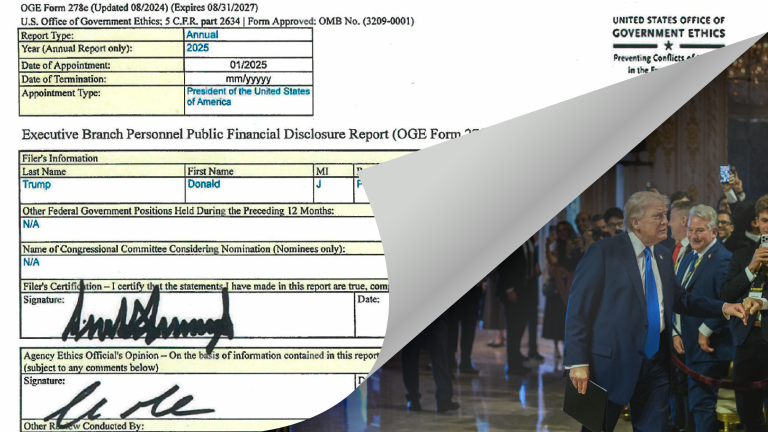
While President Trump is not subject to the criminal conflict of interest law, he is subject to the Ethics in Government Act, 5 U.S.C. 13101 et al., which subjects him to disclosure requirements regarding his assets and income, including his crypto assets. President Trump is expected to file his financial disclosure report by May 15, and more detailed information about the value of his crypto assets and income from those assets is expected to be disclosed.
Foreign Emoluments Clause
World Liberty Financial is expressly targeting foreign governments and their sovereign wealth funds to be USD1 customers. In particular, WLFI’s March 25 press release expressly states that it is “offering a digital dollar stablecoin that sovereign investors and major institutions can confidently integrate into their strategies for seamless, secure cross-border transactions.”
Soliciting sovereign investors to invest in USD1 is reminiscent of the efforts in President Trump’s first administration when the then Trump-owned Old Post Office Hotel sought business from foreign embassies for their “national day” parties raising possible violations of the Foreign Emoluments Clause. The Foreign Emoluments Clause bars persons holding an “Office of Profit or Trust” from accepting “any Present, Emolument, Office, or Title” from a foreign government. An emolument has been defined by one U.S. District Court as encompassing any “profit,” “gain,” or “advantage,” including those from private market-rate transactions. In the Trump Old Post Office Hotel scenario, journalists, government watchdogs and other members of the public were able to observe who was entering the hotel. In contrast, when dealing with Trump crypto assets, its customer base appears largely opaque except for those who voluntarily disclose that relationship.
Even though President Trump has a potential conflict of interest arising from the announcement of WLFI’s plans to target sovereign investors, there is no provision in the GENIUS Act that would bar the president from holding interests in stablecoins.
Weak Enforcement Program
Within a few months of taking office, the Trump Administration has taken measures that indicate that it is weakening enforcement of federal securities laws involving crypto and digital assets. Just a few months after Justin Sun invested in $WLFI tokens, the Securities and Exchange Commission (“SEC”) jointly sought to stay an enforcement case against him. In March 2023, Sun had been charged by the SEC with marketing unregistered securities and market manipulation through a scheme known as “wash trading”. The judge stayed the proceedings on February 27 based on a request submitted jointly by the SEC and Sun on February 26. The joint request for a stay in Sun’s case and recent efforts by the SEC to drop cases against Coinbase COIN.O, the largest U.S. cryptocurrency exchange, and possibly Kraken, one of the world’s largest cryptocurrency exchanges, signal that the Commission under the Trump Administration would be taking a much more friendly view towards treating digital assets.
That view was reinforced when President Trump nominated Paul Atkins as SEC Chairman. Atkins is an experienced former SEC commissioner who more recently has represented the crypto industry, and who is expected to shift the agency toward a more industry friendly posture. A complicating factor is that some courts have questioned whether specific crypto assets are securities, casting doubt on the agency’s jurisdiction and raising the critical question of which federal agency, if not the SEC, will regulate crypto.
In connection with an anti-money laundering enforcement matter, President Trump recently pardoned cryptocurrency exchange BitMEX, which had entered a guilty plea last summer for violating the Bank Secrecy Act because it lacked a “meaningful anti-money laundering program”. The absence of a meaningful anti-money laundering program had opened BitMEX up to being a “vehicle for large-scaled money laundering and sanctions evasion schemes.” In addition to BitMEX, President Trump’s pardon covered its co-founders.
The Wall Street Journal is reporting that representatives of Binance, another of the world’s largest cryptocurrency exchanges, met in March 2025 with Treasury officials in an effort to remove independent monitors that were imposed as part of the company’s plea agreement with the Justice Department for anti-money laundering violations. Binance also agreed to pay $4.3 billion in financial penalties as part of the plea agreement. When the plea agreement was announced, a DOJ official stated that, “Binance’s crimes gave sanctioned customers unfettered access to American capital and financial service.” The Wall Street Journal is also reporting that Binance is seeking a pardon for its founder Changpeng Zhao who pleaded guilty to related charges and is in talks with members of the Trump family about the possibility of the Trump family taking a stake in Binance and listing World Liberty Financial’s stablecoin on its exchange, which if it materializes could prove lucrative for WLFI given the size of Binance’s market share.
Conclusion
President Trump’s recent foray into crypto assets has allowed him to substantially increase his wealth in a relatively short period of time. Trump will likely profit more from them in the future now that one of the companies he is affiliated with has added a new stablecoin to its portfolio. Unlike other executive branch employees, he is not subject to the primary criminal conflict of interest law, which has allowed him to adopt regulatory policies that favor private sector stablecoins like those offered by WLFI. Trump’s less aggressive stance towards the regulation and enforcement of digital assets appears to have taken hold at the SEC even before the new SEC Chairman has been confirmed and with new leadership at the DOJ. The regulation of digital assets is in its nascency, but rather than divest his crypto assets to avoid any possible conflict of interest, President Trump seems to have positioned himself to maximize profiting from them by adopting a less aggressive regulatory and enforcement program than his predecessor. Congress has a unique opportunity to prevent President Trump and future presidents from using their public office for private gain by adopting legislation barring them and other elected officials from holding stablecoins and other digital assets.