
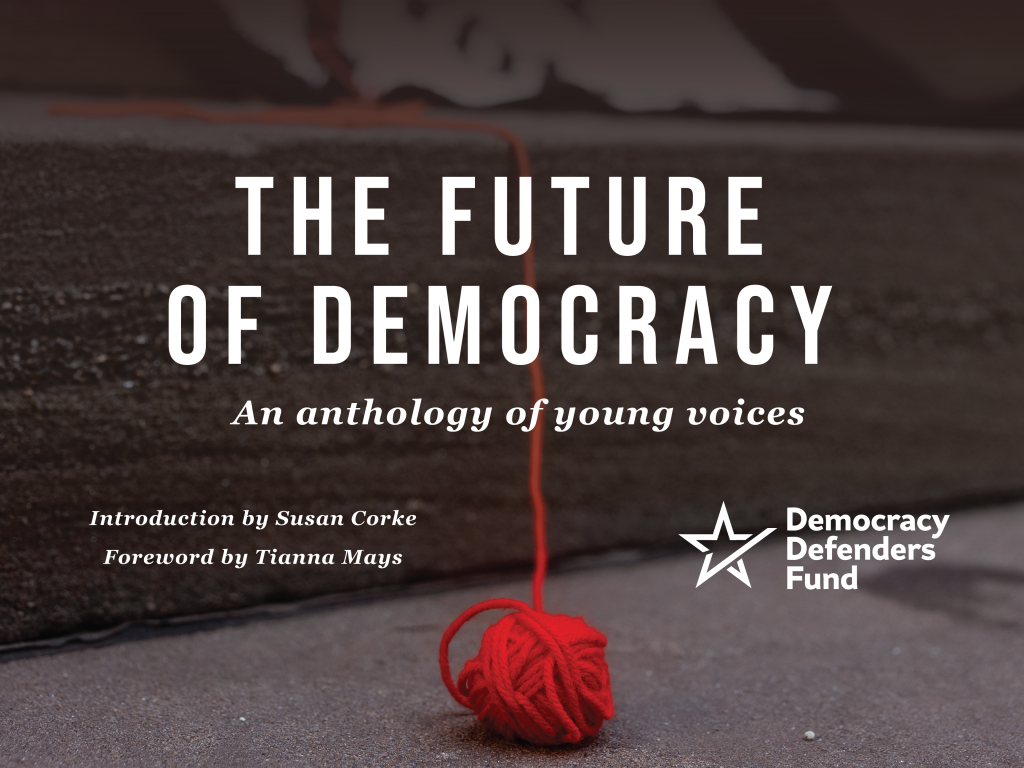
The Future of Democracy
A national anthology of young voices

The Future of Democracy Prize is a national competition designed to elevate the voices of the next generation at a pivotal moment for democratic governance. Eleven winners between the ages of 18 to 30 were selected from states across the country for their bold ideas in response to a defining question: What will it take for U.S. democracy not only to survive, but to thrive?
Introduction by Susan Corke
We are living through a moment that has forced us to confront an old question with new urgency: Can American democracy survive?
This much is true: our democracy will not be saved by strongly worded criticisms, viral videos, news clips, frustrated screeds from public figures, or even court decisions alone. It will thrive only when people decide, again and again, that our democracy belongs to us, our leaders are elected by us, and that we are responsible for building and defending it. That conviction runs through every work in this anthology.

In response to the question, “What will it take for democracy not only to survive but to thrive in the future?” the winners of Democracy Defenders Fund’s Future of Democracy Prize offer answers grounded in community, racial justice, imagination, and policy reform. They write with a clear-eyed understanding that democracy is built from the bottom up and that systems failing ordinary people must be challenged and changed. From their vantage point, democracy must be practiced, defended, and renewed everywhere: in neighborhoods and schools, public offices and places of worship, through art and organizing, and in the everyday acts of solidarity that bind communities together.
When we launched this prize, we placed only two requirements on entrants—age and U.S. citizenship. We spread the word through influencers, college newspapers, local libraries, social media, and in small towns and big cities, hoping to hear from people whose experiences and perspectives might not otherwise find their way into a national conversation about democracy. What we received was deeply encouraging. The winning works—nine essays, a short film, and a cross-stitch project—describe democracy as something people experience, shape, and build where they live. That gave me hope. Because their words are hopeful.
Before coming to Democracy Defenders Fund, I spent most of my career defending democracy in countries where people had learned not to expect institutions or their (mostly) authoritarian leaders to save them. In Ukraine, Russia, Central Asia, Turkey, Hungary, and Poland, I watched citizens fight back with whatever tools they had: independent newspapers, coalitions, protests, art and music, and community networks. They built power where they stood, with whatever space they had, and they refused to let authoritarianism go unchallenged. At times that came with great personal risk.
What makes the United States different—and what gives me genuine optimism—is our long history of building democracy and the hard won successes. We have checks and balances in America. Even now, we have institutions capable of withstanding enormous pressure. But history teaches us that those institutions do not hold on their own. They hold only when people act to defend them. When people respect the norms and values they represent.
The young people whose work appears in this anthology, too, approach democracy from the latter vantage point. They define democracy as a sense of whether people feel it belongs to them and whether they believe their own voices can make a difference. That perspective is precisely why we created this project.
Protecting the constitutional right to birthright citizenship, for example, required people to immediately speak out, organize, and challenge the Trump administration in the court of law. The Supreme Court ultimately provided the essential check, but it could do so only because people—supported by attorneys from the ACLU, Democracy Defenders Fund, and other organizations—were willing to bring the fight to the courts. And were willing to share their stories so that people understood what was at stake.
At Democracy Defenders Fund, we approach the business of defending our democracy through the courts, legislatures, other levers of public power, and in the court of public opinion.
The young people whose work appears in this anthology, too, approach democracy from the latter vantage point. They define democracy as a sense of whether people feel it belongs to them and whether they believe their own voices can make a difference. That perspective is precisely why we created this project.
Democracy is stronger when people feel that their voices matter between elections, not only on Election Day. People being civically engaged is what makes democracy work and sustains the entire democratic enterprise.
Democracy Defenders Fund will continue to fight in courtrooms to protect voting rights and elections, to counter corruption, and to uphold the rule of law. Our work ensures that now and in the future, the public can act, organize, dissent, imagine, build, and simply be. Every success for us or the broader pro-democracy movement creates the conditions in which new leaders, new movements, and new visions can take root and ultimately thrive .
We intend to ensure that when these young people take the reins of power—with all the passion and imagination they possess—they can do so in a country where the rules still permit them to build and work toward a democracy that will make their lives better.
That is what makes this project so important to me. The work in this anthology reminds us that defending democracy is not simply about preventing what is worst. It is also about making possible what comes next, what is better. The Civil Rights Movement made us better, but it did not make us perfect. Democracy is a journey not a destination. I hope you read these essays with the same humility, urgency, and hope they inspired in us, and with a renewed commitment to the work ahead in the courts, in our communities, in the streets, and everywhere democracy is being made.
Foreword by Tianna Mays
Growing up in West Virginia, I understood from an early age what it means to hold a shared belief in the American dream. My mother is a pipefitter. My great-grandfather mined coal. Our family carries the pride of Appalachia and pride for a country we believe is ours to hold accountable.
That belief led me first to public defense, where I represented people whom the legal system was not built to hear. Now, as legal director of Democracy Defenders Fund, I bring that same commitment to an organization whose mission is grounded in the belief that our institutions were built to serve We the People, and that our democratic ideals are worth fighting for. We work to ensure free and fair elections, uphold the rule of law, and fight corruption.

Our work comes at a moment when the basic promises of American democracy feel less certain than they have in decades. Rights once understood as settled are being challenged by the very people entrusted with political power. Public institutions are being tested, facts are increasingly contested, and many Americans no longer trust the systems meant to represent them.
Defending those systems requires more than resisting current threats. It also requires imagining the democracy we want to build for the future. That is why we announced our first Future of Democracy Prize, inviting people between the ages of 18 and 30 to answer a question that is both urgent and expansive: What will it take for democracy not only to survive, but to thrive?
We wanted to hear from a generation coming of age during a period of extraordinary democratic uncertainty. The winning submissions take many forms: nine essays, a documentary, and a cross-stitch. But the ideas behind them are grounded in a shared conviction that democracy is not something that happens only in Washington, only during an election, or only when a case reaches the Supreme Court. Democracy is where people experience their lives together. For it to survive and thrive, people must have the power to shape the communities and institutions that shape their lives.
For Sharjah M’Bodji, democracy is found on Harlem stoops and at neighborhood block parties, places that can disappear when communities are displaced. For Jaylen Tang, it means giving young people meaningful opportunities to participate between elections, not simply asking for their votes on Election Day. For Carolina Nazario, it means protecting the local election officials who make the right to vote real, even as threats drive many of them from public service. For Thomas Hassen, it means turning to grassroots organized labor to fuel the engine of democratic change.
These contributors remind us that democracy is a neighborhood, a constituent office, a polling place, a classroom, and a union hall. It is the chance to be heard before decisions are made, and the ability to work with others to change what is possible.
Several of the pieces ask what democracy requires before public debate can begin. Imre Huss considers how new forms of communication have reshaped civic life, while Jonathan Cavazos writes about the erosion of a shared factual foundation as local news outlets disappear. Imani Laird’s documentary, Civics Class for a Country in Crisis, looks to the democratic achievements Americans are in danger of forgetting. Gillian Gurney turns to protest music—from Billie Holiday to Marvin Gaye—to explore democracy’s enduring demand that we question what we have been promised.
Other contributors focus on the work of repair. JJ Briscoe writes, “What we fail to repair, we repeat.” Christopher Watts imagines democracy as a house being quietly dismantled by voter suppression, historical erasure, and the rollback of inclusion. Rosie Shultz offers a different kind of argument: an “I Voted” sticker stitched carefully in thread, one small act of restoration carried out one stitch at a time.
Taken together, these works reject the idea that democracy can be preserved by institutions alone. They place our institutions within a larger democratic project. Courts and laws are essential to protecting rights and establishing accountability. But democratic power also depends on people: on communities, relationships, participation, and the persistent work of showing up for one another.
These contributors remind us that democracy is a neighborhood, a constituent office, a polling place, a classroom, and a union hall. It is the chance to be heard before decisions are made, and the ability to work with others to change what is possible.
I teach a civil rights seminar at Howard University, and every semester my students remind me how unfinished the work of building a more perfect union is. They are quick to challenge assumptions that older generations have learned to accept. They understand that rights are not permanently secured simply because someone once won them. Each generation must decide whether to defend those rights, expand them, and make them real for people who have been excluded from them.
Much has been written about this moment. Scholars, journalists, and historians have drawn comparisons between what is happening in the United States and the rise (and fall) of authoritarian regimes in Europe. At Democracy Defenders Fund, we have successfully used litigation to ensure the courts hold the line on some of the most pressing issues of the day. We have also seen how legal institutions can enable, or fail to prevent, policies that undermine democratic norms. But the courts cannot carry the full weight of democracy.
One truth still holds. We the people have the power to determine the future of this nation. That power is exercised by voting. It is built through collective action, sustained relationships, shared purpose, and the decision to keep showing up.
The future of democracy is being decided now. The contributors to this anthology show us not only what is at stake, but where our power lies and how democracy can be strengthened through community, accountability, memory, imagination, and persistence.
Winning Essays
-

The Shared Record: What Democracy Can’t Survive Without
While democracy can withstand disagreement, it cannot function without a verifiable record of events that people can examine and contest. Reestablishing that baseline requires four concrete measures: funding for local journalism, transparency in platform ranking, verification skills in education, and labeling of synthetic media.
-
The Courts Won’t Save Us. Organized Labor Just Might.
In the last five years, the Court has erased generations of societal progress. Case after case, it has upended once-settled legal doctrine and stripped Americans of rights they assumed were permanent.
-
Making Media Work for Democracy: Lessons from the Past, a Vision for Our Future
Our democratic system is experiencing extreme strain. The checks and balances that have long defined our government are eroding, partisan polarization is increasing, and policymakers are failing to meet voters’ needs. In a Pew Research Center survey, 69 percent of Americans expressed dissatisfaction with the way democracy is working in the United States.
-

Civics Class for a Country in Crisis
"Civics Class for a Country in Crisis" is an exploration into American democracy and the current state of civics education. Young documentarian Imani Laird warns Americans are forgetting the many successes of our democracy—and in turn, they are failing to preserve it.
-

Cracks in the Foundation
Imagine standing before a house that has sheltered multigenerational families. At first glance, it appears intact. The roof still stands and the windows catch the morning light. But behind the door, a system is quietly, methodically removing every brick, chiseling names off the mantle, burning the blueprint, leaving the labor unacknowledged. The house still stands, but cracks in the walls are spreading and its collapse has begun.
-

I Am Because We Are
Democracy only thrives when we work together to continue expanding its promise. The work is not to preserve institutions as they are, but to fulfill the democratic ideals they have yet to realize.
-

The 80% Problem: How Women in Civic Life Are Overworked and Unsafe
A heightened risk of violence extends beyond women who are on the ballot to women who make sure our elections are safe, secure, and functioning so people like you and me can show up and vote. Eighty percent of local election officials are women, and they are disproportionately targeted with harassment and political violence.
-
What We Fail to Repair, We Repeat
The United States has spent 250 years asking the same unresolved questions: who belongs, who governs, and whose humanity deserves protection under the law?
-

Democracy Dies Without Questions
Democracy's strength doesn't lie in consensus. It lies in a culture of continuous questioning. Critique, dissent, and creative reimagining are the embodiment of democracy. When we lose our ability to creatively express ourselves or speak out, democracy itself is at risk.
-
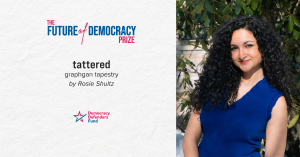
tattered
During the semiquincentennial, we are called to recognize the violent, bloody suppression of the right to vote, both throughout history and in the present day. To craft a thriving American democracy, we must stitch together a democratic system that expands and protects voter access for all.
-

Democracy Will Thrive When Young People Are Actively Encouraged to Participate
For American democracy to do more than survive—to truly thrive—it has to stop treating young people as future citizens and start treating us as partners in self-government.
Meet the Winners
About the Contest
The Future of Democracy Prize is nonpartisan and was open to participants across the country and across the ideological spectrum. The goal is not partisan advocacy, but serious engagement with one of the most important questions facing the nation’s future.
Finalists received a $1,000 honorarium, and selected works are published in a professionally produced anthology with a introduction and foreword by Democracy Defenders Fund Executive Director Susan Corke and Legal Director Tianna Mays.
Participants were encouraged to offer bold, thoughtful, and creative ideas for strengthening democratic resilience in the decades to come. Submissions drew on lessons from American history, democratic struggles abroad, civic innovation, and cultural imagination.
Recognizing that democracy is shaped not only in institutions but also through culture and storytelling, the contest accepted a wide range of formats, including:
- Essays
- Visual art
- Digital design
- Video
- Multimedia and other creative formats
Meet the Judges
Submissions to The Future of Democracy Prize were evaluated by an esteemed panel of leaders from law, journalism, civic advocacy, and public service. Together, the judges bring deep experience defending democratic institutions, strengthening civic engagement, and advancing public accountability.
The panel reviews submissions based on originality, clarity of vision, relevance to the contest prompt, and overall potential impact.

Senior Policy Counsel,
Democracy Defenders Fund

Program Associate,
The Contrarian
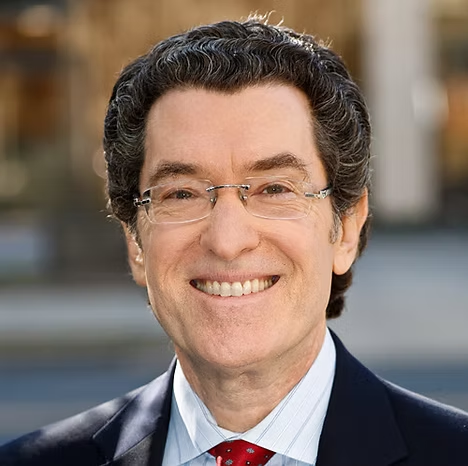
Executive Chair,
Democracy Defenders Fund
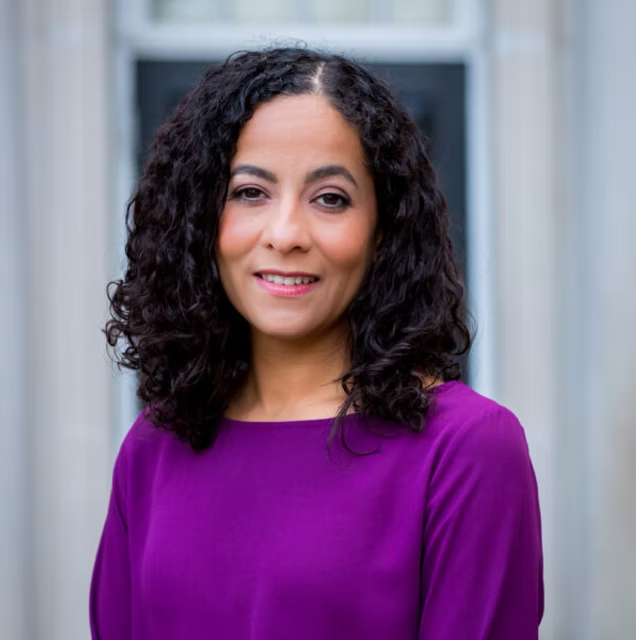
Board Member,
Democracy Defenders Fund
Senior Fellow, Just Security

Legal Analyst and Independent Journalist