The Family Legacy
Conflicts of Interest and Profiting from the Presidency
The American people deserve a government that serves the public interest, not one in which those entrusted with public office can use it to enrich themselves. This report documents the scope of the problem and offers lawmakers the beginnings of a roadmap to address it.
Introduction
When Donald Trump ran for president for the first time in 2016, he broke with decades of political precedent: He became the first major-party presidential candidate since 1976 to refuse to release complete tax returns, and the first modern president to decline to voluntarily separate his personal business assets from the powers of the presidency before taking office. Trump cited an ongoing IRS audit as his reason for withholding his returns and said he would turn day-to-day management of the Trump Organization over to his two oldest sons. But he established no verifiable mechanism to separate his personal financial interests from his presidential duties. That breach of longstanding norms set the stage for the absence of any meaningful financial firewall between the presidency and the Trump family’s private business interests, a condition that has persisted through his second term.
The scale of the family’s financial gains during Trump’s second term is difficult to overstate. Trump reported more than $2 billion in income in 2025, including $1.4 billion from cryptocurrency ventures alone. Collectively, the President and his family earned an estimated $4 billion last year. Since the 2024 election, family members have launched, joined, or invested in at least 40 business ventures spanning defense contracting, cryptocurrency, real estate licensing, and consumer goods.1 Many of those businesses have benefited from federal contracts, foreign investment, or favorable regulatory treatment, raising serious questions about the intersection of presidential power and private profit. In President Trump’s own words, “Almost anything they do, if [my sons] want to buy a truck… if they buy an energy efficient truck, they have inside information.”
The documented conflicts are striking in both their scope and their brazenness. They include Pentagon contracts, foreign investments, and favorable regulatory decisions that benefit Trump family businesses. Taken together, the evidence points to a President and his family leveraging presidential power and access to generate extraordinary private wealth, often in industries where they have little or no prior experience and with apparent cooperation from federal agencies. These conflicts reflect a breakdown in the safeguards meant to prevent public office from becoming a vehicle for private enrichment, underscoring the urgent need for stronger legislative and regulatory protections.
The report is organized in three parts. Part 1 examines joint family ventures, principally the Trump Organization and World Liberty Financial. Part 2 examines the individual business ventures of Donald Jr., Eric, Jared Kushner and Ivanka, Barron, and Melania. Part 3 presents recommendations for reform, identifying gaps in federal ethics laws exposed by the Trump family’s conduct and proposing specific statutory and regulatory solutions.
The American people deserve a government that serves the public interest, not one in which those entrusted with public office can use it to enrich themselves. This report documents the scope of the problem and offers lawmakers the beginnings of a roadmap to address it.
Part 1: Joint Trump Family Ventures
President Trump’s family operates a vast empire of businesses primarily consisting of Limited Liability Corporations (LLCs). At the center of this empire stands the Trump Organization and its web of related companies through which the President and his family are invested in legacy business lines, including real estate, hotels, golf courses, and licensing agreements.
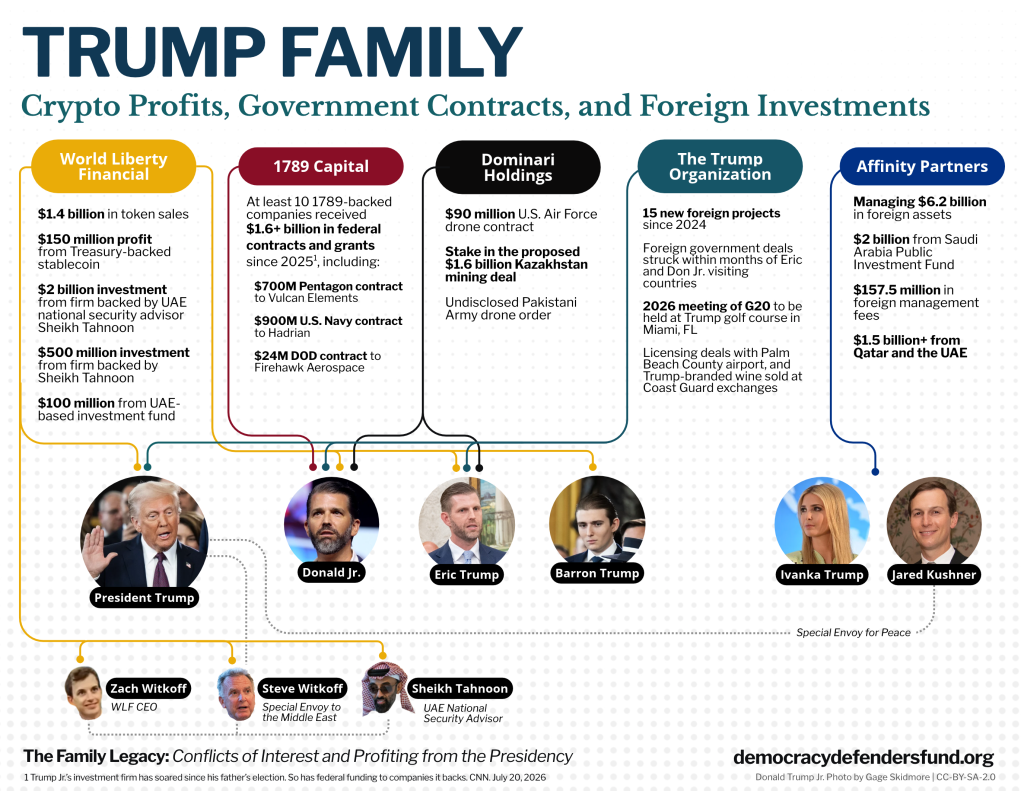
The Trump family enterprise’s newest crown jewel, however, is its World Liberty Financial crypto business, co-founded just before the 2024 presidential election by President Trump and his sons Donald Jr., Eric, and Barron, along with President Trump’s now senior White House advisor Steve Witkoff and his two sons. Despite its short existence, World Liberty Financial has generated an estimated $1.4 billion in revenue as of June 2026.
Collectively, the Trump Organization and World Liberty Financial businesses are estimated to have brought in billions of dollars for President Trump and his family last year. Donald Jr. and Eric Trump hold prominent roles within both businesses. Donald Jr. and Eric are both executive vice presidents of the Trump Organization, and are both co-founders and “Web3 Ambassadors” of WLF, as is Barron.
Donald Jr. and Eric are also investors and board members in various other businesses, both together and individually. Most prominently, they are investors and on the board of advisors for Dominari Holdings, a private investment fund that backs companies like Powerus, Kaz Resources, Tron, and American Ventures, as detailed below.
Before taking office, the Trump Organization acknowledged and attempted to address some of the conflicts of interest that could arise from the Trump presidency by issuing an ethics agreement on January 10, 2025.2 The organization agreed it would “not enter into any new material transactions or contracts with a foreign government, except for Ordinary Course Transactions.”3 It also agreed to donate to the U.S. Treasury all profits from foreign governments that patronize its hotels and similar businesses. But the agreement made no mention of the adult children’s financial interests or the family’s new crypto business.
Despite the Trump family’s acknowledgment that foreign business deals could create possible conflicts of interest, the brothers have been exceedingly bullish on overseas business deals during the second term. The Democratic staff of the House Committee on Oversight and Government Reform estimate that President Trump and his family profited around $2.25 billion from “foreign payments, corrupt oligarchs, and others,” as of January 2026, with over $600 million in digital assets from foreign interests. Eric told The New York Times in 2024, “The first term we did everything imaginable to avoid any appearance of impropriety, and frankly, we got crushed anyway…We can’t just sit out in perpetuity, and I won’t.”
The Trump Organization
Trump Family Role

President Trump
Donald Trump, Jr.
Photo: Gage Skidmore, CC-BY-SA-2.0

Eric Trump
Since 2017, Donald Jr. and Eric have served as executive vice presidents of the Trump Organization. Most, if not all, of the Trump Organization is held in trust by the Donald J. Trump Revocable Trust. According to Forbes, the Revocable Trust holds “virtually every … asset in Donald Trump’s empire.” While President Trump is the sole beneficiary of the Donald J. Trump Revocable Trust, Donald Jr. serves as its trustee, and Donald Jr. and Eric each hold smaller individual equity interests in many of the underlying Trump Organization LLCs, including the newly created crypto business World Liberty Financial.
Tracking the Money: The Trump Organization is the primary vehicle for the family’s hotel, golf, and real estate development projects. Statistics from President Trump’s annual financial disclosure suggest that a handful of the Trump Organization’s subsidiaries raked in a minimum of over one billion dollars in 2025.4 According to Forbes, Eric and Donald Jr.’s shares of the real estate licensing business were each worth around $34 million in 2025. CNBC reports that the use of the Trump name on foreign properties has risen 71% since 2024, while Forbes states that the overall value of the international licensing business skyrocketed by 900% since 2023, and 30% since 2024. Some of the organization’s licensing deals abroad appear to directly benefit Eric and Donald Jr., including those in which they reportedly split 20% of the profits, netting each son estimates of over $3 million from new licensing deals alone in 2024. Because there are no public financial disclosure reporting requirements that apply to President Trump’s adult sons, more precise calculations of their asset values and revenue are not readily available.
Foreign Projects: The Trump Organization has announced 15 new commercial and residential real estate projects located overseas since Trump’s campaign for re-election, according to The Financial Times, with five more foreign projects in development listed on the President’s financial disclosure that have yet to be announced by the Trump Organization on its website.5 The Financial Times also tracks at least 18 times that Eric and Donald Jr. have met with foreign leaders since their father re-took office, noting that the brothers “often seem to be greeted as emissaries of the Trump Administration — despite the fact that neither man holds a formal government role.” Among these trips, Donald Jr. spoke at a business summit hosted by Saudi royals, met with the Hungarian foreign minister in Budapest, and reportedly took the inaugural flight on the Air Force One gift-plane from Qatar. A spokesperson for Donald Jr. said that he makes clear that he is not a government official when meeting with foreign officials. “Don is a private citizen and has the same First Amendment rights that any other law-abiding American has,” the spokesperson said. Eric also took international trips to discuss business interests, including golf courses and Trump real estate developments in Vietnam, Scotland, China, and across Qatar. Eric and Donald Jr.’s fraternization with foreign ministers represents apparent further amalgamation of personal business and political office.
While Donald Jr. and Eric were engaging in multiple overseas business deals for the Trump Organization, various negotiations were pending between the United States and the countries they visited, giving rise to pay-to-play concerns. The Trump Administration negotiated trade deals or commercial agreements, including partial relief from Trump’s sweeping tariffs, with Qatar, Vietnam, the UAE, Indonesia, China, South Korea, Saudi Arabia, and Scotland—all countries doing business with the Trump Organization. Six of these government deals were struck within four months of either Eric or Donald Jr. visiting these countries.6
Federal, State, and Local Government Deals: Trump has hosted several official events at his properties, and is planning to host the 2026 meeting of the G20 at Trump National Doral golf course in Miami, Florida. Although the White House stated that Trump Doral will host the event ‟at-cost, and will receive no profit from either the State Department or a foreign government,” there is no way to confirm this representation without an audit. Not only will the Trump Organization benefit from the prestige of hosting a G20 event at one of its properties, but they will likely experience increased sales driven by interest in the event, including through golf fees and sales of food, beverages, and keepsakes. Most importantly, unless they are excluded from Trump Doral, hosting the G20 at a family company property could present an opportunity for the Trump family to curry favor with representatives of those countries to promote their joint and individual businesses.
The organization, under the leadership of the Trump sons, has expanded its licensing and trademark operations domestically. The Palm Beach County Board of County Commissioners has entered into a licensing deal to rename its local airport the President Donald J. Trump International Airport. The deal was signed by the President himself and Donald Jr. as President of DTTM Operations LLC, which manages licensing arrangements and intellectual property for the Trump Organization. The Guardian reports that DTTM will be able to approve vending, manufacturing, and supply for branded merchandise at the branded airport, and sell its airport-branded merchandise on the organization’s website alongside its hundreds of candles, baseball hats, and wine tumblers already bearing the family name.
In November of 2025 it was reported that Trump-branded wine was being sold at Coast Guard exchanges. The Oval Office, the physical embodiment of the President’s formal responsibilities, is fully decked-out in official Trump merchandise, including baseball caps advertising an unconstitutional third presidential term, which former Speaker of the House Kevin McCarthy coined “a gift shop.” This all suggests that the President and his family view the federal government as a platform to feature properties and products of the Trump Organization.
The Trump Organization under the leadership of Donald Jr. and Eric has used the President’s name and their access to the presidency for personal gain in countless instances. Throughout their father’s term, Donald Jr. and Eric—employing the organization’s convoluted web of affiliated subsidiaries—have shamelessly overseen the expansion of real estate developments, trademark deals, licensing agreements, and merchandise branding in the family name.
World Liberty Financial
World Liberty Financial (WLF), the Trump family’s prime cryptocurrency venture, was founded by President Trump, his three sons, and members of the Witkoff family.
Trump and Witkoff Family Roles
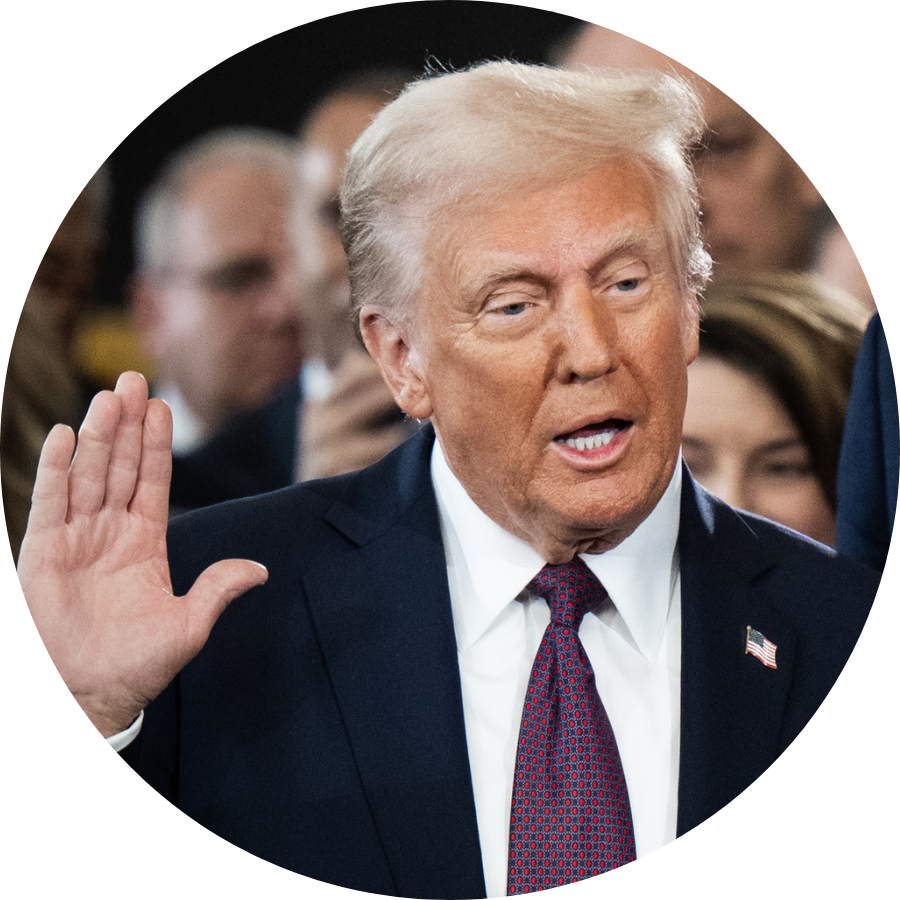
President Trump
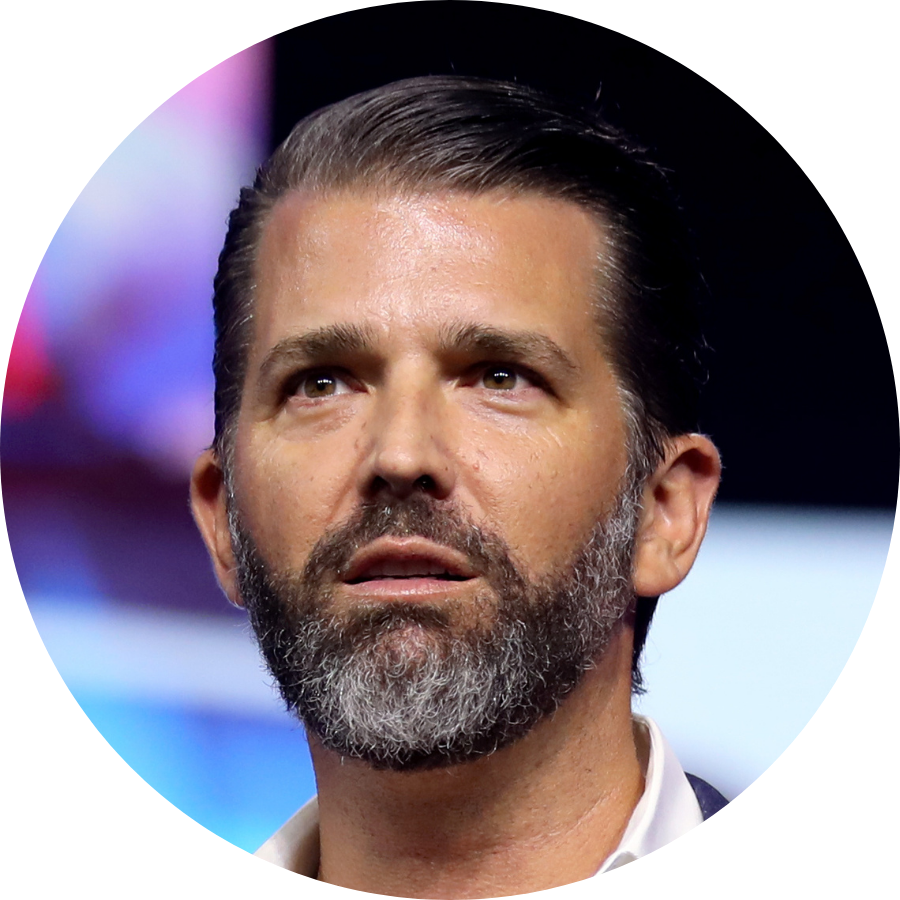
Donald Trump, Jr.
Photo: Gage Skidmore, CC-BY-SA-2.0
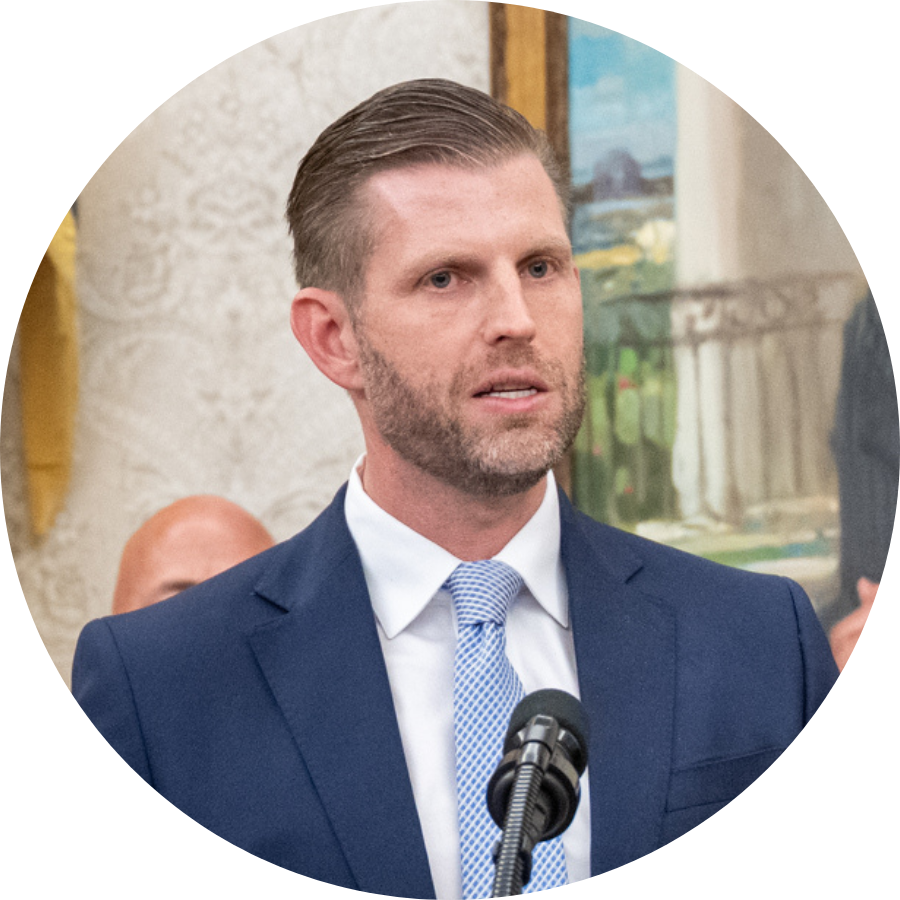
Eric Trump
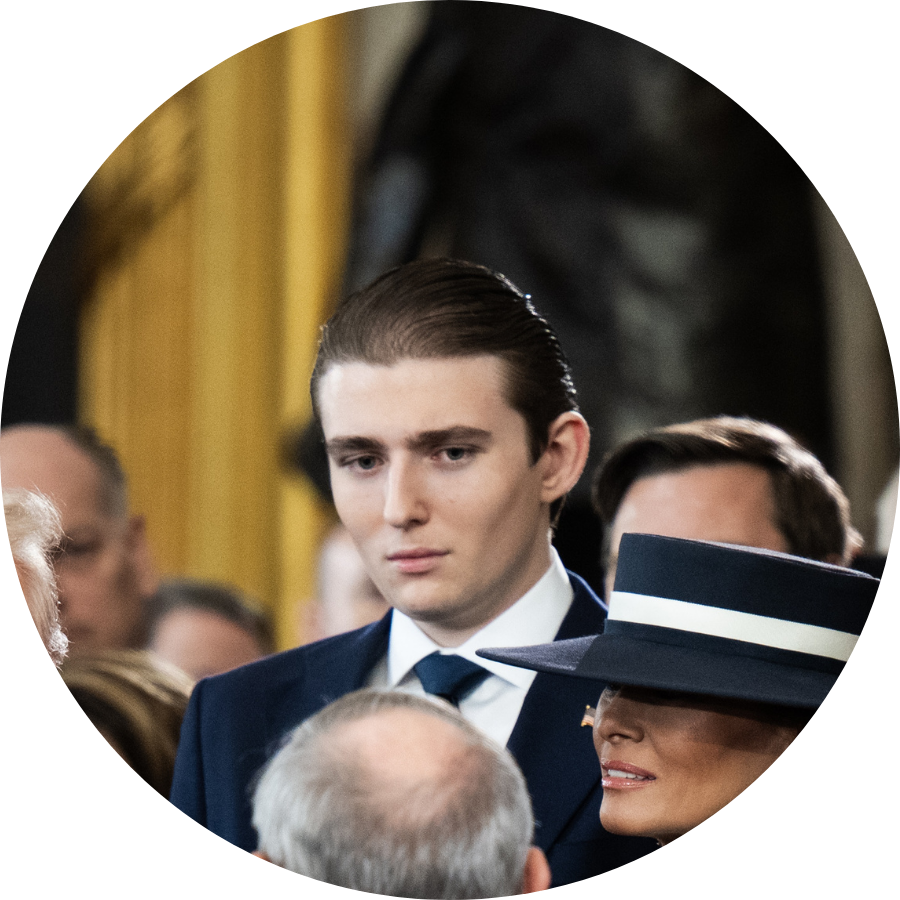
Barron Trump
President Trump, Donald Jr., Eric, and Barron are all co-founders, as are Steve Witkoff’s sons, Zach and Alex Witkoff. President Trump and Steve Witkoff, who subsequently joined the Trump White House as a special envoy, are now each listed as a “Co-founder Emeritus.” Eric and Donald Jr. have been key promoters of WLF, including in international business ventures, while Zach Witkoff has taken over as CEO, though the platform is reportedly not “owned, managed, operated, or sold” by members of the Trump family. At 20, Barron Trump seems to have played a key role in the development of WLF. Vanity Fair reported that Barron was the first in the family to embrace crypto and helped persuade his father to enter the space—a claim the President has echoed, joking at the launch that his son owns “four wallets or something” and knows the subject thoroughly. However, Barron’s role seems less visible than his brothers since there is less public reporting that would indicate he has been actively negotiating WLF transactions, signing agreements, or participating in the governance decisions.
Tracking the Money: The total value of the Trump family’s World Liberty Financial holdings is estimated to be $2.6 billion, according to Bloomberg. The family has made over $1.4 billion in proceeds from WLF token sales, including the Alt5 purchase, according to Reuters estimates. Separately, the President’s disclosure reports $1.4 billion from total crypto income for 20257, including more than $800 million from $WLFI token sales and sale of interest. WLF’s stablecoin business, USD1, was valued at roughly $1.7 billion, with the Trump family owning a $630 million stake, Bloomberg estimates. Each son’s stake in WLF was estimated to be worth at least $133 million in December 2025. While Trump’s 2026 financial disclosure revealed more than $550 million in revenue from $WLFI token sales and $260 million from sales of interests, a Reuters investigation revealed that massive WLF profits for the Trump family came alongside steep losses of up to $2.3 billion for investors in the company.
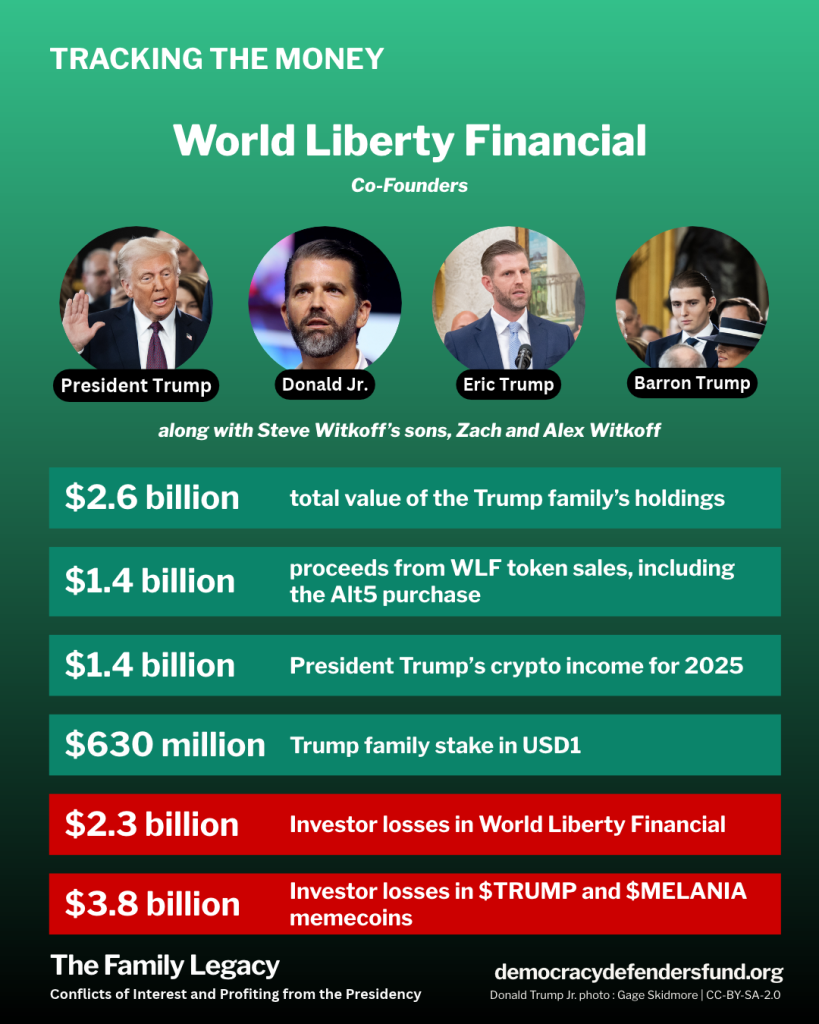
The company sells a governance token, $WLFI, that nets 75% of the proceeds to the Trump family through DT Marks DEFI LLC—of which President Trump owns 70% through the revocable trust and his family holds the remaining 30%.8 The Trump family cumulatively owns 22.5 billion $WLFI tokens, and the President himself owns 15.75 billion of these tokens, according to his financial disclosure. Forbes assumes that the three sons split a 22% stake, though this may have since been reduced. They estimate that a 7% share in token sale proceeds was worth $80 million in December of 2025, in addition to around $34 million in token stockpile value and $19 million in stablecoin in WLF’s first year. Of course, precise values are difficult to calculate due to the lack of public financial reporting requirements for adult children of the President.
Another World Liberty Financial business is the USD1 stablecoin—which is backed 1:1 by the U.S. dollar in cash or cash equivalents. USD1 sale proceeds are shared among the family, with Bloomberg estimating that they will earn around $150 million this year from stablecoin issuance.
As shown below, a company affiliated with World Liberty Financial recently received conditional approval from a federal banking regulator to organize a new national trust bank that will take over the USD1 issuance and custodial responsibilities previously held exclusively by BitGo Trust Company.9
Sheikh Tahnoon and Other Foreign Investors: In May of 2025, CEO Zach Witkoff announced that investment firm MGX, which is backed by UAE national security advisor and Royal Emirati family member, Sheikh Tahnoon bin Zayed al Nahyan, would purchase $2 billion in USD1 stablecoin, a form of digital currency that World Liberty Financial launched only a few weeks earlier, to close an equity deal with crypto exchange Binance. MGX’s funding provided external validation and the seed money for USD1, making it, in just a few short months, the world’s fifth largest stablecoin. Shortly thereafter, WLF was in talks with Pakistan, Malaysia and Kyrgyzstan over deals involving USD1.
March 2025
President Trump hosts Sheikh Tahnoon bin Zayed al Nahyan, UAE Security Advisor and Royal Emirati family member, at the White House.

May
2025
World Liberty Financial CEO Zach Witkoff announces MGX, backed by Sheikh Tahnoon, will purchase $2 billion in the company’s USD1 stablecoin.
Shortly thereafter, WLF is in talks with Pakistan, Malaysia and Kyrgyzstan over deals involving USD1.
January
2026
World Liberty Financial signs MOU with Pakistan to integrate USD1 into the country’s regulated payments.
In addition to MGX, UAE Sheikh Tahnoon is reportedly the backer of Aryam Investment 1, which made a $500 million secret investment in World Liberty Financial in January 2025 in exchange for a 49% equity interest in World Liberty Financial, netting the family entities $263 million, shortly before President Trump’s second inauguration. More recently, StringZ Holding RSC, another Sheikh Tahnoon-backed investment fund, obtained a 49% stake in another company closely affiliated with World Liberty Financial. As reported by The Wall Street Journal, Sheikh Tahnoon invested in WLTC Holding through StringZ Holding RSC, which was created in Abu Dhabi in April 2025.
In addition to the Trump family, Sheikh Tahnoon appears to maintain a relationship with WLF Co-founder Emeritus and Middle East Envoy Steve Witkoff; the two reportedly met in September 2026 to discuss issues of national security. Witkoff reaped more than $100 million from World Liberty Financial last year, according to his financial disclosure.
Given Sheikh Tahnoon’s UAE royal status and his national security role, his investments in businesses backed by the Trump and Witkoff families raise questions about the potential impact on U.S. foreign policy. A White House spokesperson told The Wall Street Journal, “there are no conflicts of interest.” A spokesperson for WLF said neither Trump nor Witkoff had any involvement in the Aryam investment and that they have not been involved in the company since President Trump’s second term started. The spokesperson told The Wall Street Journal, “we operate by the same rules and regulations as any other company in our space.”
Other foreign investors in WLF include Chinese businessman Bobby Zhou. In June of 2025, WLF received a $100 million investment from a little-known, UAE-based investment fund, Aqua 1 Foundation, prompting articles questioning the existence and pointing out the mysterious nature of the backer. More than a year later, a New York Times investigation reported that Bobby Zhou facilitated the Aqua 1 investment. Zhou is a businessman who has been investigated for money laundering in Britain, and who remained under investigation by U.K. authorities at the time of The New York Times story. The New York Times reports that Zhou “seemed to be constantly asking for money from others” and “had a significant change in fortune just after his crypto company burned through $7.6 million” and “decamped” from London to the UAE in 2024. A digital asset crime expert told The New York Times that the combination of Zhou’s “red flags” should have prompted documentation in compliance with anti-money laundering laws. Approximately 75%—$75 million—of Zhou’s investment was distributed through DT Marks DEFI LLC. A WLF spokesperson said, “World Liberty maintains a compliance program that meets or exceeds industry standards.”
In the same month, Reuters reported that Hong Kong-based WorldClaw, an artificial-intelligence company with ties to the Chinese military and tech sphere, was using WLF’s stablecoin as payment. WorldClaw accepts USD1 stablecoin for its client-facing AI models, which the Trump family earns profit on due to increased circulation of the coin. According to the article, security experts have flagged the partnership for possible national security concerns, given that the AI company’s business model runs counter to the U.S.’s official stance on Chinese technology. A WLF spokesperson said, “major U.S. firms offer AI from Chinese as well as American tech companies,” and a White House spokesperson said that there were no conflicts of interest.
Favorable Government Action: World Liberty Trust Company, National Association
In August of 2026, the Office of the Comptroller of the Currency (OCC)—a federal banking regulator within the U.S. Department of the Treasury—conditionally approved a national trust bank charter for World Liberty Trust Company (WLTC). The charter allows WLTC to manage and hold digital assets directly for customers and to issue WLF’s USD1 stablecoin, which, as Reuters reports, “mak[es] it easier to court major institutional clients.”
WLTC is a wholly-owned subsidiary of WLTC Holdings LLC, and shares common ownership interests and executive leadership with World Liberty Financial. In particular, Zach Witkoff who serves as Co-founder and CEO of WLF, also heads WLTC as its President and Director. DT Marks SC LLC, in which President Trump holds a 70% interest, is a common owner of both WLF and WLTC. See 2026 public financial disclosure report (line 114 of Schedule 1 for part 2). As president of DT Marks SC LLC, Eric Trump committed to maintaining a “passive” investment in the new bank. However, President Trump, along with the other Trump family members who own the remaining 30% interest in DT Marks SC, will likely profit from WLTC’s new bank charter by virtue of DT Marks SC’s 38.25% ownership interest in WLTC. See 2026 public financial disclosure report (line 204 of schedule 1 of part 2). President Trump and his sons are expected to derive profits from an expected increase in USD1 circulation and from assuming responsibility for custody and issuance services for USD1.
Ethics experts have condemned OCC’s approval of the charter, citing concerns over a lack of impartiality given the President’s influence on the OCC. In particular, the President’s crypto venture is being regulated by his own appointee, OCC Comptroller Jonathan Gould, who also had authority over the bank charter application decision. Gould has been at the forefront of the push for crypto regulatory changes; he has been a staunch supporter of cryptocurrency, speaking at a blockchain Symposium in Wyoming in August where he declared “crypto is part of the business of banking.” A WLF spokesperson told CNN that the charter approval “will ensure “robust and permanent” regulatory supervision “that will outlast the Trump Administration,” and a White House spokesperson denied any conflicts of interest.
WLF – AI Financial Corp / Alt5 Sigma
Trump Family Role
President Trump
Donald Trump, Jr.
Photo: Gage Skidmore, CC-BY-SA-2.0
Eric Trump
Eric, Donald Jr. and Barron, and President Trump are all linked to AI Financial through World Liberty Financial. Eric is a former board observer and advisor of the company.
Tracking the Money: A deal between AI Financial (formerly known as Alt5 Sigma) and World Liberty Financial netted $500 million to the Trump Family. Forbes estimates that the deal netted $41 million to each Trump son.
In August 2025, Eric and Donald Jr. partnered with publicly traded financial technology company Alt5 Sigma. As reported by CNBC, Alt5 traded shares and stocks with World Liberty Financial in exchange for $750 million of $WLFI crypto tokens, selling $750 million in shares to investors at $7.50 a share. Alt5 received over 7 billion $WLFI tokens, worth $1.5 billion. Because the Trump family is entitled to 75% of the proceeds from World Liberty’s crypto token sales, the family directly gained about $500 million from this transaction.
Less than 10 months after Eric and Donald Jr.’s investment in Alt5 Sigma, the company warned investors that it may not be able to stay in business since the share price fell more than 90%. Alt5 Sigma subsequently changed its name to AI Financial Corporation, but its rebrand did not help increase interest. In November of 2025, Alt5 told investors that it faced being delisted by Nasdaq because it failed to file its quarterly report on time after a series of outside auditors were unable to complete the audit. In November, the original auditor resigned and was replaced by a second auditor, but in December, the second auditor’s license expired. By June of 2026, the share price of the company fell by more than 90%, putting Alt5 at risk of going out of business and being delisted by Nasdaq. A Trump Organization spokesperson told MSNOW, “Neither Eric nor Don have any involvement in ALT5, nor have any visibility to the company.”
In April 2026, Democracy Defenders Fund, in partnership with Platkin LLC, urged the Securities and Exchange Commission (SEC) to open an investigation into Alt5 Sigma for misrepresenting or withholding material compliance information in possible violation of federal and state securities laws. No record of an SEC investigation yet exists.
Dominari Holdings
Trump Family Role
Donald Trump, Jr.
Photo: Gage Skidmore, CC-BY-SA-2.0
Eric Trump
Eric Trump and Donald Jr. are advisors and investors.
Tracking the Money: In February 2025, Eric Trump and Donald Jr. joined the advisory board for Dominari Holdings, a firm focused on wealth management, investment banking, sales and trading through subsidiaries. Both brothers received 750,000 shares, reportedly worth $3 million at the time. They also paid $1 million for 216,138 shares and warrants to purchase 432,000 additional shares. In September 2026, SEC filings showed that both Eric and Donald Jr. each owned 1,398,414 shares in Dominari, worth approximately $1.1 million in November 2026.10 Following Donald Jr. and Eric’s sign-on, there was a 30% increase in stock value to around $11.90 per share, but the value of that publicly-traded stock has declined since then to $0.79 per share in November 2026.
According to the CEO of the firm, Kyle Wool, the company is looking to invest in opportunities related to artificial intelligence and data centers. Dominari announced a $13.5 million private placement offering, which Eric and Donald Jr. were involved with.
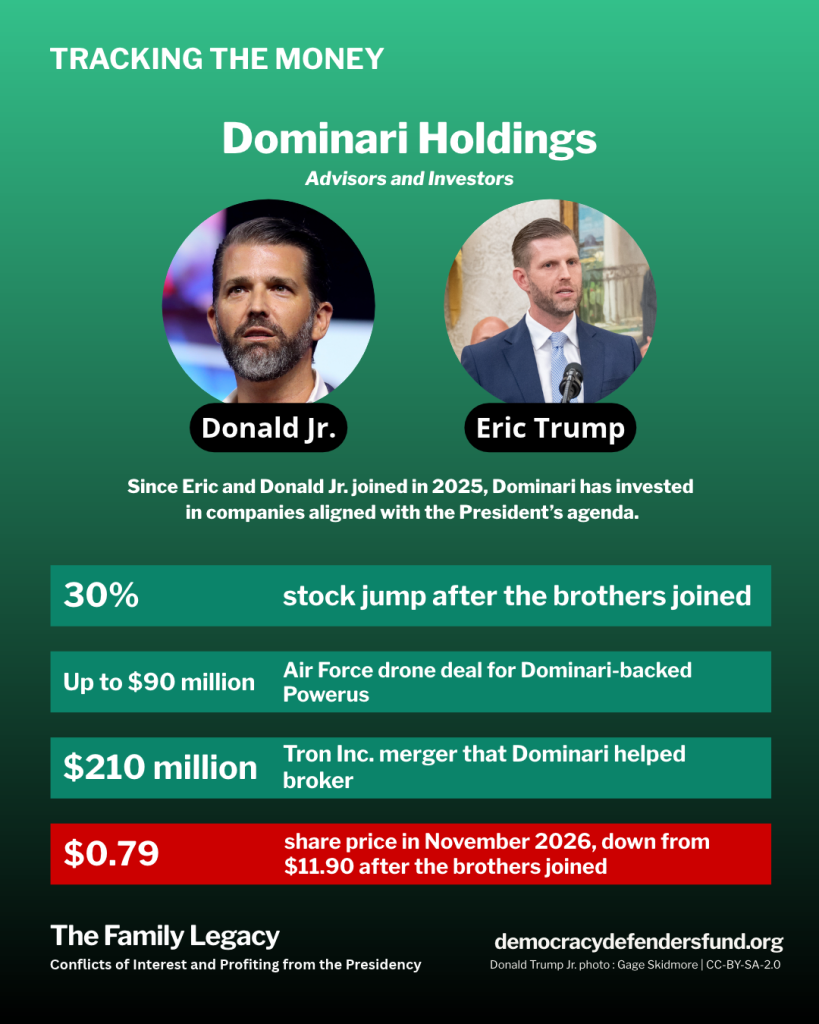
Dominari Holdings is the parent company of Dominari Securities, a boutique investment bank. Since the Trump brothers joined Dominari, “the firm launched an explicit effort to invest in companies aligned with the President’s agenda, ranging from military drones to critical minerals,” according to The New York Times. In pursuit of this mission, Dominari invested in drone manufacturer Powerus and critical minerals company Kaz Resources, which have both benefited substantially from newly-awarded federal contracts or federal financing raising significant profiteering concerns given their extraordinary access to presidential power through their father.
Trump Family Role: Donald Jr. and Eric Trump are both investors.
Tracking the money: Powerus’ subsidiary was awarded a drone contract with the U.S. Air Force for up to $90 million. Powerus was also given a spot in the $1.1 billion military drone initiative and sold an undisclosed number of interceptor drones to the Air Force, potentially netting profits to Donald Jr. and Eric.
In March 2026, drone manufacturer Powerus announced a reverse merger with a publicly traded golf course company linked to Eric and Donald Jr. called Aureus Greenway Holdings. Unusual Machines, Dominari Securities, and American Ventures, of which the Trump sons are board members and/or advisors, invested in the merger.
In April 2026, around the 60-day mark of President Trump’s war with Iran, the U.S. Air Force agreed to purchase some of its drone supply from Powerus, although the number of drones purchased was not disclosed. Powerus Co-founder Brett Velicovich denied a conflict of interest, stating, “They’re not going to pick a system because of who’s on an investor list. They’re picking because they need it now.” The same month, Powerus was reportedly looking to sell drone interceptors to countries under attack from the Iran war.
In August 2026, Powerus’ wholly owned subsidiary Tandem Defense LLC was awarded a contract of up to $90 million selling drones to the U.S. Air Force. The following month, they signed an MOU with the Pakistani Army for a drone order. The value was undisclosed, and spokespersons for both Donald Jr. and Eric said that the brothers had no role in the Pakistan deal.
Eric and Donald Jr. potentially stand to profit from Powerus’ military contracts with the U.S. Air Force and the MOU signed with the Pakistani Army. Representatives from the Trump Organization and Powerus have told The Wall Street Journal that Donald Jr. and Eric have no involvement in Powerus’ management or operations. A Pentagon representative said “outside affiliations, investors, or political connections play absolutely no role in the department’s funding decisions.”
The Powerus awards along with other multimillion-dollar government contracts prompted Senator Elizabeth Warren to complain that the Department of Defense has no processes in place to ensure that contracts are being “fairly awarded to companies based on our national security and defense requirements—rather than the financial interests of the President’s family.”
Trump Family Role: Donald Jr. and Eric both hold a minor indirect stake in Kaz Resources through Dominari Securities’ holding in Skyline Builders.
Tracking the Money: Through Dominari Securities’ investment in Skyline Builders, the brothers took part of a 20% stake in Kaz Resources, an entity that was expected to profit from a federally funded $1.6 billion Kazakhstan tungsten mining deal. Tungsten is a metal used in drilling tools, bullets and kinetic energy missiles.
The Trump brothers used their advisory firm, Dominari Securities, alongside Cantor Fitzgerald, a firm controlled by Commerce Secretary Howard Lutnick’s sons, to raise funding for companies tied to the tungsten project. In a “complex corporate” maneuver, Dominari, Donald Jr., and Eric used a special purpose vehicle to take a stake in Skyline Builders, a construction group, that in turn would allow the Trump brothers to obtain a financial interest in Kaz Resources. Donald Jr. and Eric separately obtained a smaller Skyline position by contributing to a private placement that raised almost $24 million. Days later, Skyline paid $20 million for a 20% stake in Kaz Resources, and a merger between its affiliate Cove Kaz and Skyline was proposed. A spokesperson for both Eric and Donald Jr. said that they had no involvement in the specifics of the deal.
Earlier this year, The New York Times reported that in the fall of 2025, President Trump and Secretary Lutnick negotiated a deal with Kazakhstan’s president to obtain access to its tungsten reserves, resulting in preliminary approval of $1.6 billion in federal funds to Kaz Resources for a tungsten mining project in Kazakhstan. However, federal financing for that project appears to now be in jeopardy. Bloomberg’s November 2026 reporting indicates that government lenders do not plan to approve the $1.6 billion funds, although company officials continue to believe they have the support of the U.S. government.
As The New York Times investigation notes, one or both of the Trump and Lutnick families have ties to at least 14 companies working on federally funded mining projects. Though the $1.6 billion in federal funds may now be cancelled, The New York Times writes that both Cantor Fitzgerald and Dominari Securities have reported profiting from transaction fees.
Trump Family Role: Dominari Securities, where Eric and Donald Jr. are stakeholders, facilitated the reverse merger involving SRM Entertainment and Tron Inc.
Tracking the Money: The brothers likely profited from a portion of the $210 million deal. In 2025, Dominari Securities, a subsidiary of Dominari Holdings, helped facilitate toy merchandise company SRM Entertainment’s reverse merger with cryptocurrency company Tron Inc, led by Justin Sun, an early investor in the Trump family’s World Liberty Financial. SRM announced the merger in June, causing its share price to jump more than 500%. The deal was valued at up to $210 million with warrants, creating quick profits for Dominari and its stakeholders. Dominari also reportedly received warrants as compensation for their support in the transaction.
In March 2026, the SEC settled its civil fraud lawsuit against primary investor Justin Sun in March, prompting backlash from Senate Democrats. Sun was accused of violating securities laws and self-trading, involving “hundreds of thousands of fraudulent trades in an attempt to manipulate the price of a cryptocurrency developed on TRON.”
Justin Sun was an early key investor in World Liberty Financial, but he later sued the company in April of 2026, accusing them of illegally freezing his $WLFI tokens. The following month, WLF filed a defamation suit against Sun.
Though there is no evidence that the Trump sons were personally involved in the merger, nor the introduction of crypto billionaire and former-Trump-ally Justin Sun to the board of advisors, the brothers benefit through fees and warrants paid to Dominari.
Part 2: Individual Ventures
Donald Trump Jr.
Donald Trump, Jr.
Photo: Gage Skidmore, CC-BY-SA-2.0
Before the 2024 election, Forbes estimated that Donald Jr. was worth about $50 million. By December 2025, they estimated that his wealth increased nearly six fold, valuing it around $300 million. Even that number may underestimate his net worth, especially given the sheer number of companies that claim Donald Jr. as an advisor or an investor, and his venture capital firm 1789 Capital’s assets are estimated to have increased by 17.5 times over their original value in a little over a year. During this same period, many of Donald Jr.’s financial interests (mostly through companies 1789 is invested in) have been given unprecedented federal grants and deals worth millions.
In addition to his role with the Trump Organization and its associated LLCs, Donald Jr. has taken on a variety of positions with a number of other companies. Since President Trump was re-elected, Donald Jr. has joined the advisory board or board of directors for at least 10 companies across multiple industries, including two military drone companies, a nuclear fusion start-up, and an online prescription drug service.11 Donald Jr. is also an indirect backer for dozens more companies through his role in 1789 Capital. The Washington Post tracks 15 defense and technology related companies in which Donald Jr. is a backer through 1789, while the broader portfolio maintains at least a dozen more.12 Much of his profits from the last two years appear to have been a result of this role at 1789, which has investments in Polymarket, BlinkRx, Vulcan Elements, and GrabAgun, which have led to the firm reporting returns of approximately 200%. Since its initiation, the fund has grown from $200 million to $3.5 billion in assets.
1789 Capital
Donald Jr.’s Role: Partner at 1789 Capital
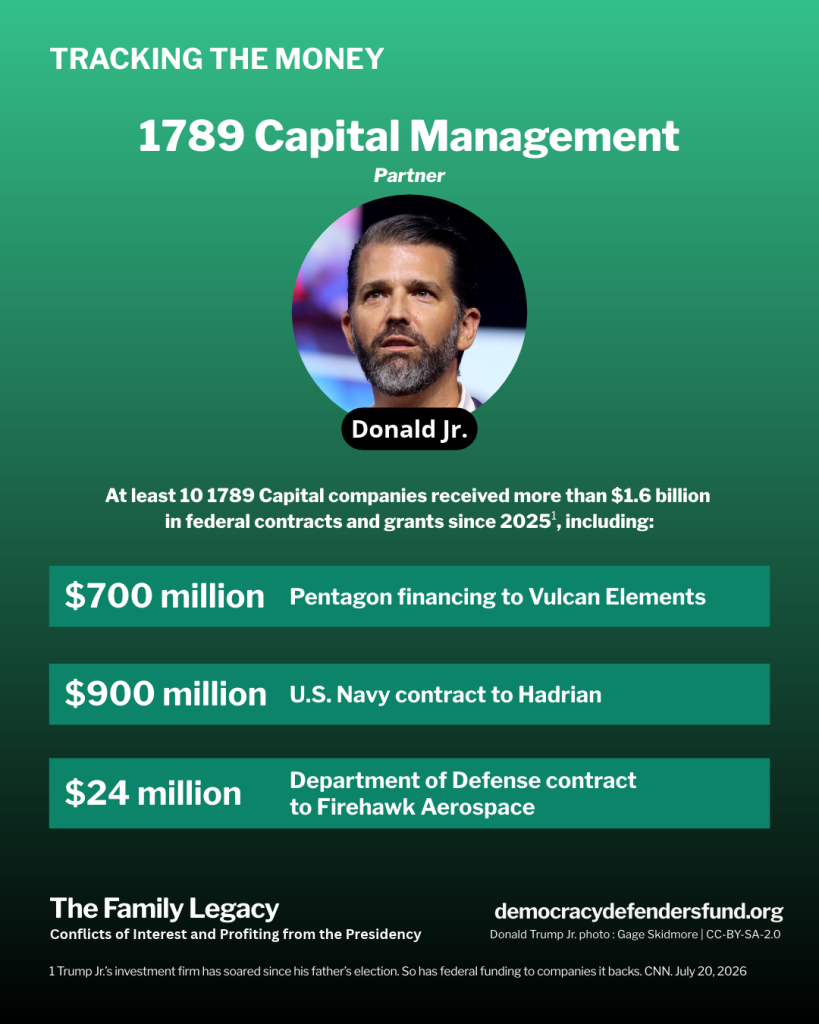
Tracking the Money: The firm grew from $200 million to $3.5 billion in assets from 2025-2026. At least ten 1789 Capital companies have received over $1.6 billion in federal contracts and grants since Trump took office for the second time.
Shortly after the 2024 election, Donald Jr. became a partner in 1789 Capital Management, a Palm Beach venture capital firm. As a partner, Donald Jr. is expected to receive management fees and profits earned from the company’s underlying investments. According to CNN, at least 10 1789-backed companies have received federal contracts and/or grants in President Trump’s second term, worth over $1.6 billion. These companies include defense contractor Axiom Space, quantum computing company PsiQuantam, and Firehawk Aerospace. The correlation between Donald Jr.-backed companies and federal financing prompted a congressional investigation, launched by Representative Raskin, demanding records of 1789’s communications with federal officials, government actions, and Donald Jr.’s role in the company. “With Don Jr.’s new leadership role, 1789 Capital has developed an uncanny ability to identify companies that are about to receive massive influxes of cash from the Trump Administration or to benefit from significant changes in federal policies and regulations. They say there is no such thing as a sure thing in investing, but this is about as close as you can get,” said Representative Raskin.
As reported by CNN, a spokesperson for Donald Jr. said that he plays no role in the contracting process for 1789-backed companies, and an attorney for the firm denied that 1789 has discussed federal contracts with the Trump Administration. However, while pitching his venture capital firm in Saudi Arabia last year, Donald Jr. said, “We understand what the administration wants to do, because we helped craft some of that messaging… so we can be on the outside but still have that understanding of what they plan to do.” This report details certain 1789-backed companies that have received some of the most prominent favorable action from the government—including Vulcan Elements, GrabAGun, Polymarket, Hadrian, and BlinkRx—though it must be noted that it is not an exhaustive list.13
Donald Jr.’s Role: 1789 Capital is an investor. Donald Jr. is a partner at 1789 Capital.
Tracking the Money: Vulcan Elements was awarded Pentagon contract of almost $700 million
In August of 2025, 1789 purchased a stake in Vulcan Elements, which months later was awarded an unprecedented $620 million loan from the Department of Defense’s Office of Strategic Capital and $50 million in federal incentives from the Department of Commerce under the CHIPS and Science Act for which the Department of Commerce will receive $50 million in equity from Vulcan Elements. The agreement came despite the novelty of Vulcan Elements, founded in 2023, and apparently without competitive bidding.
Donald Jr.’s friend Peter Navarro reportedly requested the deal, while serving as an advisor to the President. One person involved in the deal told ProPublica that it was fast-tracked, with staff working overtime to get it through in weeks. They said, “the call came from the White House: We have to get this done.” It was the only Pentagon deal at the time to be initiated by a top aide to the President. It attracted attention from congressmembers, sparking a vote on a subpoena that was blocked by House Republicans in March 2026, along with an August letter from House oversight leaders demanding details regarding the apparent political favoritism. The letter, addressed to Vulcan Elements CEO John Maslin, points out that Maslin assured House Democrats that he was not benefiting from political favoritism through his connection to Donald Jr., yet the prioritization of an unprecedented loan was the “result of direct White House intervention.”
A bicameral June 2, 2026 letter from Senators Elizabeth Warren, Richard Blumenthal, and Mazie Hirono and Representatives Jason Crow and Mark Levin, was also sent to White House Chief of Staff Susan Wiles demanding a full explanation of the White House’s involvement in the DOD loan to Vulcan Elements in “what appears to be an egregious example of Trump Administration corruption.” They also raised concerns about a $10.8 million contract awarded to PsiQuantum, a quantum chip start-up backed by 1789 Capital, in April 2025, and a $100 million equity stake taken by the Commerce Department in that company. Spokespersons for Donald Jr. and 1789 told ProPublica that 1789 played no role in Vulcan getting the loan, and that, “the President’s son does not discuss companies he has invested in with federal government officials and did not speak to Navarro about Vulcan.”
Donald Jr.’s Role: He is a stakeholder and board member.
Tracking the Money: Donald Jr. was awarded 300,000 shares, estimated to be worth $700,000.
GrabAGun, the “Amazon of Guns,” is an online firearm retailer company that also stands to gain from 1789 Capital investment and recent developments in federal regulations. The firearm e-commerce site was founded in 2010, but only gained significant public attention upon Donald Jr.’s involvement in 2024. Donald Jr. reportedly helped the company go public in 2025 through special purpose acquisition company Colombier Acquisition Corp. II. Colombier Acquisition is led by 1789 Capital President and Republican donor Omeed Malik. One year later, the Trump Administration’s Bureau of Alcohol, Tobacco, Firearms and Explosives proposed a rule to soften restrictions on delivering firearms to homes, which stands to financially benefit companies like GrabAGun that offer these services. Following the announcement, GrabAGun CEO Marc Nemati told investors ,“GrabAGun is uniquely positioned for this opportunity.” As a GrabAGun stakeholder, Donald Jr. would benefit from any increase in value enabled by new federal regulations. A spokesperson for Donald Jr. told Reuters that he had no role in the proposed rule.
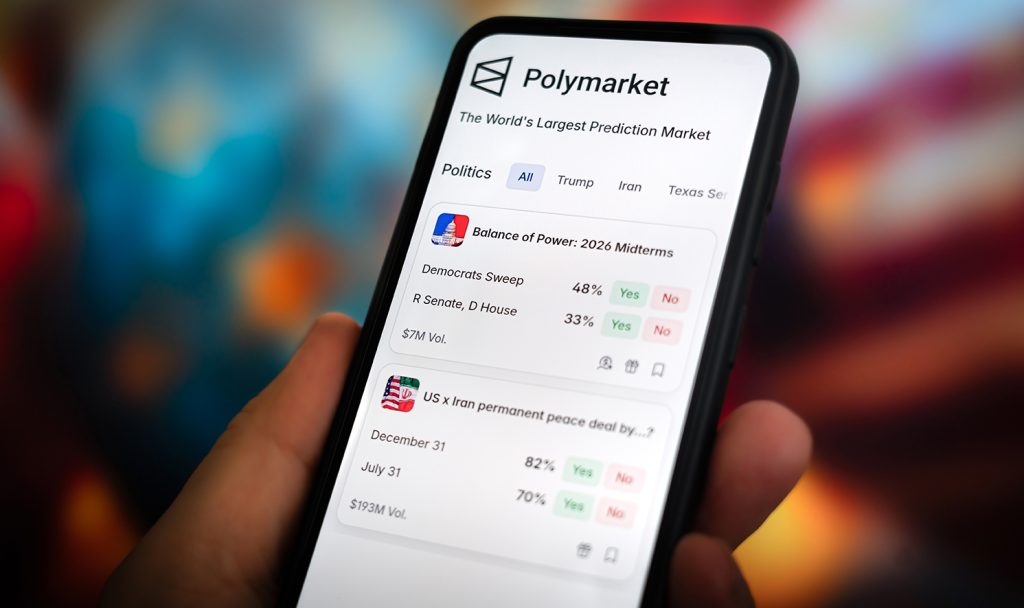
Donald Jr.’s Role: He is an advisory board member at Polymarket and was formerly a strategic advisor at Kalshi.
Tracking the Money: 1789 invested approximately $500 million in Polymarket.
Prediction markets like Polymarket and Kalshi have expanded in popularity exponentially since the 2024 election. 1789 Capital invested approximately $300 million in Polymarket in August of 2026, in addition to prior investments of approximately $200 million.
These investments come at a critical time for prediction markets in the legal world. Trump-appointed Commodity Futures Trading Commission (CFTC) Chairman Michael Selig has been a staunch supporter of Polymarket in the face of state-level lawsuits. Regulatory agencies like the CFTC have introduced sweeping staff cuts and reduced enforcement in the past two years, according to an investigation by The New York Times. During previous administrations, CFTC leadership prevented prediction markets from listing broad categories of event contracts. Selig has taken a softer approach, allowing markets to operate in areas where bans and stricter regulations had been attempted, suing multiple states for exclusive jurisdiction. Amidst these state battles, The New York Times reported that Donald Jr. spoke to state attorneys general at a retreat in March, suggesting state AGs should leave prediction market control up to federal officials, a message in line with the actions of his father’s administration. A spokesperson told The New York Times that Donald Jr. “does not interface with the federal government on behalf of any company he invests in or advises.”
Democracy Defenders Fund filed a complaint in June 2026 urging the CFTC to investigate Polymarket.com over possible violation of a 2022 settlement agreement, which barred it from operating as an unregistered entity in the U.S. After bringing charges against a military service member for allegedly conducting a series of trades on Polymarket.com‘s platform using classified information, the CFTC’s failure to bring charges against Polymarket.com under the circumstances “reinforces the view that the CFTC appears to have fallen victim to regulatory capture by the Trump family’s business ventures,” likely arising from Donald Jr., as a member of Polymarket’s advisory board and as a partner at 1789 Capital.
As The Associated Press reports, “Any friendly decision the CFTC makes on this industry could end up financially benefiting the president’s family as well.” Expanded regulatory power and relaxed enforcement clear the path for increased company value, as barriers to growth are removed. 1789 Capital—as an investor in Polymarket—and Donald Jr., thus stand to benefit from the Trump Administration’s backing of prediction markets.
In January, Donald Jr. also became a strategic advisor for Kalshi, which came with a generous sign-on package of $300,000 worth of equity. Kalshi is estimated to be worth $40 billion as of July 2026. In August of 2026, the CFTC exercised an emergency authority mechanism to permit Kalshi to operate against the decision of the New York Attorney General. This is the second time in two months that the CFTC has invoked this power, which was reportedly previously last used in 1980. Since Donald Jr. joined the organization, Kalshi’s valuation has reportedly increased tenfold. However, Kalshi ended his advisory contract in November 2026 after 1789 Capital increased its investment in Polymarket, according to Reuters.
Democracy Defenders Fund Urges CFTC to Investigate Polymarket Violations of Settlement Agreement to Prevent Fraud and Insider Trading
JUNE 9, 2026
Donald Jr.’s Role: 1789 Capital is an investor. Donald Jr. is a partner at 1789 Capital.
Tracking the Money: 1789 invested in Hadrian during three rounds of private equity financing. Hadrian received a $900 million contract from the U.S. Navy. The company’s chief executive later donated $443,000 to Republican National Committee entities.
Hadrian, a factory automation startup contracting for defense, aerospace, and maritime manufacturing, reportedly received investments from 1789 Capital during three rounds of private equity financing in June 2025, December 2025, and August of 2026. In March of 2026, Hadrian received a $900 million contract from the U.S. Navy to produce military submarine components, with funding allocated through the One Big Beautiful Bill.
In August, The Financial Times reported that Hadrian Chief Executive Chris Power “gave the maximum individual donation allowed,” $443,000, to entities of the Republican National Committee (RNC), following 1789’s increase in investment. The article notes that two other 1789 partners “whose portfolio companies have won several government contracts” have given a combined $300,000 to the RNC in the same month. In response to these facts, 1789 told The Financial Times, “any statement or suggestion, directly or indirectly, that 1789 has a conflict-of-interest, or that it is somehow participating in or benefitting from any form of corruption, is provably false and defamatory.” CNN reports that 10 federal contractors in 1789’s portfolio have received federal contracts or grants during President Trump’s second term, which saw a 79% increase in federal funding compared to the same time period during President Biden’s term.
Donald Jr.’s Role: He is a board member at BlinkRx.
Tracking the Money: 1789 Capital invested $140 million in BlinkRx.
In February of 2026, the Trump Administration launched TrumpRx, a prescription drug platform run by the federal government. BlinkRx coordinated with TrumpRx for online platform compliance, and will likely profit from the administration’s prescription venture. Donald Jr. joined the board of BlinkRx in 2025, following a $140 million investment from 1789 Capital.
The business ties sparked an inquiry led by House and Senate Democratic Health Committee leaders, raising questions about “potential coordination, influence, and self-dealing” on the part of the Trump family. Congressional leaders sent a letter to BlinkRx requesting information about its ties to the federal program, noting, “this information is particularly important given the likelihood that members of the Trump family could benefit financially if BlinkRx were to be involved in the operation or implementation of TrumpRx.”
Democracy Defenders Fund has also filed a complaint with the Department of Health and Human Services Office of Inspector General requesting an investigation into whether BlinkRx received an unfair competitive advantage in a bid to administer the TrumpRx platform. The complaint notes, “the appearance of a close relationship between BlinkRx and the Trump Administration raises serious questions about potential sharing of nonpublic information that could create an unfair competitive advantage to BlinkRx,” in violation of federal ethics laws. The White House has pushed back against such claims; a spokesperson told The Wall Street Journal, “As long as drugmakers deliver cost savings for American patients through TrumpRx, how they do so is irrelevant.”
Donald Jr.’s Role: 1789 Capital is an investor. Donald Jr. is a partner at 1789 Capital.
Tracking the Money: 1789 led an investment round worth $60 million. Firehawk was later awarded a $24 million Department of Defense contract and a multimillion-dollar contract with the Air Force Research Laboratory.
In September of 2025, 1789 Capital led a $60 million investment round for Firehawk, an aerospace manufacturer. This was 1789’s first investment in a defense technology company.
In July of 2026, DOD awarded Firehawk a multimillion-dollar contract to produce propulsion systems for the Air Force, and in August, Firehawk secured a $24 million contract with the Department of Defense to produce thermoplastic propellants for the DOW’s Industrial Base Analysis and Sustainment program. Firehawk was previously selected by the Air Force for a Phase II Small Business Innovation Research (SBIR) award worth $1.25 million, before 1789 invested in the company. Firehawk also received government contracts prior to President Trump’s second term. A spokesperson for 1789 Capital told ABC News that they invested in Firehawk during the Biden administration, predating Donald Jr.’s time at the firm.
Donald Jr.’s Role: 1789 Capital is an investor. Donald Jr. is a partner at 1789 Capital.
Tracking the Money: 1789 invested $50 million. Anduril has been awarded several government contracts worth billions of dollars during both the Trump and Biden administrations.
In 2025, 1789 Capital invested $50 million in defense company Anduril Industries as part of a $2.5 billion funding round. Although Anduril also had a pre-existing portfolio of government contracts before 1789’s investment, since being acquired by 1789 Capital, the company has since received about $1.8 billion in government contracts. A spokesperson for the brothers has said, “Their investment decisions are based solely on their independent business judgment and personal convictions and they do not seek to influence, direct, or participate in any government decision, procurement, award, regulatory action, or other governmental process. Attempts to portray their ordinary investment activities as improper are a deliberate distortion of the facts.”14
Unusual Machines
Donald Jr.’s Role: He is an advisory board member and shareholder.
Tracking the Money: Received over 300,000 shares in Unusual Machines, worth almost $8 million in July 2026. Military orders worth $15.2 million followed.
In November of 2024, Donald Jr. joined the advisory board of Unusual Machines, which awarded him millions of dollars in shares of the company. Forbes reports that the first-person view drone company is “at least the second company that appears to have activated an advisory board specifically to give a Trump a role” with a multimillion-dollar Pentagon contract to follow.
Following Donald Jr.’s sign-on, Unusual Machines received federally funded deals valued at over $15.2 million, in line with President Trump’s Executive Order to “unleash American drone dominance.” Stock prices for the company increased 39% over premarket following reporting that the Trump Administration might boost funding for American drone manufacturers. A spokesperson for Donald Jr. told The Financial Times, “Don has never communicated with anyone in the administration on behalf of Unusual Machines or about the contract in question.”
PublicSquare
Donald Jr.’s Role: He is an investor and board member.
Tracking the Money: Donald Jr. was reportedly paid $42,000 per month in 2024 and $500,000 in 2025 for his role as an advisor.
PublicSquare, an e-commerce site marketed as a right-wing alternative to Amazon, brought Donald Jr. to their board of directors in 2024. PublicSquare previously merged with Colombier Acquisition Corp in July 2023, and Donald Jr is now also part of Colombier Acquisition Corp. III’s board of directors, which is led by 1789 President Omeed Malik. PublicSquare paid Donald Jr. $42,000 per month in 2024 and $500,000 annually in 2025, even though he attended the least amount of board meetings compared to all other members, as reported by The Wall Street Journal. Donald Jr. reportedly helped PublicSquare navigate the closing of the marketplace and transition to a financial technology model this year. He profited at least several hundred thousand dollars through PublicSquare, in addition to valuable shares, though investors in the Donald Jr.-backed company likely saw massive losses from the stock-price drop.
PublicSquare initially aimed to profit from the “anti-woke” narrative President Trump had advertised on the campaign trail. Their business model fell apart after the President rekindled his relationships with tech executives, according to The Wall Street Journal. PublicSquare became unprofitable, with stock prices falling 99% since they went public. The company lost over $36 million in 2025 in addition to over $12 million in the first half of 2026, while Donald Jr. continued to receive thousands of dollars per month—more than the salary of the company’s chief executive in 2025. PublicSquare’s Head of Investor Relations told The Wall Street Journal, “Mr. Trump’s compensation reflected the fact that he is a well-known public figure who speaks directly to an audience the Marketplace was built to reach.” In August 2026, Donald Jr. and other board members led a $1.3 million private placement.
Trump Media and Technology Group & TAE Technologies
Donald Jr.’s Role: He is on the board of directors.
Tracking the Money: Paid over $800,000 for his role as director.
Donald Jr. is a director of Trump Media & Technology Group (TMTG), which owns Truth Social, and is majority-owned by The Donald J. Trump Revocable Trust, for which Donald Jr. serves as the sole trustee. Donald Jr. reportedly made over $800,000 through this director role in 2024, which was almost 25% of its annual revenue. As reported by Forbes, a Securities and Exchange Commission (SEC) filing reveals that Donald Jr. made these profits despite attending just two board meetings that year.
In July of 2025, TMTG pivoted to an investment firm model when it bought $2 billion of Bitcoin and related securities, “with the goal of creating a reserve of the cryptocurrency,” according to CNBC. However, the business model failed when the price of Bitcoin dropped, and TMTG sold their reserve after hundreds of millions in losses.

In December of 2025, TMTG merged with nuclear fusion start-up TAE Technologies in a $6 billion deal. TMTG agreed to invest $300 million in TAE and Donald Jr. remained on the board of the merged company, despite no previous experience in nuclear energy. The Trump family retains 41% of TMTG and will reportedly maintain a large stake in the merged venture. As The Washington Post quoted, Economist Peter Schiff said, “The only real value DJT offers an energy company is political leverage: access to power and the prospect of favorable treatment from the Trump Administration,” a crucial prospect for the company’s innovative and costly fusion power plans.
The financial relationship between TMTG and TAE has gathered the attention of ethics experts for the potential conflict of interest it poses—given the President and his family’s financial interest in the company and the Trump Administration’s regulatory oversight of this energy source. Parties involved with the deal remarked that they hope the merger will be a growth opportunity for TMTG, getting TMTG stock value “substantially higher,” which would inevitably benefit Donald Jr. The White House denied any conflicts of interest.

SF City Attorney Sues Truth Social for Enabling Insider Trading by Selling Early Access to Trump Posts
September 22, 2026
Read morePhoto: A2Z AI – stock.adobe.com
In July 2026, TMTG announced a new subscription service, advertising a $100,000 monthly fee for early access to President Trump’s social media posts. This model creates a new stream of revenue for those with financial interests in TMTG, like Donald Jr. as Director, who could benefit from increased proceeds. TMTG’s subscription service is the subject of an unfair competition lawsuit brought against it by the San Francisco City Attorney with backing from Democracy Defenders Fund and Platkin LLP. The complaint alleges TMTG’s scheme violates a federal ethics law known as the STOCK Act prohibiting executive branch officials, including the president, from using nonpublic government information for private profit. It also alleges violations of “U.S. securities laws prohibiting trading on, or enabling trading on, material nonpublic information… and that the company’s conduct constitutes unlawful and unfair business practices under California’s Unfair Competition Law.”
Controversial Russian Oligarch Wedding Gift
In addition to self-dealing and pay-for-play questions that arise from Donald Jr.’s business deals, he made headlines in September 2026 when ProPublica reported that a Russian oligarch close to Vladimir Putin bankrolled his Bahamas wedding. According to the report, Umar Kremlev “footed the bill for hundreds of thousands of dollars of wedding expenses,” including paying for a private island and a fireworks show. A spokesperson for Donald Jr. said that Kremlev is a “personal friend,” while a spokesperson for Eric said, “Eric has absolutely no clue who this person is, nor has never heard his name.” Regardless of the extent of the relationship, Donald Jr. accepted gifts worth hundreds of thousands of dollars from a foreign actor amidst his father’s handling of the Russia-Ukraine war. The report prompted congressional action; members of the House Committee on Oversight and Government Reform requested preservation of records and certain communications regarding Donald Jr.’s relationship with Umar Kremlev. In a speech, Senator Chuck Schumer remarked, “You’re dealing with a Russian oligarch, not just a cousin who’s giving you a gift…sometimes a wedding gift is a bribe from a foreign autocrat.” Days after the ProPublica report was published, President Trump said that his son would be paying back Kremlev.
Eric Trump
Eric Trump
Before President Trump took office in 2024, his son, Eric, was worth an estimated $40 million. In December 2025, Forbes estimated that he was worth around $400 million—making him the wealthiest of all of his siblings. Eric is involved in a variety of ventures—including military weapon technology companies, cryptocurrency, rare earth minerals, and deals with foreign nations that introduce a glaring conflict of interest. Both XTEND and Foundation Future Industries have benefited from Pentagon contracts awarded in 2026, prompting criticism from current and former members of Congress. As stated by Arizona Senator Ruben Gallego, “For your family the war in Iran means paying more. For Trump’s family the war in Iran means making more.”
XTEND
Eric’s Role: He is an investor.
Tracking the Money: Invested an undisclosed amount in a $1.5 billion merger involving the company. XTEND was later selected for the Pentagon’s $1 billion procurement program.
In February 2026, Eric Trump invested an undisclosed amount in the $1.5 billion merger between XTEND, an Israeli drone manufacturer, and the Florida-based company JFB Construction Holdings in an attempt to take XTEND public. Unusual Machines, of which Donald Jr. is an advisor, also invested in the merger. XTEND was founded in Tel Aviv but has been headquartered in Tampa, Florida since its merger with JFB Construction Holdings. Drones have been increasingly of interest to the Pentagon, playing a central role in the Ukrainian battlefield and XTEND AI-enabled systems are being used by the US DOD, Singapore, Europe, the UK and the IDF as of July 2025.
In June of 2026, it was announced that XTEND was selected for the Pentagon’s Drone Dominance Program (DDP), allowing it to become one of just a few companies tied to the Pentagon’s drone procurement goals. The purpose of the program is to test whether low-cost systems can be manufactured at a scale and pace that meet the demand of the US military. The program aims to procure over 200,000 drones by 2027 to be deployed across “complex operational environments.”
Foundation Future Industries
Eric’s Role: He is an investor and strategy advisor.
Tracking the Money: The company was awarded a $24 million Pentagon contract following Eric’s investment.
Foundation Future Industries is a Silicon Valley startup that is developing the “Phantom” android, a humanoid robot created for military applications such as breaching enemy sites and surveying hostile territory. Eric Trump has been an investor in the startup and the chief strategy advisor since March 2026. In April 2026, the Marine Corps granted Foundation Future a $24 million contract to test the android. On April 23, 2026 Eric Trump joined CEO Sankaet Pathak on Fox’s Mornings with Maria to discuss the company’s contract. During this discussion, Eric stated, “[w]e are America first. We have to win this race. We better be winning this race in the United States of America. We’re the greatest economy in the world.”
American Bitcoin
Eric’s Role: Eric is a co-founder and chief strategy officer. Donald Jr. is also a senior advisor.
Tracking the Money: Eric and Donald Jr. own an estimated 20% stake, which was valued at over $1.5 billion at its peak.
Eric Trump co-founded American Bitcoin in March 2025 with Donald Jr. and cryptocurrency company Hut 8. Though Donald Jr. is an advisor, Eric is the apparent lead of the company. Eric announced the company at an Abu Dhabi crypto conference shortly before his father’s visit to the city. Eric and Donald Jr. own an estimated 20% stake in the company, which was valued at over $1.5 billion at its peak, but has since dropped significantly.
The Bitcoin venture reportedly has ties to Chinese company Bitmain, a manufacturer of cryptocurrency hardware. The partnership sparked an inquiry by Senator Elizabeth Warren over national security concerns, saying, “Bitmain gave Eric Trump’s American Bitcoin ‘unusual’ terms, including exchanging hundreds of million dollars worth of equipment for future, ‘pledged,’ Bitcoin rather than cash—a deal that some industry experts viewed as ‘distinctly generous to American Bitcoin.”’

In tandem with Eric’s leadership of American Bitcoin, his father’s administration has softened regulatory oversight of cryptocurrency under CFTC Chairman Michael Selig and advocated for the Clarity Act, which according to some Senate Banking Democrats, “fails to adequately protect investors, our financial system, and our national security.” President Trump has the ability to influence cryptocurrency regulation due to his authority to make political appointments to regulatory agencies. The Trump family is deeply entrenched in the world of cryptocurrency, as Eric Trump himself said, “90% of my time in life is in this [cryptocurrency] community,” despite the President’s regulatory authority in the area.
Jared Kushner and Ivanka Trump
Jared Kushner

Ivanka Trump
Jared Kushner is the founder and CEO of A Fin Management LLC (Affinity Partners), a private equity firm whose largest investor is Saudi Arabia’s Public Investment Fund (PIF), the kingdom’s sovereign wealth fund controlled by Crown Prince Mohammed bin Salman (MBS). Members of Congress, including Rep. Jamie Raskin and Senator Ron Wyden and Rep. Robert Garcia, have raised questions about whether Kushner’s roles create conflicts of interest between his private financial relationships and his responsibilities as a special envoy.
According to a report from The Atlantic, Kushner operated in the first 14 months of the second Trump Administration “[w]ithout title or remit or any kind of official designation—only ‘presidential son-in-law,’” although he sat down with world leaders including Vladimir Putin, Benjamin Netanyahu, and Volodymyr Zelensky, along with Saudis and multiple other actors from the Middle East.
In February 2026, Kushner was given the title of “Special Envoy for Peace” amidst President Trump’s launch of the “Board of Peace,” however, the White House claims that Kushner is not a government employee, and refers to him as a “volunteer.” Both Representatives Raskin and Garcia and Senator Wyden cite conflict-of-interest and emoluments frameworks to question the Trump Administration’s classification of Kushner.15 The administration describes Kushner as a private citizen despite the fact that he appears to be appointed by the President to carry out a federal function, and is seemingly representing the U.S. in foreign negotiations. A White House Spokesperson stated that Jared “is acting in his capacity as a private citizen; therefore, he is not subject to disclosure requirements.” Given his title and special envoy responsibilities, Democracy Defenders Fund requested that the State Department’s Inspector General investigate Kushner’s appointment in March of 2026 based on apparent violations of the anti-nepotism statute and conflicts of interest.
Kushner’s Special Envoy appointment was made in tandem with the creation of the Board of Peace—a multinational organization which was founded by President Trump through Executive Order, but which has never been authorized by Congress. Representatives Meeks and Raskin refer to President Trump as “Chairman for Life,” given that the charter appoints him as Chairman until voluntary resignation or removal by a unanimous vote of the board due to incapacity. Trump also appointed Kushner to serve on its Executive Board. Membership is invitation only, subject to three-year terms and renewal by the Chairman, except that Member States who contribute more than $1 billion serve without a term-limit, causing some to characterize it as a “privatized U.N.” The Board of Peace has been subject to congressional scrutiny, particularly given the appearance that the administration does “not intend to seek congressional authorizations for U.S. participation in the Board of Peace or secure Senate ratification of the board’s charter as a U.S. treaty,” according to an expert at the Carnegie Endowment for International Peace.
One of the main proposals of the Board is the development of a $2.45 billion Gaza peace plan. As of June 2026, the Board is operating as an International Nongovernmental Organization (INGO) with a reported $7 billion pledged thus far by Member States. However, Representatives Meeks and Raskin have requested details about funding accountability from Secretary of State Marco Rubio, seeking clarification on the role of the World Bank which, “has established an account to facilitate contributions but disclaims oversight responsibility for how the money is ultimately used.” As a result, “[c]ontributors can even choose to bypass the World Bank altogether and deposit money directly into the Board’s private J.P. Morgan accounts.” Through this new Board, President Trump and Jared Kushner have not only championed a shift in U.S. diplomatic strategy, but have done so without any apparent congressional authorization or accountability. According to The New Yorker, Kushner has said that peace deals are like real-estate deals, raising questions as to whether monies raised to support reconstruction and development in Gaza will be used as intended or as a vehicle for enrichment by private investors.
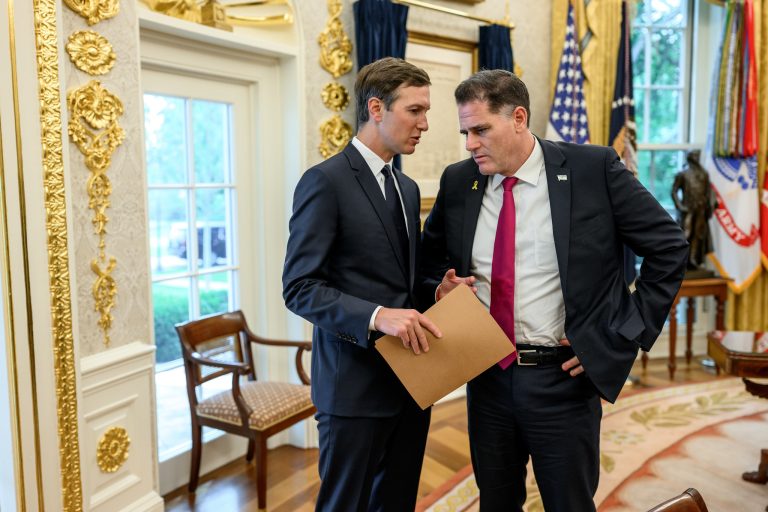
Democracy Defenders Fund Demands Investigation into Appointment of Jared Kushner as Special Envoy for Peace
March 3, 2026
Read moreAffinity Partners
Kushner’s Role: He is the Chief Executive Officer.
Tracking the Money: Kushner has overseen several multimillion-dollar deals at Affinity Partners, in addition to Saudi Arabia’s $2 billion investment in 2021. The firm manages over $6 billion in assets.
According to Forbes, Jared Kushner wholly owns Affinity Partners, a private equity firm that manages over $6.2 billion—approximately 99% of which originates from overseas—mainly Middle Eastern sovereign wealth funds. The firm launched when Saudi Arabia’s Public Investment Fund (PIF) committed $2 billion to Affinity in 2021; by 2023, the firm received around $200 million each from Qatar and the UAE, and an additional $1.5 billion from these two countries at the end of 2024. By 2024, Affinity had collected approximately $157.5 million in management fees from foreign investors, with $87 million from the Saudi PIF. According to a letter from Senator Wyden, Affinity was ensured to collect an additional $90 million in management fees from foreign investors between September 2024 until August 2026, with $50 million of those fees coming from the Saudi PIF. Affinity Partners is also the financial vehicle behind a $1.4 billion resort development on Albania’s Sazan Island, as well as a $4.7 billion luxury real estate and mega-resort initiative on Albania’s protected Vjosa-Narta coastline, in which both Kushner and Ivanka Trump are involved.
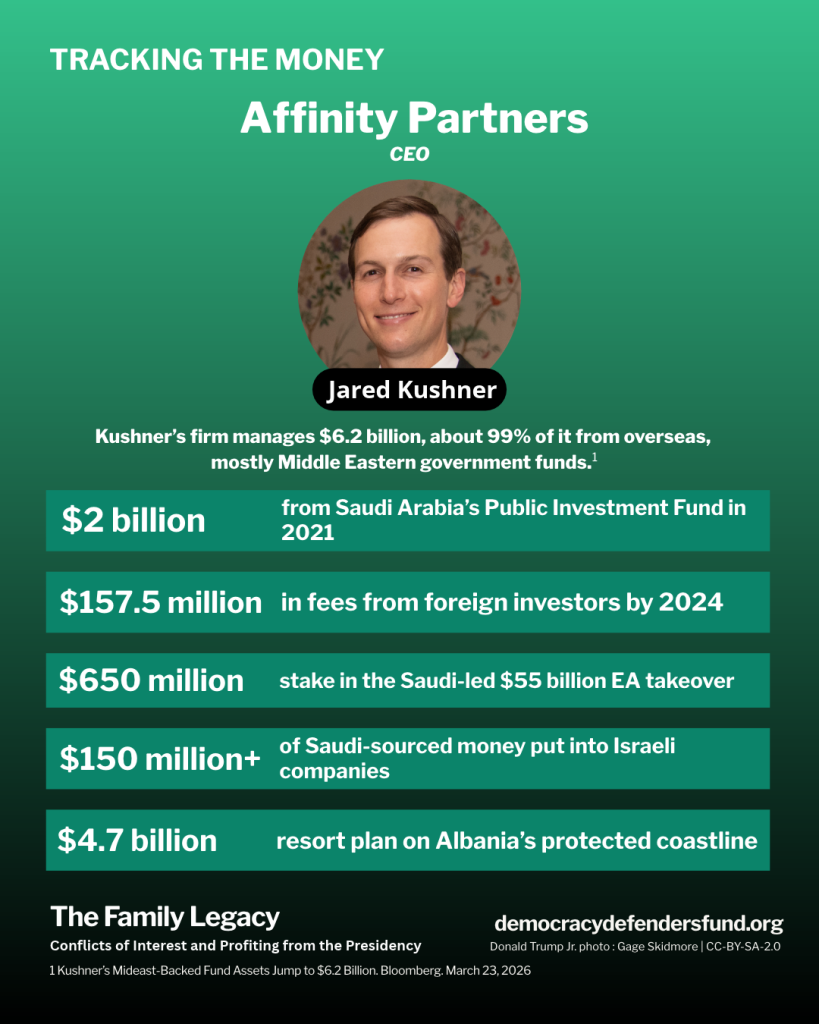
Affinity also worked with the PIF to take video game maker Electronic Arts (EA) private in a $55 billion deal—purchasing approximately 1.1% of the company’s equity (about $650 million). The PIF led the deal, purchasing approximately 93.4% of the outstanding shares—or approximately $51.3 billion. The transaction closed on August 4, 2026, with EA shareholders receiving $210 per share in cash. EA generated approximately $7.5 billion in net revenue in fiscal year 2026. No profits from the EA investment or Affinity’s prior investments have yet been returned to Affinity’s investors.
As stated above, Affinity Partners’ largest investor is Saudi Arabia’s Public Investment Fund (PIF), which is controlled by Crown Prince Mohammed bin Salman (MBS). In October 2024, before Trump returned to office, Senator Wyden and Rep. Raskin filed a formal referral to the Department of Justice asking the Department to appoint a special counsel to investigate whether Kushner’s failure to register as a foreign agent while simultaneously being paid by the Saudi government while engaging in political activity was in violation of the Foreign Agents Registration Act (FARA).
Following the PIF’s $2 billion investment in Affinity Partners, reporting emerged that the PIF’s own investment screening committee had previously recommended rejecting Kushner’s investment proposal, citing his firm’s lack of experience and excessive fees. MBS, who heads PIF’s board of directors, overruled the committee and approved the deal. During the first year of President Trump’s second term, Affinity’s assets under management grew 30% to $6.2 billion. Bloomberg attributes the increase to gains recorded by the fund on some of its investments.
While collecting management fees from Saudi Arabia, Kushner served as a lead U.S. negotiator in three rounds of indirect nuclear talks with Iran in February 2026, Saudi Arabia’s primary regional adversary. The Arms Control Association, which received recordings and transcripts from participants in the talks, concluded in its post-war analysis that “Trump’s dissatisfaction and impatience with the negotiating process appear to have been fed, in part, by Witkoff and Kushner’s accounts of the U.S.-Iran talks.” Kushner and Witkoff reportedly “chose not to include nuclear technical experts in the negotiations,” according to a senior Middle East diplomat with knowledge of the talks. However, Kushner later denied this, saying a senior nuclear nonproliferation expert participated in negotiations along with other government energy officials. During this same period, Saudi Crown Prince MBS was reportedly privately urging President Trump to attack Iran. On February 28, 2026, less than 48 hours after the third round of Geneva talks ended without a deal, the U.S. and Israel launched coordinated strikes on Iran.
Kushner has stated that he has “raised no additional funds” for the firm since his father-in-law retook office. While Affinity acknowledged having “early conversations” with Saudi officials, it said it would take in no “additional capital” while Kushner is “volunteering” for the Trump Administration. However, the terms of Affinity’s agreement with the PIF give Saudi Arabia a contractual right beginning in August 2026 to renegotiate or withdraw its $2 billion commitment. A withdrawal of that magnitude could adversely affect Affinity’s profitability giving Kushner a financial incentive to maintain good relations with Saudi Arabia. Because there is little transparency about Affinity’s and Kushner’s business dealings, it’s not yet known whether the $2 billion commitment was renewed or renegotiated by the parties. In late June, Trump reportedly told staff he did not mind if Iran negotiations extended beyond August, the same month in which Saudi Arabia’s renegotiation right activated.
Most troubling, the U.S. has entered into a series of defense and energy compacts with countries who are primary investors and benefactors to Kushner’s investment firm. At the end of July, 2026, for example, the U.S. entered into a nuclear cooperation deal with Saudi Arabia.
In October 2026, Kushner garnered attention when CNN reported that Affinity Partners has maintained a large stake in Phoenix Financial, a backer of Israeli military suppliers—including during a period of time when Kushner was negotiating in Gaza as Trump’s Envoy for Peace. His investments were uncovered by CNN only through the use of Israeli financial transparency laws given Kushner’s position that he is not subject to federal ethics disclosure requirements. According to CNN, Phoenix has invested at least $456 million across nine companies involved in Israeli arms manufacturing, $265 million of which is in Israel’s largest arms manufacturer, Elbit Systems. Affinity Partners is Phoenix’s largest stakeholder, having doubled its 4.95% stake in Phoenix Financial right before Trump returned to office in 2025. One of Kushner’s attorneys told CNN, “any suggestion that Jared’s diplomatic work influenced Phoenix’s investments in the companies you identify, or vice versa, is incorrect.” Kushner took to X.com to state that the CNN report was misleading: “Think of Phoenix as the Israeli equivalent of Vanguard or Fidelity. It manages the retirement savings of millions of Israelis. The savers don’t choose the individual investments, and neither do I. I have no role in deciding what Phoenix buys or sells.”
Affinity has maintained a focus on Israeli investment by deploying at least $150 million into Israeli companies using Saudi-sourced capital. Kushner’s Israeli investments through Affinity Partners are notable for two reasons. First, they represent the deployment of Saudi sovereign wealth capital into Israeli companies, an unusual financial relationship given the lack of formal diplomatic relations between the two countries. Second, Kushner has described these investments as building a “Saudi-Israel investment corridor,” which directly mirrors the diplomatic work he undertook during the first Trump Administration on the Abraham Accords; Affinity’s own pitch deck cites the Abraham Accords as a reason to trust and invest with the firm.
In February 2024, Affinity made its first Israeli deal, a $110 million investment for a 15% stake in the auto services unit of Shlomo Group, an Israeli car leasing, rental, and credit company. This appears to be the first Saudi-sponsored investment in an Israeli company in history. The deal was structured through a new subsidiary with an original equity valuation of NIS 3.8 billion, decreasing to NIS 2.7 billion, approximately $740 million, at the time of closing. Shlomo Holdings retains 85% of the new company’s issued share capital, while Affinity holds 15%.
Around the same time, Affinity was in talks to invest approximately $250 million for a 25% stake in Israel’s Phoenix Insurance Agencies, a part of one of Israel’s largest insurance groups. The discussion contemplated Affinity deploying additional Saudi-backed capital into a major Israeli financial institution.
Affinity’s Israeli investments, its financial relationship with Saudi Arabia, and Kushner’s simultaneous involvement in U.S. diplomacy concerning Iran, raises serious conflict of interest concerns, as Kushner has a clear commercial interest in the war in Iran, and in pursuing a U.S. foreign policy that will protect his business investments with Saudi Arabia and in Israel. Speaking to 60 Minutes about his diplomatic work in Israel and Gaza last year, Kushner told CBS News, “What people call conflicts of interests, Steve [Witkoff] and I call experience and trusted relationships that we have throughout the world.”
On September 29, 2025, Electronic Arts agreed to be taken private in a $55 billion acquisition by a consortium of Saudi Arabia’s Public Investment Fund (93.4%), private equity firm Silver Lake (5.5%), and Jared Kushner’s Affinity Partners (1.1%). The PIF secured a $20 billion loan from JPMorgan to fund the transaction, making it the largest leveraged buyout in history. The deal closed on August 4, 2026, with EA shareholders receiving $210 per share, a 25% premium over the stock price before the deal was announced.
Democratic senators have raised concerns about the “unprecedented, proposed foreign privatization of a major American technology and entertainment company,” and the sufficiency of the Treasury Department’s national security review process conducted by the Committee on Foreign Investment in the United States (CFIUS). Notwithstanding these national security concerns, CFIUS cleared the deal on July 30, 2026, five days before closing. The deal also required clearance from the European Commission, which was granted in late July 2026.
The timing of the transaction overlapped with Kushner’s diplomatic position. The EA deal was announced on September 29, 2025, while Kushner was actively engaged in U.S. diplomacy in the Middle East and Iran nuclear negotiations were beginning to take shape. The transaction closed on August 4, 2026, the same month Saudi Arabia gained the contractual right to renegotiate or withdraw its $2 billion Affinity commitment.
The EA deal also raised congressional eyebrows. Following the transaction’s official announcement, Representatives Debbie Dingell and Steven Horsford, co-chairs of the Congressional Labor Caucus, called on the Federal Trade Commission to conduct a “thorough review” of the EA acquisition, citing labor concerns and the national security implications of Saudi Arabia owning a major American entertainment company.
In 2024, Affinity Partners proposed multiple real estate developments in Albania, following a “holiday yacht trip” that Jared and Ivanka took around the Albanian coast in 2021. In December 2024, approximately two months after Trump’s reelection and weeks before his inauguration, the Albanian government granted “strategic investor status” to Kushner-backed Atlantic Incubation Partners for real estate developments on Sazan Island, including on protected land. In August 2026, The Wall Street Journal reported that a Kushner-backed development group paid over $120 million for Albanian land to “suspected gangster” Artur Shehu, who faces international drug-smuggling charges. Shehu’s lawyer denied accusations of drug dealing and land theft to The Wall Street Journal, and said Shehu never dealt directly with Kushner.
Given the appearance of conflicts of interest and suspicious actors, the deal has prompted a congressional investigation by Ranking Member Jamie Raskin, whose office referred to the Albanian government actions as “extraordinary concessions” benefiting Kushner in his “de facto government role” while they “sought to cultivate influence in American politics and with the Trump Administration.” The deal led Albania’s Special Anti-Corruption Prosecutor (SPAK) to open a formal investigation into land designation changes connected to those developments. Kushner’s project in Albania contributed to violent protests against possible damage to the country’s ecosystem as a result of the real-estate developments. Kushner has defended the purchase as a “straightforward private real-estate investment based on [the] belief in Albania’s potential as a rising destination and the opportunity to create something truly special there.”
Kushner and Affinity were also invested in a project to build a Trump Hotel in Belgrade, but ultimately withdrew after Serbian officials were criminally indicted for abusing their office and forging a key document used to strip the site of its cultural-heritage status. One of the defendants admitted to fabricating an expert’s opinion on the documents.
Russian Oil Deal
In October 2026, The New York Times reported that U.S.-Russia talks include an oil negotiation that stands to benefit Middle East-based businessmen with ties to both Kushner and Steve Witkoff. The deal, contingent on government approval, involves oil field, refinery, and gas station developments by Russian energy company Lukoil. The New York Times reports that Putin is seen as the decisionmaker for the deal, despite Lukoil’s status as a private company. Investors in Lukoil include Moutaz and Ramez Al-Khayyat, who are investors in Kushner’s resort development in Albania, WLF equity owner Sheikh Tahnoon, and Todd Boehly, who has donated millions to President Trump.
As reported by The New York Times, it is not clear that Kushner or Witkoff will directly profit, however, the multibillion-dollar deal “represents a striking intermingling of personal business ties with geopolitics.” Russian President Vladimir Putin reportedly brought up the deal to Witkoff and Kushner in September during their visit to Moscow.
Barron Trump
Barron Trump
Barron Trump, the President’s youngest son and a junior at NYU’s Stern School of Business, has amassed an estimated $150 million as of October 2025—more, by Forbes‘ estimate, than his mother, First Lady Melania Trump. The source of that extraordinary windfall is almost entirely World Liberty Financial (or “WLF”), the Trump family cryptocurrency venture, which Barron co-founded with his father and older brothers less than two months before the 2024 election.
As noted above, WLF has added an estimated $1.4 billion to the family’s collective fortune, with roughly 7% of token sales and some stockpile and stablecoin revenue, worth about $133 million in December 2025, attributable to Barron. An August 2025 transaction with publicly traded Alt5 Sigma—which raised capital to build a treasury of $WLFI tokens—generated an estimated $41 million after taxes to Barron alone.
Those estimated interests are only part of the bigger picture. Barron was originally estimated to hold 2.25 billion $WLFI tokens, representing 10% of the 22.5 billion tokens originally allocated to the Trump family entity. However, Forbes has estimated since then that the Trump sons each have a roughly 7% stake, rather than 10%, in WLF as of last December. Taken together, these figures demonstrate the extraordinary speed in which WLF transformed Barron’s financial position. His fortune appears to have been created largely through a cryptocurrency venture launched only weeks before the 2024 election and whose value exponentially increased after his father returned to the presidency.
Meanwhile, in January 2026, Barron co-founded Sollos Yerba Mate Inc., a Palm Beach beverage startup that raised $1 million from investors it has never identified. Who put up the money, and how much Barron has profited from the beverage’s sales, remain unknown.
Sollos Yerba Mate
Barron’s Role: One of five directors and executive officers; co-founder alongside Palm Beach schoolmates.
Tracking the Money: $1 million raised through a fully subscribed private placement. No investor has been publicly identified and neither have the company’s profits.
In January 2026, Florida and Delaware filings listed Barron as one of five executives of Sollos Yerba Mate Inc., a beverage startup headquartered roughly a mile from Mar-a-Lago and staffed by friends in their late teens and early twenties.
Public filings show that the company, under the name Soulstice Inc., raised approximately $1 million through a private placement, revealing no public identities of the core investors. The Florida filing shows that the company was registered to do business as a foreign corporation, using the name “Sollos Yerba Mate,” rather than Soulstice, in Florida, according to The Latin Times. But that is also where meaningful public visibility ends with this company. The available record provides no basis to conclude that those investments were improper—but it also provides no way to determine who is financially backing a business owned by a member of the President’s immediate family, what interests those investors may have before the federal government, or whether those financial relationships have created conflicts of interest and potential avenues of improper influence.
Melania Trump

Melania Trump
The First Lady reported more than $17.2 million in 2025 income on the President’s certified annual financial disclosure, released by the Office of Government Ethics on June 30, 2026—$10.71 million in net proceeds from the Amazon MGM documentary Melania, $6,011,259 from sales of NFTs and other digital collectibles, and $521,161 in royalties from her 2024 memoir. The earnings flow through MKT World LLC, a Palm Beach holding company.
As the First Lady, Melania’s income appears on the President’s federal disclosure. But the disclosure provides little transparency about who was ultimately paying the First Lady, what interests those payors have before the federal government, and what they may be expecting in return. It is not clear why Amazon reportedly paid roughly three times the next-highest bid for a film it did not expect to break even on. The $6,011,259 figure on the President’s disclosure references income from the First Lady’s license agreements for “the sale of NFTs and other collectibles,” likely including revenue from the $MELANIA meme coin launched the day before the inauguration; however, purchasers of the coin are not subject to public disclosure.
Transparency about amounts, paired with opacity about counterparties, is its own kind of gap—and in her case it is the subject of an active congressional inquiry by Senator Elizabeth Warren. The ventures detailed below illustrate how the First Lady’s private business interests intersect with her proximity to presidential power, and how existing disclosure rules can leave the most consequential questions unanswered.
Amazon MGM Documentary
Melania’s Role: She is the subject and executive producer; she personally pitched the project.
Tracking the Money: Amazon paid $40 million in license fee with a $35 million marketing budget; roughly $28 million went to her directly, of which $10.71 million was booked as 2025 income.
According to Wall Street Journal reporting, Melania Trump pitched the documentary to Jeff Bezos over dinner at Mar-a-Lago in December 2024, weeks after the election; Amazon agreed roughly two weeks later to pay $40 million—the most it had ever paid for a documentary—plus an unprecedented $35 million marketing budget. Amazon’s bid exceeded the next-highest bidder, Disney, by about $26 million, and the film grossed $16.6 million worldwide, meaning the First Lady’s personal take approached the film’s entire global box office. Reporting indicates roughly 70% of the acquisition price, about $28 million, goes directly to her.
At the same time, Amazon has exposure to the administration. Amazon faces an FTC antitrust suit, holds substantial federal cloud contracts through AWS, and Bezos’ Blue Origin holds multibillion-dollar NASA and national security launch contracts. In March 2026, Senator Elizabeth Warren, Representative Hank Johnson, Senator Ben Ray Luján, and Representatives. Dan Goldman and Pramila Jayapal wrote to Amazon CEO Andy Jassy asking whether Amazon’s investment in the Melania documentary was a corrupt pay-to-play arrangement and whether Amazon has exposure under federal anti-bribery law; the letter cites Defense Secretary Pete Hegseth’s February 2026 visit to a Blue Origin facility as further evidence of Amazon’s stake in administration goodwill. Warren later called the transaction “bribery in plain sight.” Amazon rejects the characterization, saying it licensed the film for its access and cultural relevance. Still, having an eight-figure deal with the President’s wife raises questions about transparency and accountability, especially given Bezos’ deep financial interest in federal business.
The $MELANIA Meme Coin
Melania’s Role: She is the namesake and promoter.
Tracking the Money: $6,011,259 is reported on the President’s disclosure under income from the First Lady’s license agreements for “the sale of NFTs and other collectibles,” likely including revenue from the $MELANIA meme coin. The exact value of revenue from the meme coin is unknown. Pre-launch buyers realized roughly $100 million; the token has since fallen about 98%, leaving many Trump fans with devastating losses.
The First Lady launched $MELANIA on January 19, 2025, one day before the inauguration and two days after the $TRUMP launch. Because such tokens carry no intrinsic economic function, purchases amount to direct transfers to the issuers—and the public cannot see wallets identifying who bought or how much she made from the $MELANIA coin. The President’s financial disclosure includes over $6 million in income for the First Lady from NFTs and collectibles, however, it is unknown how much of this revenue is from the meme coin. A Financial Times article on chain analysis found that 24 wallets bought $2.6 million of the token roughly two and a half minutes before the public announcement and realized about $99.6 million; 81% was sold within the first 12 hours. Because meme coins fall outside the SEC’s securities framework, these trades sit beyond federal insider-trading rules. Wallets involved in the pre-launch accumulation have been linked to Hayden Davis of Kelsier Ventures, who also co-founded the $LIBRA token promoted by Argentine President Javier Milei, and an October 2025 RICO complaint names $MELANIA among tokens allegedly used in a coordinated insider scheme.
NFTs, Collectibles, and the Memoir
Melania’s Role: She is the sole proprietor of the brand; sales run through MKT World LLC, her personal holding company and issuer of $MELANIA.
Tracking the Money: $6,011,259 from NFTs and collectibles in 2025, presumably including meme coins, up from $216,710 the prior year. $521,161 in memoir royalties.
The $6 million in NFT and collectible sales represents a 28-fold single-year increase that the filing neither explains nor attributes to specific collections. Individual pieces in prior collections were priced from $50 to $180,000. As with the meme coin, purchasers are anonymous by design: No affirmative public disclosure mechanism exists by which the public, or Congress, can learn whether a buyer held contracts, licenses, or regulatory matters before the federal government. Her memoir, published by Skyhorse in October 2024, added $521,161 in 2025 royalties.
Part 3: Avenues for Reform
Reform Recommendations
The Trump family’s extensive business ties, access to government contracts, and increased financial patronage by foreign governments create an avenue for undue influence, nepotism, and kleptocracy at an immense scale. Some of these arrangements might violate current law; regardless, it is clear that the current statutory structure is not strong enough to deter questionable business arrangements involving the President’s family. We will be issuing a subsequent report that will go in depth into suggested legislative remedies, but we would be remiss if we did not at least provide some initial analysis in that regard.
Financial Conflicts of Interest Tied to the President’s Name, Image and Likeness
Every government employee in the executive branch other than the President and Vice President is covered by 18 U.S.C. § 208, the principal financial conflict of interest statute for the executive branch. That provision prohibits a government employee from participating in any government decision in which he, “his spouse,” or “his dependent children,” among others, has a financial interest. Likewise, all executive branch employees are considered to have a “covered relationship” with their parents and children—including adult children—requiring an assessment of whether an employee may be biased or prejudiced when asked to work on a particular matter involving their parent or children. These laws were enacted to prevent employees from participating in government matters in which they had a conflict of interest, yet because they do not apply to the President and his family, there is an obvious vulnerability to the exact types of opaque, self-serving business arrangements that the President and his family have reportedly engaged in over the past year.
Step one for preventing opportunistic abuse of the President’s office for his family’s financial gain is to take immediate steps to limit the types of interests in outside companies that the President and his immediate family, including his spouse and dependent children, can have while he is in office. For example, limiting the use of trademarks, business names, and the name, likeness, and image of the President can sharply reduce the types of business ventures that have arisen through companies like Trump Media & Technology Group, $TRUMP meme coin, and the Trump Organization.
A statute, 5 U.S.C. § 501, already provides that “[a]n individual, firm, or corporation practicing before an agency of the United States may not use the name of a Member of either House of Congress or of an individual in the service of the United States in advertising the business.” Yet this section has apparently never been enforced. Another statute, 18 U.S.C. § 713, prohibits the use of the seal of the President and Vice President in a way that implies “sponsorship or approval” of the government or that are used on commercial products. That provision is both underenforced and does not go to the President’s name and likeness. More could be done to advance stronger rules around the use of the President’s name, likeness, and image during the President’s tenure.
Prevent Channeling Contracts to Family Members
Businesses associated with Trump’s family members have been awarded dozens of government contracts. Many of these are in millions of dollars. Donald Jr. and Eric Trump’s investment firms are tied to nearly $6.3 billion in defense spending alone—including $3.2 billion in direct business and $3.1 billion in future contract options, according to The Washington Post.16
Several statutes and regulations attempt to regulate the provision of contracts and benefits to government employees. The aforementioned conflict of interest statute, 18 U.S.C. § 208, was established in part to prevent employees from engaging in collusive arrangements to benefit from contracts with the government. Members of Congress have been prohibited from receiving government contracts since 1868.17 The Federal Acquisition Regulation Subpart 3.6 likewise provides that a contracting officer should not “knowingly award a contract to a government employee or to a business concern or other organization owned or substantially owned or controlled by one or more Government employees.”18 GSA previously provided in its contracts, including the lease agreement between President Trump and GSA, a provision that no “elected official of the Government of the United States” may benefit from the lease.19 Changes to the standard leasing terms in March 2026 appear to have removed this language.
These rules do not prevent government contracts with the President or their family members. This is notwithstanding the fact that the contracting process is particularly vulnerable to corruption risks.20 This is particularly true for politically exposed persons, like the President’s family members. As a result, it is necessary to take additional steps to prohibit the President and his family from gaining a financial stake in public contracts other than through diversified registered mutual funds. This could take the form of an outright ban with limited exceptions (as applied to members of Congress) or could require additional oversight and transparency checks, such as requiring that all contracts provided to a company associated with a member of the President’s family be fully competed, reviewed by the Office of Inspector General for the relevant agency for consistency with generally accepted guidelines, and provided to Congress with a delayed effective date for review. Similarly, the President and his family should be barred from entering into settlement agreements with the Department of Justice and other federal agencies to resolve outstanding tax issues and other legal disputes while in office and settlement should wait until after the President leaves office.
Increase Oversight of Presidential Family Foreign Entanglements
Many of the Trump family’s business arrangements are supported by foreign investors, including billions of dollars from foreign nations and their sovereign wealth funds. The timing of these investments raises at least the question of whether they were made with the goal of securing favorable policy outcomes for the foreign benefactors and introduces the risk of financial leverage over the Trump family in the future. This type of foreign entanglement was so concerning to the Framers that the U.S. Constitution’s Foreign Emoluments Clause specifically provides:
[N]o Person holding any Office of Profit or Trust under them, shall, without the Consent of the Congress, accept of any present, Emolument, Office, or Title, of any kind whatever, from any King, Prince, or foreign State.
To reduce the risk of foreign influence, Congress may wish to consider enacting legislation that would claw back foreign emoluments received by the President.21 This legislation would authorize the government or other parties to seek disgorgement through litigation of any profits the President or other officer of profit or trust receives from a foreign government. For President Trump, it would cover any emoluments he is determined to have received while in office from a foreign government through his business enterprises, including the Trump Organization, any of its underlying businesses, or World Liberty Financial.
If a President’s family member is appointed to an office of profit or trust, they would be covered by the clawback legislation like the President and other government officials. For Jared Kushner, a court would need to determine if he should be considered an officer of profit or trust by virtue of having been designated by the President to serve as his Special Envoy for Peace. This analysis would consider relevant factors, including whether he has a defined set of responsibilities, direct access to the President, and authority to act on behalf of the United States in negotiations with foreign governments. If the answer is in the affirmative, then any profits Kushner is found to have received while in office through his firm from any foreign governments would be clawed back.
As for other members of the President’s family, including adult children and their spouses, Congress should consider whether they should be barred by legislation from entering into contracts with, or accepting valuable gifts from, any foreign government absent congressional consent. This limitation would enable Congress to assess whether these arrangements pose substantial risks of foreign influence over government decisions. In addition, the President’s family should be prohibited from entering into any business relationships with any country that is currently a country of concern.
Conclusion
Since the 2024 election, the President and his family have leveraged the power of the presidency or proximity to it to build extraordinary personal wealth. Trump family members have launched, joined, or invested in at least 40 businesses spanning defense contracting, cryptocurrency, real estate licensing, and consumer goods. Some of these ventures are in industries where they have little or no prior experience, which should raise red flags.
The transactions documented in this report point to a recurring pattern of potential conflicts and self-dealing. Businesses linked to the family have repeatedly received federal contracts, foreign investment, or favorable regulatory treatment. In most cases, the timing merits scrutiny: Pentagon awards following 1789 Capital investments, a national trust bank charter approved by a regulator whom the President appointed, tariff relief and trade deals struck within months of Trump Organization trips abroad, and a $40 million documentary payment to the First Lady from Amazon, a company with substantial federal business. Collectively, these deals and transactions suggest the executive office and private profit are no longer meaningfully separated.
This report draws on information publicly available through mid-November 2026. Since then, new reporting has added to the list of potential conflicts involving the Trump family. On November 18, for example, a report in The Atlantic revealed Jared Kushner’s Affinity Partners holds a $31.8 million stake in Arxis, a defense contractor whose components have been deployed in the Middle East and Ukraine, while Kushner acts as a peace negotiator for both conflicts. And on November 22, the President held his third gala for top holders of the $TRUMP meme coin. The event came amid reports that he has pocketed more than $600 million from the venture while roughly one million investors collectively lost nearly $4 billion.
The nation has largely depended on norms to prevent this kind of personal enrichment. Existing law leaves significant gaps in preventing and disclosing these conflicts…
These gaps will continue to be exploited unless Congress enacts safeguards that apply to this President and future administrations.
The nation has largely depended on norms to prevent this kind of personal enrichment. Existing law leaves significant gaps in preventing and disclosing these conflicts. For example, the legal safeguards that might ordinarily catch such conflicts do not apply to the President or his adult family members. The principal financial conflict-of-interest statute, 18 U.S.C. § 208, exempts the President and Vice President. The Foreign Emoluments Clause does not apply to adult children who are private citizens and hold no government office, a gap Jared Kushner’s foreign-funded business activities illustrate directly. Federal acquisition rules bar contracts with government employees but say nothing about the President’s family. And the absence of financial disclosure requirements for adult children means that, in many cases, the public cannot determine who is funding a presidential family business or what those investors may expect in return. The January 2025 Trump Organization ethics agreement addressed only new foreign government contracts. It did not address the crypto business or the adult children’s interests, and it did not resolve these broader gaps.
These gaps will continue to be exploited unless Congress enacts safeguards that apply to this President and future administrations. As this report recommends, Congress should restrict the President and immediate family from holding interests in outside companies that trade on the President’s name, likeness, or image during his tenure; prohibit the President and family members from holding financial stakes in public contracts; and require congressional consent before covered family members, including adult children and their spouses, enter contracts with or accept valuable gifts from foreign governments.
Continually breaking news of the Trump family’s apparent conflicts of interest make it all the more urgent that Congress use its power to investigate. The evidence clearly establishes that the existing ethics framework is inadequate. The onus is on Congress to act to close the legal and ethical gaps the Trump family’s conduct has exposed. This report documents the scope of the problem and offers lawmakers a roadmap to address it.
Acknowledgements
We greatly appreciate Democracy Defenders Fund’s leadership and support for this project, including Co-founder and Executive Chair Amb. Norman Eisen (ret.) and Executive Director Susan Corke. Many hours of hard work were spent by Diamond Brown, Virginia Canter, Stephanie Clegg, Natasha Davis-Mickles, Amelia Letson, Gabriel Lezra, Jenice Robinson, Amorae Shamberger, Christopher Swartz, and Anna Zell.
Methodology
This report draws on investigative reporting and public filings from more than a dozen major news organizations, including The Associated Press, The Atlantic, The Guardian, The New York Times, ProPublica, Reuters, CNBC, Forbes, CNN, The Washington Post, The Wall Street Journal, and The Financial Times. It also examines federal financial disclosures, SEC filings, congressional correspondence, and other public records. Across these sources, we identified a consistent pattern of apparent conflicts of interest. Sources are linked within each statistic. Additionally, we provided timeline context whenever possible; however, many statistics such as share prices and value are calculated based on a price that changes day-to-day. We also relied on previous Democracy Defenders Fund reports regarding President Trump’s crypto conflicts of interest.
- This figure includes Trump family member advisory, backing, or profiting from World Liberty Financial, Powerus, Kaz Resources, Tron Inc, Vulcan Elements, GrabAGun, Kalshi, Polymarket, Unusual Machines, Anduril, Axiom Space, PsiQuantam, SpaceX, Databricks, Hadrian, BlinkRx/TrumpRx, Firehawk Aerospace, Publicsquare, TMTG/TAE, American Bitcoin, XTEND, Foundation Future Industries, Sollos Yerba Mate, $MELANIA, and the Melania film. This figure also includes fifteen post-election foreign real estate development projects, including hotels, golf courses, and towers constructed through the Trump Organization (Forbes reports Donald Jr. and Eric hold a 20% stake in new licensing deals). The statistic does not include the hundreds of other affiliated LLCs under the Trump Organization umbrella, which primarily direct money to President Trump himself, as detailed below. Some of the Trump sons’ new investments were channeled through 1789 and Dominari Holdings, companies in which Donald Jr. and/or Eric Trump are partners, advisors, and/or investors. A spokesperson for the brothers has said “Their investment decisions are based solely on their independent business judgment and personal convictions and they do not seek to influence, direct, or participate in any government decision, procurement, award, regulatory action, or other governmental process. Attempts to portray their ordinary investment activities as improper are a deliberate distortion of the facts.” This figure does not include the entire 1789 Capital investment portfolio, only those that either received federal funding since Trump’s return to office or those in which Donald Jr. has an explicit role, such as member of the board of advisors. ↩︎
- As President, Trump is subject to a portfolio of ethics laws, including the Foreign and Domestic Emoluments Clauses of the Constitution, the Ethics in Government Act of 1978 as amended, the Foreign Gifts and Decorations Act, and the bribery statute, at 18 U.S.C. §201. ↩︎
- Ordinary Course Transactions are defined as “renewing, extending, amending or modifying the terms of any existing contracts, filing and/or renewing any patents, trademarks, copyrights or other intellectual property, engaging in any tax appeals, tax certiorari proceedings… obtaining zoning approvals, construction or other permits and approvals … purchasing or financing equipment necessary… engaging in any other transactions or activities that are normal and customary in the ordinary course of maintaining, operating and managing the Company’s businesses and commercial interests” By comparison, Trump’s tax lawyer issued a broader pledge in 2017 that committed “no new foreign deals will be made whatsoever during the duration of President Trump’s presidency.” ↩︎
- CIC Digital LLC, an affiliate of the Trump Organization, brought in $635 million in 2025 through sales of $TRUMP meme coins. Trump golf courses reportedly brought in $392 million in 2025. The Trump Organization’s foreign real estate licensing brought in $61 million in 2025 (this estimate includes some international golf course revenue). ↩︎
- The Trump Organization has announced new projects in Romania, The UAE, Vietnam, Australia, Georgia, India (which has three projects), the Maldives, Qatar, Saudi Arabia (which has three projects), Serbia, and South Korea, according to analysis from The Financial Times and Citizens for Responsibility and Ethics in Washington (CREW). Projects in Australia and Serbia have since been canceled. ↩︎
- The six countries include Qatar, UAE, Saudi Arabia, Vietnam, Scotland, China. Eric Trump visited Qatar and the UAE in April 2025. The U.S. made a $1.2 trillion economic commitment with Qatar and a $200 billion commercial deal with the UAE in May 2025. Donald Jr. took a trip to Saudi Arabia in October 2025, who secured an economic and defense partnership in November of 2025. In May 2025, Eric went to Vietnam to promote a Trump Organization golf course; the U.S. gave them a discounted deal (20% rather than 46%) on blanket tariffs in July 2025. Eric met with the First Minister of Scotland in March of 2025; two months later, the United Kingdom signed a trade deal with the U.S. Eric traveled to China with his father in May 2026. In September, Trump pledged tariff cuts for China. ↩︎
- President Trump’s venture into the $TRUMP meme coin appears to be managed separately from World Liberty Financial. The $TRUMP meme coin has netted the President $636 million in royalties in 2025, according to his financial disclosure, representing significant profits from the monetization of the President’s name and likeness while he holds public office. $TRUMP meme coin transactions are facilitated by Fight Fight Fight LLC and CIC Digital LLC, which are affiliated with the Trump Organization; the two LLCs jointly own 80% of the total meme coin supply of 1,000,000,000 coins reported to be worth $10,500,000,000 last May, now estimated to be worth just under $1 billion. The 80% ownership is thus valued at approximately $800 million as of November 2026. These LLCs, along with Celebration Cards LLC, also profit from trading fees. While Trump has reaped millions from the meme coin, nearly 1 million everyday investors collectively lost $3.8 billion from the crypto venture. His family members are not known to be involved in this enterprise. ↩︎
- Trump and his sons are entitled to benefit from rights held individually and through DT Marks DEFI LLC and WLF Holdco LLC. In total, WLF Holdco LLC is entitled to “all of the rights to net protocol revenues from the WLF protocol” and DT Marks DEFI LLC is entitled to 75% of $WLFI token sale proceeds. They also have been awarded a substantial portion of circulating $WLFI tokens. ↩︎
- Under that arrangement, BitGo and World Liberty Financial were each entitled to the interest earned on the reserve assets backing USD1. In particular, DT Marks SC LLC, an “entity affiliated with Donald J. Trump and certain of his family members, has an indirect economic interest through approximately 38% beneficial ownership of an affiliate of World Liberty Financial LLC which is entitled to interest earned on the reserve assets backing USD1 held or maintained by BitGo.” ↩︎
- Value is based on Dominari’s share price of $0.79 on 11/13/2026. ↩︎
- Donald Jr. is listed as a member of the board for Trump Media & Technology Group, PublicSquare, GrabAGun, BlinkRx, Credova, Colombier Acquisition Corp. III, Unusual Machines, Polymarket, Dominari Holdings, New America Acquisition I Corp. This does not include strategic advisor roles for Kalshi and Mixed Martial Arts Group, nor his founder role at World Liberty Financial and 1789 Capital. ↩︎
- The Washington Post tracks 1789’s investments in Anduril Industries, Hadrian, SpaceX, Databricks, Firehawk Aerospace, Perplexity AI, Vulcan Elements, Aeon Industrial, and PsiQuantum. Others companies in the broader portfolio include BlinkRX, Enhanced Games, Juul, GrabaGun, Happy Dad LLC, Cerebras, Groq, Reflection AI, Plaid Inc, Ramp, Polymarket, Substack, Last Country Inc, Neuralink, X, Powerus, PublicSquare, and Ayar Labs. This is not an exhaustive list. ↩︎
- Companies were selected based on the degree of federal financing and favorable action they received, along with each company’s background, and Donald Jr.’s role in the company. E.g., corporations such as SpaceX and Databricks are not detailed below, despite 1789’s investment, given their pre-existing histories of government contracts and external factors that could contribute to federal financing or contracts they receive. Additionally, companies like Unusual Machines were included in our report even though they received federal orders worth only $15.2 million, because Donald Jr. is a member of the advisory board. ↩︎
- Reporting by ABC News on October 7, 2026 which appears to have since been corrected, prompted Rep. Bernie Moreno to request an FCC investigation over what he characterized as a “deliberately malicious” report that overstated the value of 1789’s investment in Anduril. A CNN reporter said on X that FCC Chair Brendan Carr directed the opening of an investigation. ↩︎
- Federal conflict-of-interest statutes, including 18 U.S.C. § 208, generally prohibit government officials from participating in certain categories of matters in which they have a direct or indirect financial interest. The Foreign Emoluments Clause of the Constitution prohibits the receipt of profit, gain or advantage from foreign governments by persons holding federal office. ↩︎
- As explained above, the Post’s analysis includes SpaceX and Anduril in these estimates, accounting for 97% of the direct government cash figure and 42% of the guaranteed future contract options. Both of these companies are large, wealthy businesses with a history of receiving government contracts prior to this administration and several other factors that could account for favorable action (e.g. Elon Musk’s relationship to the President.) ↩︎
- 41 U.S.C. § 6306; Rev. Stat. § 3739; Act of Apr. 21, 1868, c. 48, s. 1, v.2, p.484. ↩︎
- 48 C.F.R. § 3.601. ↩︎
- Ground Lease by and between the United States of America and Trump Old Post Office LLC (Aug. 5, 2013) https://www.gsa.gov/system/files/Part_One_of_Segment_001_of_OPO_Ground_Lease_(2013)_RA.pdf. ↩︎
- See, e.g., OECD, Directorate for Financial and Enterprise Affairs, Competition Committee: Competition and Corruption in Public Procurement (Jun. 26, 2026), https://one.oecd.org/document/DAF/COMP(2026)5/en/pdf. ↩︎
- The term “emolument” as used in the Foreign Emoluments Clause means any profit, gain, or advantage. See District of Columbia v. Trump, 315 F. Supp. 3d 875, 904 (D. Md. 2018), rev’d and remanded sub nom. In re Trump, 928 F.3d 360 (4th Cir. 2019), on reh’g en banc, 958 F.3d 274 (4th Cir. 2020), cert. granted, judgment vacated as moot sub. nom. Trump v. District of Columbia, 141 S. Ct. 1262, 209 L. Ed. 2d 5 (2021), and vacated, 838 F. App’x 789 (4th Cir.). ↩︎