
Executive Defiance of Judicial Orders and the Response of the Legal Community and Civil Society

Throughout our nation’s history, the courts have played a critical role as a check on executive power, especially in times of crisis. For example, when President Truman seized the nation’s steel mills during the Korean War to end a strike, the Supreme Court ruled his actions unconstitutional and ordered the President to relinquish control of the mills. The President complied immediately, in a remarkable display of the strength of America’s independent judiciary.
Over the last year, the courts have been essential to slowing the Trump administration’s autocratic onslaught. With each new executive decree, the legal community has responded by securing court orders at rapid speed in a valiant effort to contain the damage. In some cases this has led to clear wins, stopping unlawful deportations and returning unjustly fired officials to their posts (at least for the time being), among other things. In others, courts have allowed Trump’s unconstitutional actions to go forward, often through rulings from the Supreme Court’s infamous “shadow docket.”
There is, however, a third category of cases, one largely alien to American judicial history. In these cases, the administration loses, but it ignores the court’s ruling and proceeds forward anyway. To be sure, the administration has never explicitly acknowledged violating court orders. Instead, the administration has stretched law, fact, and reason to cover up clear violations of explicit court orders. This practice—described by legal scholars Leah Litman and Dan Deacon as “legalistic noncompliance”—reflects a reasoned political risk assessment: the administration cannot afford to acknowledge that it is disregarding the courts outright (at least for now), but it can pretend to comply and hope the public does not notice.
This essay analyzes the Trump administration’s noncompliance with judicial orders, examining specific case studies from this administration, and looking to foreign precedents for clues of where this may be headed. It further explores the successful strategies used by the legal community and civil society to compel executive adherence to the rule of law.
The Stakes
The administration’s failure to comply with court orders poses a serious threat to the rule of law. Examples from other countries that have experienced a descent into authoritarianism illustrate the potential dangers of this path. Two years into his reign, millennial autocrat Nayib Bukele of El Salvador fired all of the judges on the country’s high court and the independent attorney general. In their respective pursuits of unchecked power, Turkish Prime Minister Recep Tayyip Erdogan and Hungarian President Viktor Orban both packed their country’s highest courts with handpicked candidates of their choosing and then hugely expanded the courts’ jurisdiction. This was not to give courts more power, but to flood them with a deluge of insignificant cases in order to inhibit their functioning.
Each of these leaders understood that the courts were a substantial obstacle to their absolutist designs and took steps to neutralize them. With the courts dispensed of, each regime was free to erode individual rights, persecute political rivals, destroy the civil service, and silence dissent. If the administration successfully marginalizes the judiciary, we can expect a similar result in the United States.
The Administration’s Attempts at Defying the Courts
The Trump administration’s attempts to undermine the judiciary have had mixed results thus far. In some cases, the administration flew under the radar, evading public scrutiny and potential contempt to violate court orders. The JGG case, for instance, shows how the administration can succeed through speed and obstruction. In March 2025, President Trump invoked the Alien Enemies Act (AEA) to deport Venezuelan migrants without a hearing. Chief Judge James Boasberg of the District Court for the District of Columbia issued a Temporary Restraining Order (TRO) to halt the deportations and instructed the government from the bench to turn the planes around. The government flew the planes to El Salvador anyway, transferring the deportees to the notorious CECOT prison. Although the Supreme Court later vacated Judge Boasberg’s order, he threatened criminal contempt to rectify the government’s defiance of his order. In response, the government made baseless legal claims to assert it complied with the order, including by arguing that the verbal order to turn the planes around was not binding. The JGG plaintiffs were eventually transferred to Venezuela in a prisoner swap. It remains uncertain if and when they will be brought back. For now, the administration successfully thwarted the court.
In other cases, however, the administration has not succeeded. In another case involving the AEA, ICE mistakenly deported Kilmar Abrego Garcia, a Salvadoran husband and father living in Maryland, despite a prior court order protecting him from removal. Though District of Maryland Judge Paula Xinis ordered his return, the government initially obstructed, claiming he was held by a foreign sovereign and that their hands were tied. But public pressure and judicial scrutiny ultimately forced the administration to bring him back to the U.S., ostensibly to face criminal charges. In December, he was released as he awaits trial.
How The Legal Community Has Responded
Professor Richard Primus has compared constitutional government to a schoolyard basketball game in which each branch is a competing team. There is no referee save for the players themselves and anyone spectating. This is precisely what litigants face when the executive goes to war with the courts. Several factors can make the difference between success and failure when this takes place.
The first major factor is the response of the legal community. Following news of DOJ’s malfeasance in the JGG and Abrego Garcia matters, lawyers both inside and outside of court brought the administration to account. Within the cases themselves, lawyers used every tool at their disposal to pressure the government into complying, including by seeking sanctions and contempt. Meanwhile, legal nonprofits raised the alarm bell through other channels outside of court. For instance, Democracy Defenders Fund, together with partners, highlighted Attorney General Pam Bondi’s misconduct in these and other cases in a complaint with the Florida bar. These actions sent a message to other attorneys that this behavior was unbecoming of an officer of the court and raised the reputational risk of engaging in this conduct.
The second major factor is the way in which Courts exercise their coercive powers over the government. Courts have a menu of options for compelling recalcitrant litigants to comply with their orders, as we have argued previously. One highly effective measure taken by Judge Xinis in the Abrego Garcia case was requiring daily updates from the government on the status of Abrego Garcia’s detention. She also threatened sanctions and ordered extensive discovery into the government’s compliance with her order. This had the dual benefit of pressuring the government attorneys in court and amplifying the story of the government’s noncompliance out of court.
Finally, when legal avenues are blocked, winning in the court of public opinion through the efforts of civil society becomes essential to raising the political cost of executive overreach. The Abrego Garcia affair serves as a powerful case study, demonstrating that societal mobilization, through grassroots actions, rallies, and showcasing the human toll, can successfully change the narrative from an abstract legal fight to a concrete case of human rights abuse. This grassroots pressure, combined with media scrutiny, led to significant public disapproval of the administration’s handling of the case and an eventual loss of public trust on the broader issue of immigration. This in turn compounded the administration’s legal troubles and ultimately forced them to capitulate and bring Abrego Garcia back to the United States.
Conclusion
The balance of cases from the last year reveals that the administration is most likely to respect judicial decrees when the political and legal cost of violating them is too high. To ensure the administration upholds the rule of law over the next three years, civil society must persistently escalate the cost of defying court orders through coordinated grassroots organizing and well-executed legal action.
KEEP READING
-
Reforming the President’s Pardon Power: How Using Clemency to Compensate and Coerce Loyalty Undermines Democracy
The power to pardon has become a key piece in Trump’s system of patronage, used to both reward those who show loyalty to the president and signal that those who break the law in his favor will avoid repercussions. This system of patronage is deeply undemocratic and poses serious risks to our national security. As a result, Congress must take steps to reign in the abuse of the pardon power.
-

Exposing Corruption
Trump's promotion of high-profile vanity projects—such as his White House ballroom—and acceptance of extraordinarily expensive gifts—including a Qatari jumbo jet, a customized engraved disc and 24k gold bar from Apple CEO Tim Cook, and a Nobel Peace Prize from Venezuelan opposition leader Maria Corina Machado—not only normalize corruption, but also advance the autocratic playbook by demonstrating how self-aggrandizing displays of loyalty and fidelity can win his favor.
-
Autocracy vs. Democracy in America: A First Year Report
This comprehensive report evaluates the first year of the Trump administration’s authoritarian surge, as well as the full range of pro-democracy pushback.
-
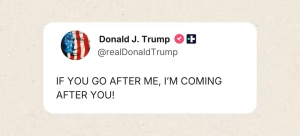
Thwarting Trump’s Persecution of Perceived Political Enemies
Many Americans spent the final weeks of 2025 worrying about spiking health insurance costs. President Donald Trump spent them enacting vengeance. The president aimed a blizzard of threats at over 22 public servants whom he perceives as his personal or political enemies. While previous presidents have been accused of weaponizing the government to hurt rivals—think President Nixon’s secret list of 500 political enemies—no modern president has used his powers to hurt enemies so overtly and comprehensively as Trump. This past year, Trump retaliated against over 269 federal officials.
-

Standing Up for America’s Civil Society and the Right to Peacefully Protest
Through a series of official executive memoranda, the Trump administration has turned the machinery of federal law enforcement into an organized effort to go after their political opponents and civil society organizations in the name of protecting against so-called “domestic terrorism.” This campaign has been outlined in a series of official government documents, including: National Security Presidential Memorandum (NSPM-7), a memo written by Attorney General Pam Bondi and two official designations of “Antifa” as a terrorist organization. The threat they pose to free speech is clear. However, there are strong legal protections against these threats.