
Autocracy vs. Democracy in America:A First Year Report
Editors: Tom Joscelyn, Susan Corke and Norm Eisen
This comprehensive report evaluates the first year of the Trump administration’s authoritarian surge, as well as the full range of pro-democracy pushback. We conclude that the administration has inflicted profound damage, but that our battered democratic guardrails have held. In year two, we must escalate peaceful, lawful, and vigorous strategies not just to protect guardrails but to achieve a democracy breakthrough, and the report discusses how to do that.
Below is our overview and a series of essays on the rule of law. Later essays in the series will examine other dimensions of the battle between democracy and autocracy, such as safeguarding elections and fighting corruption.
-

Autocracy vs. Democracy in America: Introduction
Polling shows that most Americans prefer to live in a democracy—not a dictatorship—despite what President Trump may claim. And two powerful forces within our democracy have proven to be firm impediments against the president’s autocratic designs: the court of public opinion and the court of law.
-

Defending Democracy Means Defending Fundamental Constitutional Rights
President Trump and his administration pose the most significant threat to America’s constitutional government and the rule of law in generations. Since day one of his second administration, Trump and his loyalists have sought to undermine the founders’ carefully constructed balance of power and the rights of citizens. We offer a brief sketch of the ways in which the second Trump administration has sought to undermine Americans’ constitutional rights and our democratic principles—and how the pro-democracy coalition, including our organization, has moved to block this unprecedented assault.
-
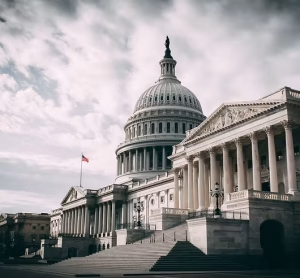
Preserving the Constitution’s Separation of Powers
The separation of powers is central to issues affecting millions of lives around the world, from how the U.S. government provides foreign humanitarian aid, to the imposition of international tariffs (which directly impact costs for everyday Americans), to the ability of the government to protect consumers from fraud, to the functioning of independent regulatory agencies that serve vital functions in the U.S. economy. We highlight some of the notable ways in which the administration’s violation of this core constitutional principle has been challenged in the courts.
-
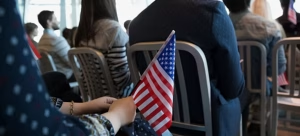
Protecting Immigrant Communities: The Role of the Courts and Civil Society
Through three presidential election cycles, President Donald Trump has repeatedly made his xenophobic and racist intentions clear. This essay highlights ways the pro-democracy coalition has successfully challenged Trump’s anti-immigrant policies in the courts—including helping force the administration to withdraw the National Guard from America’s cities—and the role that civil society has played in opposing the administration’s mass deportation operation.
-
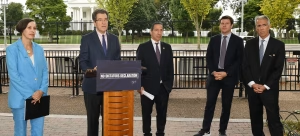
Executive Defiance of Judicial Orders and the Response of the Legal Community and Civil Society
Throughout our nation’s history, the courts have played a critical role as a check on executive power, especially in times of crisis. Over the last year, the courts have been essential to slowing the Trump administration’s autocratic onslaught. With each new executive decree, the legal community has responded by securing court orders at rapid speed in a valiant effort to contain the damage. In some cases this has led to clear wins, stopping unlawful deportations and returning unjustly fired officials to their posts (at least for the time being), among other things. In others, courts have allowed Trump’s unconstitutional actions to go forward, often through rulings from the Supreme Court’s infamous “shadow docket.”
-

Standing Up for America’s Civil Society and the Right to Peacefully Protest
Through a series of official executive memoranda, the Trump administration has turned the machinery of federal law enforcement into an organized effort to go after their political opponents and civil society organizations in the name of protecting against so-called “domestic terrorism.” This campaign has been outlined in a series of official government documents, including: National Security Presidential Memorandum (NSPM-7), a memo written by Attorney General Pam Bondi and two official designations of “Antifa” as a terrorist organization. The threat they pose to free speech is clear. However, there are strong legal protections against these threats.
-

Exposing Corruption
Trump's promotion of high-profile vanity projects—such as his White House ballroom—and acceptance of extraordinarily expensive gifts—including a Qatari jumbo jet, a customized engraved disc and 24k gold bar from Apple CEO Tim Cook, and a Nobel Peace Prize from Venezuelan opposition leader Maria Corina Machado—not only normalize corruption, but also advance the autocratic playbook by demonstrating how self-aggrandizing displays of loyalty and fidelity can win his favor.
-
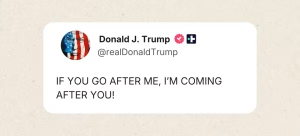
Thwarting Trump’s Persecution of Perceived Political Enemies
Many Americans spent the final weeks of 2025 worrying about spiking health insurance costs. President Donald Trump spent them enacting vengeance. The president aimed a blizzard of threats at over 22 public servants whom he perceives as his personal or political enemies. While previous presidents have been accused of weaponizing the government to hurt rivals—think President Nixon’s secret list of 500 political enemies—no modern president has used his powers to hurt enemies so overtly and comprehensively as Trump. This past year, Trump retaliated against over 269 federal officials.
-
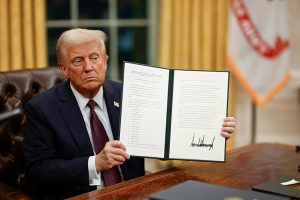
Reforming the President’s Pardon Power: How Using Clemency to Compensate and Coerce Loyalty Undermines Democracy
The power to pardon has become a key piece in Trump’s system of patronage, used to both reward those who show loyalty to the president and signal that those who break the law in his favor will avoid repercussions. This system of patronage is deeply undemocratic and poses serious risks to our national security. As a result, Congress must take steps to reign in the abuse of the pardon power.