
Please be advised that some documents linked to the DOJ Epstein Library include sexually explicit material, including descriptions of abuse and misconduct. Viewer discretion is advised.
References to document numbers are provided where applicable. These numbers are shortened versions of the document identifier used by the Department of Justice. For example, document (XXXXX) would correspond to file EFTA000XXXXX in the DOJ Epstein Library.
A COver-Up in Plain Sight (Part 2)
February 20, 2026
1. The FBI Continued to Discuss Derogatory Information on Prominent Individuals—Including President Trump—Weeks After Claiming No Basis for Further Investigations
On July 24, 2025, the same day that Deputy Attorney General Todd Blanche was interviewing Ghislaine Maxwell in prison, several members of the FBI sent emails concerning “derog” (or derogatory information) concerning several high-profile individuals including President Trump, Commerce Secretary Howard Lutnick, and former Attorney General William Barr (EFTA01648950, EFTA01648951 [note: explicit descriptions], EFTA01648955).
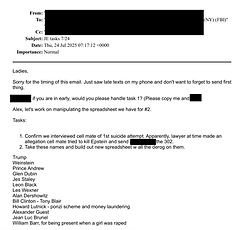

Content warning: includes references to sexual abuse
These communications occurred weeks after DOJ and the FBI sent an unsigned letter explaining that they had done “an exhaustive review of investigative holdings related to Jeffrey Epstein” and that they had determined that they “did not uncover evidence that could predicate an investigation against uncharged third parties.” The derogatory information set forth in these documents, which are described as “summaries,” allege serious violations of law. This information is also contained in a slideshow that was produced no earlier than July 2025.
In August 2025, DOJ compiled a list of salacious tips received from the public, including the above referenced allegation against President Trump.

Content warning: includes references to sexual abuse
Note: the name of one individual has been blurred out of abundance of caution.
Notwithstanding, Attorney General Bondi testified on February 11, 2026, that “There is no evidence that Donald Trump has committed a crime, everyone knows that.”
2. The Department of Justice Failed to Inform Congress of the Redactions it Made to the Epstein Files in the Final Report
Congress directed DOJ to file a report with the Senate and House Judiciary Committees listing all (1) categories of records released and withheld and (2) a summary of redactions made, including legal basis for those redactions within fifteen days of completing its production under the EFTA.
On February 14, 2026, DOJ sent a letter in an apparent attempt to meet its reporting requirement that essentially parrots the statutory text of the EFTA while doubling down on DOJ’s assertion that it has withheld information based on “various privileges.”

First, DDF has robustly countered DOJ’s assertion of privilege in our prior letters to the DOJ Office of Inspector General. Their continued reliance on that theory is unsound and improper. Second, DOJ’s letter does not provide a summary of the redactions that DOJ “made”. Rather, it simply describes the “legal basis” for those redactions. Congress clearly intended for DOJ to provide a summary of the redactions that DOJ made, which we would anticipate would include the number of redactions by total and category. Likewise, if DOJ believes that privilege applies, it should explain every single privilege it has relied on, the type of information that has been redacted and why it has been redacted, and when it has exercised or waived privilege.
The lack of summarization is important. DOJ has continued to over-redact the files. Pages of the files have been redacted with no explanation. And DOJ’s offer to allow only members of Congress access to the unredacted files does not comport with the EFTA. Moreover, after several members of Congress went to the Department of Justice to review unredacted versions of the Epstein files, they identified that many files had pre-existing redactions that were never appropriately un-redacted as required by the law.
3. The Department of Justice’s List of Government Officials and Politically Exposed Persons is a Classic Case of Obfuscation by Overproduction
Section 3 of the EFTA requires that DOJ provide the Senate and House Judiciary Committees with a list of all government officials and politically exposed persons (PEP) named or referenced in the released materials. In response to the Congressional requirement, DOJ published a list of 305 people. That list contains notable government officials and politicians, as well as dozens of celebrities, actors, comedians, and musicians. Strangely enough, the list includes the names of many people who have been dead for decades, including Elvis Pressley and Kurt Cobain.


DOJ explained in its February 14, 2026, letter that Congress did not define “political exposed persons” and thus DOJ leadership simply advised reviewers to notate any person who they thought was a PEP without any further guidance on what that term means. DOJ’s January 4, 2026, instructions to first round reviewers likewise does not provide any further information or definition of what constitutes a PEP.
Congress was not drafting the EFTA on a blank slate. The term PEP is used extensively in both the international and domestic contexts. The term is used frequently in the banking and financial industries to refer to individuals who have been entrusted with prominent public functions, as well as their immediate family members. That is how the term is used by federal agencies for purposes of applying the due diligence provisions of the Bank Secrecy Act. It is also how the Financial Action Task Force (FATF), the premier inter-governmental body that develops policies against money laundering, defines the term.
The inclusion of celebrities, actors, comedians, and musicians is not just incompetent: it looks very much like an attempt to obfuscate who the government officials and other prominent politicians are that were associated with Epstein.
RELATED NEWS
Press Release | April 24, 2026
DEMOCRACY DEFENDERS FUND’S PUSH LEADS DOJ INSPECTOR GENERAL TO LAUNCH EPSTEIN FILES TRANSPARENCY AUDIT
In three separate filings to the Department of Justice’s Office of Inspector General (OIG) this year, Democracy Defenders Fund (DDF) called for an audit of the Department of Justice’s (DOJ) handling of the Epstein files release for over-redacting and withholding responsive documents, limiting the scope of its review, modifying documents after release without notice or accountability, and failing to adhere to its legal obligations for transparency around the release. The following is a statement by Chris Swartz, senior ethics counsel for DDF, regarding the Office of Inspector General's decision to conduct an audit regarding the DOJ's release of the Epstein files:
Statement | April 21, 2026
ACTING AG BLANCHE MUST RECUSE HIMSELF FROM EPSTEIN INVESTIGATION DUE TO CONFLICT OF INTEREST
Following is a statement by Amb. Norman Eisen (ret.), executive chair of Democracy Defenders Fund, on the continued failure of the Trump administration’s Department of Justice to comply with the Epstein Files Transparency Act. In recent weeks, Acting Attorney General Todd Blanche has made clear he does not intend to comply with the legislation signed into law five months ago.
Statement | March 18, 2026
HOUSE OVERSIGHT COMMITTEE MUST DEMAND BONDI AND BLANCHE EXPLAIN DOJ’S CONTINUED FAILURE TO RELEASE ALL EPSTEIN FILES
Ahead of Attorney General Pamela Bondi and Deputy Attorney General Todd Blanche’s appearance at today’s closed-door hearing with the House Committee on Oversight, Amb. Norm Eisen (ret.), executive chair of Democracy Defenders Fund, made the following statement.
Press Release | February 6, 2026
DOJ CLAIMS FULL COMPLIANCE WITH EPSTEIN TRANSPARENCY ACT WHILE LIMITING ITS REVIEW OF RECORD
The Department of Justice continues to violate the Epstein Files Transparency Act (EFTA) by overredacting information, withholding documents, and apparently now narrowing its document search while publicly claiming full compliance, Democracy Defenders Fund (DDF) said today.
Press Release | January 30, 2026
DEMOCRACY DEFENDERS FUND STATEMENT ON DOJ’S CONTINUED FAILURE TO COMPLY WITH THE EPSTEIN FILES TRANSPARENCY ACT
Following is a statement by Amb. Norm Eisen (ret) , executive chair of Democracy Defenders Fund, on the Department of Justice’s (DOJ) continued failure to fully release all eligible files relating to the Epstein investigation, as required by the Epstein Files Transparency Act.